Advertisements
Advertisements
प्रश्न
The string the spring and the pulley shown in figure are light. Find the time period of the mass m.
Advertisements
उत्तर
Let l be the extension in the spring when mass m is hung.

Let T1 be the tension in the string; its value is given by,
T1 = kl = mg
Let x be the extension in the string on applying a force F.
Then, the new value of tension T2 is given by,
T2 = k(x + l)
Driving force is the difference between tensions T1 and T2.
∴ Driving force = T2 − T1 = k(x + l) − kl
= kx
\[\text{Acceleration}, a = \frac{kx}{m}\]
\[\text { Time period } \left( T \right)\] is given by,
\[T = 2\pi\sqrt{\frac{\text { displacement }}{\text { Acceleration }}}\]
\[ = 2\pi\sqrt{\frac{x}{kx/m}} = 2\pi\sqrt{\frac{m}{k}}\]
APPEARS IN
संबंधित प्रश्न
The periodic time of a linear harmonic oscillator is 2π second, with maximum displacement of 1 cm. If the particle starts from extreme position, find the displacement of the particle after π/3 seconds.
A copper metal cube has each side of length 1 m. The bottom edge of the cube is fixed and tangential force 4.2x10⁸ N is applied to a top surface. Calculate the lateral displacement of the top surface if modulus of rigidity of copper is 14x1010 N/m2.
Answer in brief:
Derive an expression for the period of motion of a simple pendulum. On which factors does it depend?
A person goes to bed at sharp 10.00 pm every day. Is it an example of periodic motion? If yes, what is the time period? If no, why?
The total mechanical energy of a spring-mass system in simple harmonic motion is \[E = \frac{1}{2}m \omega^2 A^2 .\] Suppose the oscillating particle is replaced by another particle of double the mass while the amplitude A remains the same. The new mechanical energy will
A particle executes simple harmonic motion with a frequency v. The frequency with which the kinetic energy oscillates is
A particle executes simple harmonic motion under the restoring force provided by a spring. The time period is T. If the spring is divided in two equal parts and one part is used to continue the simple harmonic motion, the time period will
A particle moves in a circular path with a uniform speed. Its motion is
Consider a simple harmonic motion of time period T. Calculate the time taken for the displacement to change value from half the amplitude to the amplitude.
A small block of mass m is kept on a bigger block of mass M which is attached to a vertical spring of spring constant k as shown in the figure. The system oscillates vertically. (a) Find the resultant force on the smaller block when it is displaced through a distance x above its equilibrium position. (b) Find the normal force on the smaller block at this position. When is this force smallest in magnitude? (c) What can be the maximum amplitude with which the two blocks may oscillate together?

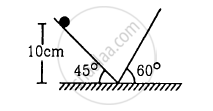
Find the time period of the motion of the particle shown in figure . Neglect the small effect of the bend near the bottom.
Find the number of oscillations performed per minute by a magnet is vibrating in the plane of a uniform field of 1.6 × 10⁻⁵ Wb/m2. The magnet has a moment of inertia 3 × 10⁻⁶ kg/m2 and magnetic moment 3 A m2.
Which of the following example represent periodic motion?
A swimmer completing one (return) trip from one bank of a river to the other and back.
Which of the following example represent (nearly) simple harmonic motion and which represent periodic but not simple harmonic motion?
The rotation of the earth about its axis.
Which of the following example represent (nearly) simple harmonic motion and which represent periodic but not simple harmonic motion?
A motion of an oscillating mercury column in a U-tube.
Which of the following example represent (nearly) simple harmonic motion and which represent periodic but not simple harmonic motion?
The motion of a ball bearing inside a smooth curved bowl, when released from a point slightly above the lowermost point.
A simple pendulum of frequency n falls freely under gravity from a certain height from the ground level. Its frequency of oscillation.
Show that the motion of a particle represented by y = sin ωt – cos ωt is simple harmonic with a period of 2π/ω.
A person normally weighing 50 kg stands on a massless platform which oscillates up and down harmonically at a frequency of 2.0 s–1 and an amplitude 5.0 cm. A weighing machine on the platform gives the persons weight against time.
- Will there be any change in weight of the body, during the oscillation?
- If answer to part (a) is yes, what will be the maximum and minimum reading in the machine and at which position?
