Advertisements
Advertisements
प्रश्न
Assuming the expression for displacement of a particle starting from extreme position, explain graphically the variation of velocity and acceleration w.r.t. time.
Advertisements
उत्तर
Displacement-time graph:
i.
At extreme position, α = π/2
Displacement, x = A cos ωt
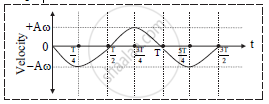
Velocity time graph:
i.
At extreme position, α = π/2
Velocity of a particle is v = - Aω sin ωt
ii. Table:
Substituting ω = 2π/T in above equation,
| Time (t) | Phase (ωt) | Velocity (v) |
| 0 | 0 | 0 |
| T/4 | π/2 | -Aω |
| T/2 | π | 0 |
| 3T/4 | 3π/2 | Aω |
| T | 2π | 0 |
Graph:
Acceleration-time graph:
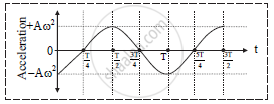
i. At extreme position,α = π/2
Acceleration of a particle is,
a =-Aω2 cos ωt
ii. Table:
Substituting ω = 2π/T in above equation
| Time (t) | Phase (ωt) | Velocity (v) |
| 0 | 0 | -Aω2 |
| T/4 | π/2 | 0 |
| T/2 | π | Aω2 |
| 3T/4 | 3π/2 | 0 |
| T | 2π | -Aω2 |
iii. Graph:
Conclusions:
i. Displacement, velocity and acceleration of S.H.M. are periodic functions of time.
ii. The displacement and acceleration curves are sine curves whereas velocity curve is
cosine curve (α = 0).
iii. The phase difference between displacement and acceleration is of π radian.
iv. The phase difference between displacement and velocity and velocity and acceleration
is of π/2 radian.
v. The displacement and acceleration is maximum at extreme position whereas velocity is
minimum at the same position.
vi. All curves repeat same path after phase of 2π radian.
APPEARS IN
संबंधित प्रश्न
The average displacement over a period of S.H.M. is ______.
(A = amplitude of S.H.M.)
State the differential equation of linear simple harmonic motion.
A small creature moves with constant speed in a vertical circle on a bright day. Does its shadow formed by the sun on a horizontal plane move in a sample harmonic motion?
Can the potential energy in a simple harmonic motion be negative? Will it be so if we choose zero potential energy at some point other than the mean position?
Can a pendulum clock be used in an earth-satellite?
A block of known mass is suspended from a fixed support through a light spring. Can you find the time period of vertical oscillation only by measuring the extension of the spring when the block is in equilibrium?
The time period of a particle in simple harmonic motion is equal to the time between consecutive appearances of the particle at a particular point in its motion. This point is
The motion of a particle is given by x = A sin ωt + B cos ωt. The motion of the particle is
The displacement of a particle is given by \[\overrightarrow{r} = A\left( \overrightarrow{i} \cos\omega t + \overrightarrow{j} \sin\omega t \right) .\] The motion of the particle is
A particle moves on the X-axis according to the equation x = A + B sin ωt. The motion is simple harmonic with amplitude
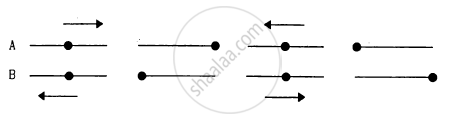
Figure represents two simple harmonic motions.
The parameter which has different values in the two motions is
The average energy in one time period in simple harmonic motion is
A pendulum clock keeping correct time is taken to high altitudes,
Select the correct statements.
(a) A simple harmonic motion is necessarily periodic.
(b) A simple harmonic motion is necessarily oscillatory.
(c) An oscillatory motion is necessarily periodic.
(d) A periodic motion is necessarily oscillatory.
A particle moves in a circular path with a continuously increasing speed. Its motion is
Suppose a tunnel is dug along a diameter of the earth. A particle is dropped from a point, a distance h directly above the tunnel. The motion of the particle as seen from the earth is
(a) simple harmonic
(b) parabolic
(c) on a straight line
(d) periodic
A particle moves on the X-axis according to the equation x = x0 sin2 ωt. The motion is simple harmonic
In a simple harmonic motion
Which of the following will change the time period as they are taken to moon?
(a) A simple pendulum
(b) A physical pendulum
(c) A torsional pendulum
(d) A spring-mass system
A pendulum clock giving correct time at a place where g = 9.800 m/s2 is taken to another place where it loses 24 seconds during 24 hours. Find the value of g at this new place.
A simple pendulum of length 40 cm is taken inside a deep mine. Assume for the time being that the mine is 1600 km deep. Calculate the time period of the pendulum there. Radius of the earth = 6400 km.
A hollow sphere of radius 2 cm is attached to an 18 cm long thread to make a pendulum. Find the time period of oscillation of this pendulum. How does it differ from the time period calculated using the formula for a simple pendulum?
In a simple harmonic oscillation, the acceleration against displacement for one complete oscillation will be __________.
A simple pendulum is suspended from the roof of a school bus which moves in a horizontal direction with an acceleration a, then the time period is
Write short notes on two springs connected in parallel.
Assume there are two identical simple pendulum clocks. Clock - 1 is placed on the earth and Clock - 2 is placed on a space station located at a height h above the earth's surface. Clock - 1 and Clock - 2 operate at time periods 4 s and 6 s respectively. Then the value of h is ______.
(consider the radius of earth RE = 6400 km and g on earth 10 m/s2)
