Advertisements
Advertisements
प्रश्न
Consider two simple harmonic motion along the x and y-axis having the same frequencies but different amplitudes as x = A sin (ωt + φ) (along x-axis) and y = B sin ωt (along y-axis). Then show that
`"x"^2/"A"^2 + "y"^2/"B"^2 - (2"xy")/"AB" cos φ = sin^2 φ`
and also discuss the special cases when
- φ = 0
- φ = π
- φ = `π/2`
- φ = `π/2` and A = B
- φ = `π/4`
Note: when a particle is subjected to two simple harmonic motions at right angle to each other the particle may move along different paths. Such paths are called Lissajous figures.
Advertisements
उत्तर
Given: x = A sin (ωt + φ) ..................(1)
y = B sin ωt .............(2)
In equation (1) use,
sin (A – B) – sin A cos B + cos A sin B
x – A sin ωt. cos (φ) + A cos ωt. sin φ
x – A sin cot. cos φ = A cos cot sin φ
squaring on both sides we get,
(x – A sin cot. cos φ)2 = A2 cos2 cot sin2 φ ........(3)
In equation (3) sin at can be re-written as, `"y"/"B"` .............[from equation (2)]
Also, use
cos2 cot = 1 – sin2 ωt in equation (3)
∴ Equation (3) becomes on expansion
`("x" - "A""y"/"B". cos Φ)^2 = "A"^2 (1 - "y"^2/"B"^2) sin^2 Φ`
`"x"^2 + ("A"^2"y"^2)/"B"^2 cos^2 Φ - (2"xAy")/"B" cos Φ`
= `"A"^2 sin^2 Φ - ("A"^2"y"^2)/"B"^2 sin^2 Φ` ......(4)
`"x"^2 + ("A"^2"y"^2)/"B"^2 (sin^2 Φ + cos^2 Φ) - (2"xyA")/"B" cos Φ`
= A2 sin2 Φ ......(÷ by A2)
We get,
`"x"^2/"A"^2 + "y"^2/"B"^2. 1 - (2"xy")/"AB" cos Φ = sin^2 Φ` ......(5)
Hence proved.
Special cases:
a. φ = 0 in equation (5) we get,
`"x"^2/"A"^2 + "y"^2/"B"^2 - (2"xy")/"AB".1 = 0`
or `("x"/"A" - "y"/"B")^2` = 0
or `"x"/"A" = "y"/"B"`
y = `"B"/"A"."x"`
The above equation resembles the equation of a straight line passing through origin with a positive slope.
b. φ = π in equation (5)
`"x"^2/"A"^2 + "y"^2/"B"^2 + (2"xy")/"AB" = 0`
or `("x"/"A" + "y"/"B")^2` = 0
or `"x"/"A" = -"y"/"B"`
y = `-"B"/"A"."x"`
The above equation is an equation of a straight line passing through origin with a negative slope.
c. φ = `π/2` in equation (5)
The above equation of an ellipse whose centre is origin.
d. φ = `π/2` and A = B n equation (5)
`"x"^2/"A"^2 + "y"^2/"A"^2` = 1
x2 + y2 = A2
The above equation of a circle whose centre is origin.
e. φ = `π/4, cos π/4 = 1/sqrt2 = 1/sqrt2` equation (5) we get,
`"x"^2/"A"^2 + "y"^2/"A"^2 - (sqrt(2)"xy")/"AB" = 1/2`
The above equation is an equation of tilted ellipse.
APPEARS IN
संबंधित प्रश्न
The force acting on a particle moving along X-axis is F = −k(x − vo t) where k is a positive constant. An observer moving at a constant velocity v0 along the X-axis looks at the particle. What kind of motion does he find for the particle?
A particle moves on the X-axis according to the equation x = A + B sin ωt. The motion is simple harmonic with amplitude
A simple pendulum is constructed by hanging a heavy ball by a 5.0 m long string. It undergoes small oscillations. (a) How many oscillations does it make per second? (b) What will be the frequency if the system is taken on the moon where acceleration due to gravitation of the moon is 1.67 m/s2?
A simple pendulum of length l is suspended through the ceiling of an elevator. Find the time period of small oscillations if the elevator (a) is going up with and acceleration a0(b) is going down with an acceleration a0 and (c) is moving with a uniform velocity.
A closed circular wire hung on a nail in a wall undergoes small oscillations of amplitude 20 and time period 2 s. Find (a) the radius of the circular wire, (b) the speed of the particle farthest away from the point of suspension as it goes through its mean position, (c) the acceleration of this particle as it goes through its mean position and (d) the acceleration of this particle when it is at an extreme position. Take g = π2 m/s2.
A uniform disc of mass m and radius r is suspended through a wire attached to its centre. If the time period of the torsional oscillations be T, what is the torsional constant of the wire?
Write short notes on two springs connected in parallel.
Consider the Earth as a homogeneous sphere of radius R and a straight hole is bored in it through its centre. Show that a particle dropped into the hole will execute a simple harmonic motion such that its time period is
T = `2π sqrt("R"/"g")`
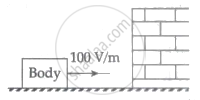
A body having specific charge 8 µC/g is resting on a frictionless plane at a distance 10 cm from the wall (as shown in the figure). It starts moving towards the wall when a uniform electric field of 100 V/m is applied horizontally toward the wall. If the collision of the body with the wall is perfectly elastic, then the time period of the motion will be ______ s.
A weightless rigid rod with a small iron bob at the end is hinged at point A to the wall so that it can rotate in all directions. The rod is kept in the horizontal position by a vertical inextensible string of length 20 cm, fixed at its midpoint. The bob is displaced slightly, perpendicular to the plane of the rod and string. The period of small oscillations of the system in the form `(pix)/10` is ______ sec. and the value of x is ______.
(g = 10 m/s2)

