Advertisements
Advertisements
प्रश्न
Show that for a particle executing simple harmonic motion.
- the average value of kinetic energy is equal to the average value of potential energy.
- average potential energy = average kinetic energy = `1/2` (total energy)
Hint: average kinetic energy = <kinetic energy> = `1/"T" int_0^"T" ("Kinetic energy") "dt"` and
average potential energy = <potential energy> = `1/"T" int_0^"T" ("Potential energy") "dt"`
Advertisements
उत्तर
Suppose a particle of mass m executes SHM of period T.
The displacement of the particles at any instant t is given by y = A sin ωt
Velocity v = `"dy"/"dt" = ω"A" cos ω"t"`
Kinetic energy, EK = `1/2 "mv"^2 = 1/2"m"ω^2 "A"^2 cos^2 ω"t"`
Potential energy, EP = `1/2"m"ω^2"y"^2 = 1/2"m"ω^2 "A"^2 sin^2 ω"t"`
a. Average K.E. over a period of oscillation,
`"E"_("K"_"av") = 1/"T" int_0^"T" "E"_"K" "dt"`
= `1/"T" int_0^"T" 1/2 "m"ω^2 "A"^2 cos^2 ω"t" "dt"`
= `1/(2"T")"m"ω^2 "A"^2 int_0^"T" [(1 + cos 2 ω"t")/2] "dt"`
= `1/(4"T")"m"ω^2 "A"^2 ["t" + (sin 2 ω"t")/(2ω)]_0^"T"`
= `1/(4"T")"m"ω^2 "A"^2 "T"`
`"E"_("K"_"av") = 1 /4"m"ω^2 "A"^2`
b. Average P.E. over a period of oscillation
`"E"_("P"_"av") = 1/"T" int_0^"T" "E"_"P" "dt"`
= `1/"T" int_0^"T" 1/2 "m"ω^2 "A"^2 sin^2 ω"t" "dt"`
= `1/(2"T")"m"ω^2 "A"^2 int_0^"T" [(1 - cos 2 ω"t")/2] "dt"`
= `1/(4"T")"m"ω^2 "A"^2 ["t" - (sin 2 ω"t")/(2ω)]_0^"T"`
= `1/(4"T")"m"ω^2 "A"^2 "T"`
`"E"_("P"_"av") = 1 /4"m"ω^2 "A"^2`
APPEARS IN
संबंधित प्रश्न
The maximum speed and acceleration of a particle executing simple harmonic motion are 10 cm/s and 50 cm/s2. Find the position(s) of the particle when the speed is 8 cm/s.
The equation of motion of a particle started at t = 0 is given by x = 5 sin (20t + π/3), where x is in centimetre and t in second. When does the particle
(a) first come to rest
(b) first have zero acceleration
(c) first have maximum speed?
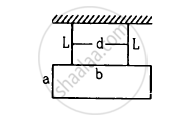
A rectangle plate of sides a and b is suspended from a ceiling by two parallel string of length L each in Figure . The separation between the string is d. The plate is displaced slightly in its plane keeping the strings tight. Show that it will execute simple harmonic motion. Find the time period.
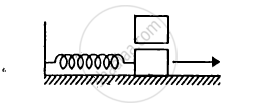
A 1 kg block is executing simple harmonic motion of amplitude 0.1 m on a smooth horizontal surface under the restoring force of a spring of spring constant 100 N/m. A block of mass 3 kg is gently placed on it at the instant it passes through the mean position. Assuming that the two blocks move together, find the frequency and the amplitude of the motion.
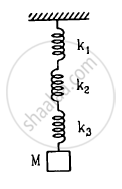
Find the elastic potential energy stored in each spring shown in figure when the block is in equilibrium. Also find the time period of vertical oscillation of the block.
When the displacement of a particle executing simple harmonic motion is half its amplitude, the ratio of its kinetic energy to potential energy is ______.
A body is executing simple harmonic motion with frequency ‘n’, the frequency of its potential energy is ______.
A body is executing simple harmonic motion with frequency ‘n’, the frequency of its potential energy is ______.
Find the displacement of a simple harmonic oscillator at which its P.E. is half of the maximum energy of the oscillator.
A body of mass m is attached to one end of a massless spring which is suspended vertically from a fixed point. The mass is held in hand so that the spring is neither stretched nor compressed. Suddenly the support of the hand is removed. The lowest position attained by the mass during oscillation is 4 cm below the point, where it was held in hand.
What is the amplitude of oscillation?
