Advertisements
Advertisements
प्रश्न
Discuss in detail the energy in simple harmonic motion.
Advertisements
उत्तर
Energy in simple harmonic motion:
(a) Expression for Potential Energy: For the simple harmonic motion, the force and the displacement are related by Hooke’s law
`vec"F" = -"k"vec("r")`
Since force is a vector quantity, in three dimensions it has three components.
Further, the force in the above equation is a conservative force field; such a force can be derived from a scalar function which has only one component. In one dimensional case
F = − kx .....................(1)
The work done by the conservative force field is independent of the path. The potential energy U can be calculated from the following expression.
F = `-"dU"/"dx"` ..........(2)
Comparing (1) and (2), we get
`-"dU"/"dx" = -"kx"`
dU = kx dx
This work done by the force F during a small displacement dx stores as potential energy
U(x) = `int_0^"x" "kx′" "dx′" = 1/2["k"("x′")^2]_0^"x" = 1/2"kx"^2` ..........(3)
From equation `ω = sqrt("k"/"m")`, we can substitute the value of force constant k = mω2 in equation (3),
U(x) = `1/2"m"ω^2"x"^2` ...................(4)
where ω is the natural frequency of the oscillating system. For the particle executing simple harmonic motion from equation y = A sin ωt, we get
x = A sin ωt
U(t) = `1/2"m"ω^2"A"^2 sin^2ω"t"` ............(5)
This variation of U is shown in figure.
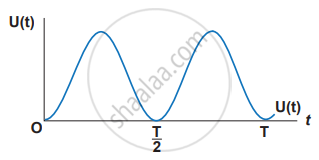
Variation of potential energy with time t
(b) Expression for Kinetic Energy:
Kinetic energy KE = `1/2"mv"_"x"^2 = 1/2"m" ("dx"/"dt")^2` ............(6)
Since the particle is executing simple harmonic motion, from equation y = A sin ωt
x = A sin ωt
Therefore, velocity is
vx = `"dx"/"dt"` = Aω cos ωt ...................(7)
= `"A"ω sqrt(1 - ("x"/"A")^2)`
vx = `ω sqrt("A"^2 - "x"^2)`
Hence, KE = `1/2"mv"_"x"^2 = 1/2"m"ω^2 ("A"^2 - "x"^2)` ........(9)
KE = `1/2"m"ω^2 "A"^2 cos^2 ω"t"` ..............(10)
This variation with time is shown in figure.
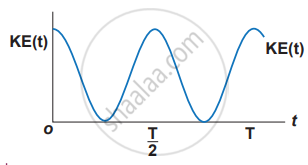
Variation of kinetic energy with time t
(c) Expression for Total Energy: Total energy is the sum of kinetic energy and potential energy
E = KE + U ..........…(11)
E = `1/2"m"ω^2 ("A"^2 - "x"^2) + 1/2 "m"ω^2 "x"^2`
Hence, cancelling x2 term,
E = `1/2"m"ω^2"A"^2` = constant ...............(12)
Alternatively, from equation (5) and equation (10), we get the total energy as
E = `1/2"m"ω^2"A"^2 sin^2 ω"t" + 1/2"m"ω^2"A"^2 cos^2 ω"t"`
= `1/2"m"ω^2"A"^2 (sin^2 ω"t" + cos^2 ω"t")`
From trigonometry identity, (sin2 ωt + cos2 ωt) = 1
E = `1/2"m"ω^2"A"^2` = constant
which gives the law of conservation of total energy. This is depicted in Figure
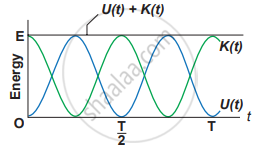
Both kinetic energy and potential energy vary but total energy is constant
Thus the amplitude of a simple harmonic oscillator can be expressed in terms of total energy.
A = `sqrt((2"E")/("m"ω^2)) = sqrt((2"E")/"k")` ..........(13)
APPEARS IN
संबंधित प्रश्न
A particle is in linear simple harmonic motion between two points, A and B, 10 cm apart. Take the direction from A to B as the positive direction and give the signs of velocity, acceleration and force on the particle when it is
(a) at the end A,
(b) at the end B,
(c) at the mid-point of AB going towards A,
(d) at 2 cm away from B going towards A,
(e) at 3 cm away from A going towards B, and
(f) at 4 cm away from B going towards A.
The maximum speed and acceleration of a particle executing simple harmonic motion are 10 cm/s and 50 cm/s2. Find the position(s) of the particle when the speed is 8 cm/s.
The pendulum of a clock is replaced by a spring-mass system with the spring having spring constant 0.1 N/m. What mass should be attached to the spring?
A block suspended from a vertical spring is in equilibrium. Show that the extension of the spring equals the length of an equivalent simple pendulum, i.e., a pendulum having frequency same as that of the block.
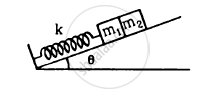
The block of mass m1 shown in figure is fastened to the spring and the block of mass m2 is placed against it. (a) Find the compression of the spring in the equilibrium position. (b) The blocks are pushed a further distance (2/k) (m1 + m2)g sin θ against the spring and released. Find the position where the two blocks separate. (c) What is the common speed of blocks at the time of separation?
The spring shown in figure is unstretched when a man starts pulling on the cord. The mass of the block is M. If the man exerts a constant force F, find (a) the amplitude and the time period of the motion of the block, (b) the energy stored in the spring when the block passes through the equilibrium position and (c) the kinetic energy of the block at this position.
When the displacement of a particle executing simple harmonic motion is half its amplitude, the ratio of its kinetic energy to potential energy is ______.
A body is executing simple harmonic motion with frequency ‘n’, the frequency of its potential energy is ______.
Motion of an oscillating liquid column in a U-tube is ______.
Find the displacement of a simple harmonic oscillator at which its P.E. is half of the maximum energy of the oscillator.
