Advertisements
Advertisements
प्रश्न
Discuss in detail the energy in simple harmonic motion.
Advertisements
उत्तर
Energy in simple harmonic motion:
(a) Expression for Potential Energy: For the simple harmonic motion, the force and the displacement are related by Hooke’s law
`vec"F" = -"k"vec("r")`
Since force is a vector quantity, in three dimensions it has three components.
Further, the force in the above equation is a conservative force field; such a force can be derived from a scalar function which has only one component. In one dimensional case
F = − kx .....................(1)
The work done by the conservative force field is independent of the path. The potential energy U can be calculated from the following expression.
F = `-"dU"/"dx"` ..........(2)
Comparing (1) and (2), we get
`-"dU"/"dx" = -"kx"`
dU = kx dx
This work done by the force F during a small displacement dx stores as potential energy
U(x) = `int_0^"x" "kx′" "dx′" = 1/2["k"("x′")^2]_0^"x" = 1/2"kx"^2` ..........(3)
From equation `ω = sqrt("k"/"m")`, we can substitute the value of force constant k = mω2 in equation (3),
U(x) = `1/2"m"ω^2"x"^2` ...................(4)
where ω is the natural frequency of the oscillating system. For the particle executing simple harmonic motion from equation y = A sin ωt, we get
x = A sin ωt
U(t) = `1/2"m"ω^2"A"^2 sin^2ω"t"` ............(5)
This variation of U is shown in figure.
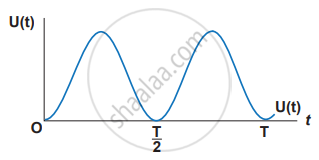
Variation of potential energy with time t
(b) Expression for Kinetic Energy:
Kinetic energy KE = `1/2"mv"_"x"^2 = 1/2"m" ("dx"/"dt")^2` ............(6)
Since the particle is executing simple harmonic motion, from equation y = A sin ωt
x = A sin ωt
Therefore, velocity is
vx = `"dx"/"dt"` = Aω cos ωt ...................(7)
= `"A"ω sqrt(1 - ("x"/"A")^2)`
vx = `ω sqrt("A"^2 - "x"^2)`
Hence, KE = `1/2"mv"_"x"^2 = 1/2"m"ω^2 ("A"^2 - "x"^2)` ........(9)
KE = `1/2"m"ω^2 "A"^2 cos^2 ω"t"` ..............(10)
This variation with time is shown in figure.
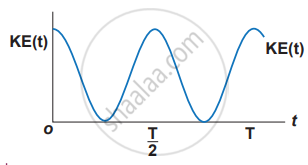
Variation of kinetic energy with time t
(c) Expression for Total Energy: Total energy is the sum of kinetic energy and potential energy
E = KE + U ..........…(11)
E = `1/2"m"ω^2 ("A"^2 - "x"^2) + 1/2 "m"ω^2 "x"^2`
Hence, cancelling x2 term,
E = `1/2"m"ω^2"A"^2` = constant ...............(12)
Alternatively, from equation (5) and equation (10), we get the total energy as
E = `1/2"m"ω^2"A"^2 sin^2 ω"t" + 1/2"m"ω^2"A"^2 cos^2 ω"t"`
= `1/2"m"ω^2"A"^2 (sin^2 ω"t" + cos^2 ω"t")`
From trigonometry identity, (sin2 ωt + cos2 ωt) = 1
E = `1/2"m"ω^2"A"^2` = constant
which gives the law of conservation of total energy. This is depicted in Figure
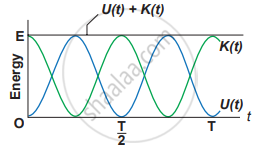
Both kinetic energy and potential energy vary but total energy is constant
Thus the amplitude of a simple harmonic oscillator can be expressed in terms of total energy.
A = `sqrt((2"E")/("m"ω^2)) = sqrt((2"E")/"k")` ..........(13)
APPEARS IN
संबंधित प्रश्न
The pendulum of a clock is replaced by a spring-mass system with the spring having spring constant 0.1 N/m. What mass should be attached to the spring?
A block of mass 0.5 kg hanging from a vertical spring executes simple harmonic motion of amplitude 0.1 m and time period 0.314 s. Find the maximum force exerted by the spring on the block.
A body of mass 2 kg suspended through a vertical spring executes simple harmonic motion of period 4 s. If the oscillations are stopped and the body hangs in equilibrium find the potential energy stored in the spring.
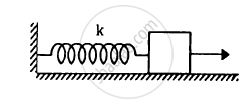
The spring shown in figure is unstretched when a man starts pulling on the cord. The mass of the block is M. If the man exerts a constant force F, find (a) the amplitude and the time period of the motion of the block, (b) the energy stored in the spring when the block passes through the equilibrium position and (c) the kinetic energy of the block at this position.
Find the elastic potential energy stored in each spring shown in figure, when the block is in equilibrium. Also find the time period of vertical oscillation of the block.
A body is executing simple harmonic motion with frequency ‘n’, the frequency of its potential energy is ______.
Motion of an oscillating liquid column in a U-tube is ______.
Draw a graph to show the variation of P.E., K.E. and total energy of a simple harmonic oscillator with displacement.
A mass of 2 kg is attached to the spring of spring constant 50 Nm–1. The block is pulled to a distance of 5 cm from its equilibrium position at x = 0 on a horizontal frictionless surface from rest at t = 0. Write the expression for its displacement at anytime t.
An object of mass 0.5 kg is executing a simple Harmonic motion. Its amplitude is 5 cm and the time period (T) is 0.2 s. What will be the potential energy of the object at an instant t = `T/4` s starting from the mean position? Assume that the initial phase of the oscillation is zero.
