Topics
Term - 1
Number System
- Integers
- Representation of Integers on the Number Line
- Ordering of Integers
- Addition of Integers
- Subtraction of Integers
- Properties of Addition and Subtraction of Integers
- Multiplication of a Positive and a Negative Integers
- Multiplication of Two Negative Integers
- Product of Three Or More Negative Integers
- Properties of Multiplication of Integers
- Closure Property of Multiplication of Integers
- Closure Property of Multiplication of Integers
- Associative Property of Multiplication of Integers
- Distributive Property of Multiplication of Integers
- Multiplicative Identity of Integers
- Division of Integers
- Properties of Division of Integers
- Statement Problems on Integers Using All Fundamental Operations.
Measurements
Algebra
Direct and Inverse Proportion
Geometry
- Concept of Lines
- Line Segments
- Rays
- Parallel Lines
- Intersecting Lines
- Concept of Points
- Types of Angles
- Trigonometrical Ratios of Complementary Angles
- Supplementary Angles
- Concept of Linear Pair
- Concept of Pairs of Angles
- Concept of Transversal Lines
- The Perpendicular Bisector
- Concept of Angle Bisector
- Angles of Special Measures - 30°, 45°, 60°, 90°, and 120°
- Concept of Angle
Information Processing
- Tetromino
- Route Map
Term - 2
Number System
Measurements
- Basic Concept of Circle
- Circumference of a Circle
- Area of Circle
- Area of Pathways
Algebra
- Concept of Exponents
- Laws of Exponents
- Multiplying Powers with the Same Base
- Dividing Powers with the Same Base
- Taking Power of a Power
- Multiplying Powers with Different Base and Same Exponents
- Dividing Powers with Different Base and Same Exponents
- Unit Digit of Numbers in Exponential Form
- Algebraic Expressions
- Terms, Factors and Coefficients of Expression
- Classification of Terms in Algebra
- Degree of Expressions
Geometry
- Basic Concepts of Triangles
- Classification of Triangles based on Sides
- Classification of Triangles based on Angles
- Basic Properties of a Triangle
- Exterior Angle of a Triangle and Its Property
- Congruence of Triangles
- Similarity and Congruency of Figures
- Congruence Among Line Segments
- Congruence of Angles
- Congruence of Triangles
- Criteria for Congruence of Triangles
- Criteria for Similarity of Triangles
- SAS Congruence Criterion
- ASA Congruence Criterion
- RHS Congruence Criterion
Information Processing
- Tables and Patterns Leading to Linear Functions
- Pascal’s Triangle
Term - 3
Number System
Percentage and Simple Interest
Algebra
Geometry
- Concept of Symmetry
- Reflection Symmetry (Mirror Symmetry)
- Translational Symmetry
- Symmetry Through Transformations
- Basic Concept of Circle
- Construction of a Circle When Its Radius is Known
- Construction of Concentric Circles
Statistics
Information Processing
- Scheduling
- Flowchart
Notes
Angles of Special Measures:
There are some elegant and accurate methods to construct some angles of special sizes which do not require the use of the protractor.
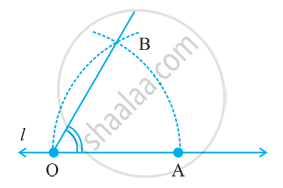
1. Constructing a 60° angle:
Step 1: Draw a line l and mark a point O on it.
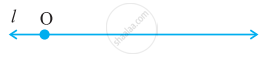
Step 2: Place the pointer of the compasses at O and draw an arc of convenient radius which cuts the line `bar"PQ"` at a point say, A.
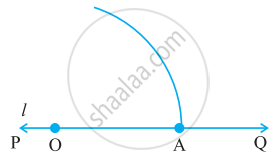
Step 3: With the pointer at A (as centre), now draw an arc that passes through O.
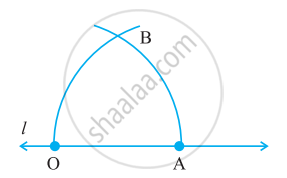
Step 4: Let the two arcs intersect at B. Join OB. We get ∠BOA whose measure is 60°.
2. Constructing a 30° angle:
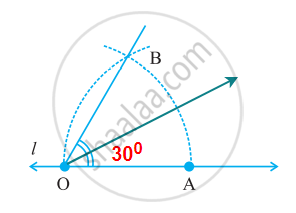
To construct an angle of 30°, we need to draw an angle of 60° as above then bisect it with the process of an angle bisector.
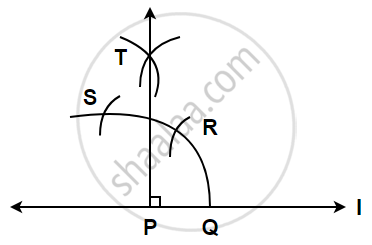
3. Constructing a 90° angle:
Step 1: Draw a line l and mark a point P on it. Now taking P as a centre and with a convenient radius, draw an arc of a circle which intersects line l at Q.
Step 2: Taking Q as a centre and with the same radius as before, draw an arc intersecting the previously drawn arc at R.
Step 3: Taking R as a centre and with the same radius as before, draw an arc intersecting the arc at S.
Step 4: Taking R and S as a centre, draw an arc of the same radius to intersect each other at T.
Step 5: Join PT, which is the required ray making 90° with line l.
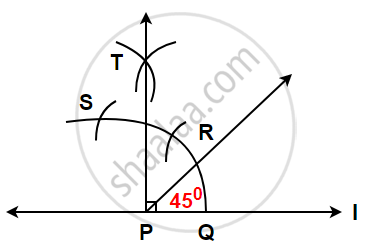
4. Constructing a 45° angle:
Draw an angle of 90° then bisect it to make an angle of 45°.
5. Constructing a 120° angle:
An angle of 120° is nothing but twice of an angle of 60°.
Therefore, it can be constructed as follows :
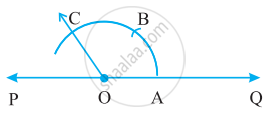
Step 1: Draw any line PQ and take a point O on it.

Step 2: Place the pointer of the compasses at O and draw an arc of convenient
radius which cuts the line at A.
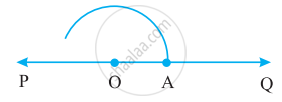
Step 3: Without disturbing the radius on the compasses, draw an arc with A as the centre which cuts the first arc at B.
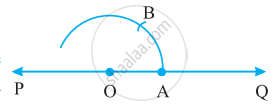
Step 4: Again without disturbing the radius on the compasses and with B as centre, draw an arc which cuts the first arc at C.
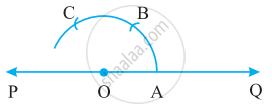
Step 5: Join OC, ∠COA is the required angle whose measure is 120°.