Advertisements
Chapters
1: Reproduction in Organisms
2: Sexual Reproduction in Flowering Plants
▶ 3: Human Reproduction
4: Reproductive Health-Problems and Strategies
Unit 2 – Genetics and Evolution
Chapter 5: Principles of Inheritance and Variation
Chapter 6: Chromosomes, Sex-Linked Inheritance and Human Genetic Disorders
Chapter 7: Molecular Basis of Inheritance
Chapter 8: Evolution-Origin of Life
Chapter 9: Theory of Evolution and Evolution of Man
Unit 3 – Biology and Human Welfare
Chapter 10: Human Health and Diseases
Chapter 11: Adolescent Issues: Alcoholism and Drugs
Chapter 12: Animal Breeding for Improvement in Food Production
Chapter 13: Plant Breeding to Enhance Food Production
Chapter 14: Microbes in Human Welfare
Unit 4 – Biotechnology
Chapter 15: Biotechnology: Principles and Processes
Chapter 16: Biotechnology and Its Applications
Unit 5 – Ecology and Environment
Chapter 17: Organisms and Populations
Chapter 18: Ecosystem
Chapter 19: Biodiversity and Conservation
Chapter 20: Environmental Issues
![Sarita Aggarwal solutions for बायोलॉजी [अंग्रेजी] कक्षा १२ आईएससी chapter 3 - Human Reproduction - Shaalaa.com](/images/biology-english-class-12-isc_6:65d11b7ee3eb4277bbdac77874c6c42a.jpg "Sarita Aggarwal solutions for बायोलॉजी [अंग्रेजी] कक्षा १२ आईएससी chapter 3 - Human Reproduction")
Advertisements
Solutions for Chapter 3: Human Reproduction
Below listed, you can find solutions for Chapter 3 of CISCE Sarita Aggarwal for बायोलॉजी [अंग्रेजी] कक्षा १२ आईएससी.
Sarita Aggarwal solutions for बायोलॉजी [अंग्रेजी] कक्षा १२ आईएससी 3 Human Reproduction EXERCISES [Pages 161 - 180]
A. OBJECTIVE QUESTIONS I. Multiple choice questions Choose the correct answer:
What is true of gametes?
They are diploid
They give rise to gonads
They produce hormones
They are formed from gonads
Which of the following is a primary sex organ?
testis
seminal vesicles
prostate
vas deferens
Sperms are produced in ______.
seminiferous tubules
vas deferens
prostate glands
interstitial cells
A single highly coiled tube where sperms are stored gets concentrated, and mature is known as ______
Epididymis
Vas efferentia
Vas deferens
Seminiferous tubule
Fertilisation of an ova takes place in the ______.
uterus
fallopian tube
vagina
ovary
The function of Sertoli cells is to ______.
secrete hormones
produce spermatogonia
nourish spermatids
produce spermatocytes
From one primary spermatocyte, number of spermatids produced are ______.
2
4
8
none of the above
From one primary oocyte, number of ova produced are ______.
1
2
3
4
The egg released from the Graafian follicle is in the following stage.
primary oocyte
secondary oocyte
mature ovum
polar body
Oestrogen is secreted by the ______.
anterior pituitary
primary follicle
Graafian follicle
corpus luteum
Meiosis II takes place in the ______.
oogonia
primary oocyte
secondary oocyte
ovum
Vas deferens is a part of a ______.
testis
epididymis
accessory glands
duct system
The secretions of seminal vesicles contain ______.
fructose
alkaline solution
clear mucous
testosterone
The large elongated cells that provide nutrition to developing sperms are ______
Primary germ cells
Sertoli cells
Leydig cells
Spermatogonia
Repeated mitotic divisions occur in ______.
primary oocyte
secondary oocyte
ovum
primary germ cell
Corpus luteum is formed by ______.
germinal epithelial cells
Graafian follicle
ruptured Graafian follicle
lutenising cells
Proliferative phase coincides with the ______.
follicular phase
luteal phase
secretory phase
ovulatory phase
The follicle cells surrounding the ova at the time of ovulation form the ______.
corona radiata
zona pellucida
vitelline membrane
fertilisation membrane
Which part of the sperm contains the respiratory enzymes?
head
neck
middle piece
acrosome
The fertilisation in human beings takes place in the ______.
ovary
oviduct
uterus
vagina
Capacitation refers to changes in the ______.
Ovum before fertilization
Ovum after fertilization
Sperm after fertilization
Sperm before fertilization
Sperm lysins are released from ______.
sperm nucleus
acrosome
egg membranes
corona radiata
A stage of development showing cells in three primary germ layers is ______.
morula
blastocyst
blastula
gastrula
The protective and nutritive layer of the blastocyst is ______.
trophoblast
embryonic disc
inner cell mass
mesoderm
Archenteron is found in the ______.
morula
blastula
gastrula
blastodermic vesicle
At which of the following stages the implantation in uterus takes place?
8-cell stage
morula
blastocyst
late gastrula
Segmentation cavity is another name for ______.
cleavage
blastocoel
archenteron
body cavity
Which of the following layers form a part of foetal placenta?
amnion
decidua basalis
chorion
yolk sac
A vital connection between mother and foetus is called ______.
uterus
placenta
embryo sac
amniotic fluid
Sequence of hormones during menstrual cycle is ______.
estrogen, progesterone and FSH
progesterone, estrogen and FSH
FSH, estrogen and progesterone
FSH, progesterone and estrogen
Proliferation of endometrium of uterus is controlled by hormone
relaxin
oxytocin
progesterone
luteinising
oestrogen
In a vertebrate which germ layer forms the skeleton muscles?
ectoderm
endoderm
mesoderm
mesoderm and ectoderm
If mammalian ovum fails to get fertilized, which one of the following is unlikely?
Corpus luteum will disintegrate
Estrogen secretion further decreases
Primary follicle starts developing
Progesterone secretion rapidly declines
Find out the incorrect statement from the following:- the process of gastrulation is characterised by
rapid division of cells by mitosis
movement and rearrangement of cells
formation of three germinal layers
formation of archenteron
Sertoli cells are regulated by the pituitary hormone known as ______.
FSH
GH
prolactin
LH
Withdrawal of which of the following hormones is the immediate cause of menstruation?
Estrogen
FSH
FSH-RH
Progesterone
Acrosome of sperms is/are modified
lysosome
ER
Golgi complex
mitochondria
Term used for the birth of the fully formed foetus is called ______.
Gestation
Oxytocin
Prolaction
Parturition
In gastrulation, which is/are formed?
Endoderm
Mesoderm
Ectoderm and endoderm
Ectoderm, mesoderm and endoderm
The embryo at 16-celled stage is known as ______.
morula
gastrula
blastula
blastomere
Capacitation of sperms occurs in ______.
female genital tract
vas deferens
vasa efferentia
vagina
Accessory sexual character in female is promoted by ______.
androgen
progesterone
estrogen
testosterone
Sertoli cells are found in testis. These cells are ______.
nurse cells
reproductive cells
receptor cells
none of these
In human adult females hormone oxytocin ______.
stimulates growth of mammary glands
stimulates pituitary to secrete vasopressin
causes strong uterine contractions during parturition
is secreted by anterior pituitary
In humans, at the end of the first meiotic division, the male germ cells differentiate into the ______.
secondary spermatocytes
spermatids
spermatogonia
primary spermatocytes
II. Fill in the blanks
Change in the female secondary sex organs are controlled by ______ of the ovary in the proliferative phase of the menstrual cycle whereas the changes in the secretory phase are controlled by the hormone ______.
Growth of the Graafian follicle is stimulated mainly by ______ of the pituitary while ovulation is stimulated mainly by ______ of the same gland.
A primary spermatocyte is produced by ______ division while a secondary oocyte results from ______ division.
Uterine glands grow and elongate in the ______ phase of the menstrual cycle while they are secreted in the ______ phase of the cycle.
Spermatozoa are produced in the ______ of testes while ova are formed in the ______ of ovaries.
Corpus luteum secretes ______ while Leydig cells secrete ______.
The secretory phase of the menstrual cycle is also called the ______ phase because it is controlled by the hormone ______.
Vasa efferentia conduct the sperms out from the ______ while vas deferens conducts the sperms from the ______.
A secondary oocyte has a ______ chromosome number while a fertilized ovum has a ______ chromosome number.
______ is a primary sex organ while ______ is a secondary sex organ in males.
The axial filament of the tail piece is attached to the ______ centriole.
______ is an active enzyme present in the sperm lysin.
The blastodermic vesicle has a fluid filled cavity called the ______.
The implantation of the embryo occurs at about ______ day.
The degenerated corpus luteum is called ______.
Hormone HCG stimulates ______ in ovary that produces progesterone.
______ and ______ foetal membranes take part in the formation of placenta.
Agents that cause malformation in the developing embryo are called ______.
______ is the first milk secreted by mother’s mammary glands.
Hormone prolactin is produced by ______.
State whether the following is true or false.
Corpus luteum secretes the female hormone oestrogen.
State whether the following is true or false.
Graafian follicle bursts to release an egg from ovary.
State whether the following is true or false.
Placenta produces hormone prolactin.
State whether the following is true or false.
Fusion of sperm and egg is called implantation.
State whether the following is true or false.
Gestation period in humans is of about 320 days.
State whether the following is true or false.
Amniotic fluid acts as a shock absorber.
Mention, if the following statement is True or False. If false rewrite the wrong statement in its correct form:
Sperm is a single cell.
State whether the following is true or false.
Sperms are produced by epididymis.
State whether the following is true or false.
Menarche is when menstruation stops.
State whether the following is true or false.
Sertoli cells produce hormone testosterone.
Match the following
| Column A | Column B |
| 1. Blastocyst | (i) Spermatid |
| 2. Acrosome | (ii) Estrogen |
| 3. Proliferative phase | (iii) Relaxin |
| 4. Leydig cells | (iv) Progesterone |
| 5. Spermiogenesis | (v) Spermatozoan |
| 6. Secretory phase | (vi) Testosterone |
| 7. Bisexual animal | (vii) Monocystis |
| 8. Endometrium | (viii) Uterus |
Mark the wrong item in the series. Give reasons for the same.
Spermatocyte; polar body; spermatid; spermatogonium.
Choose the odd item in the series.
Graafian follicle, endometrium, corpus luteum, acrosome
Mark the wrong item in the series. Give reasons for the same.
Vas deferens; fallopian tube; epididymis; Cowper’s gland.
Choose the odd item in the series.
Cowper’s glands, prostate, testes, seminal vesicles
Choose the odd item in the series.
Fallopian tubes, vagina, uterus, ovaries
Mark the wrong item in the series. Give reasons for the same.
Leydig cells; corpus luteum; Graafian follicle; sertoli cells.
Mark the wrong item in the series. Give reasons for the same.
Vasa efferentia; epididymis; vas deferens; seminal vesicle.
Mark the wrong item in the series. Give reasons for the same.
Secondary spermatocyte; polar body; spermatid; spermatogonia.
Mark the wrong item in the series. Give reasons for the same.
FSH; oestrogen; Graafian follicle; corpus luteum.
Mark the wrong item in the series. Give reasons for the same.
Acrosome; flagellum; spiral mitochondria; spermatid.
Answer the following in one or two words.
Fully developed structure in ovary containing an egg ready for ovulation.
Answer the following in one or two words.
An accessory gland in males whose secretion activates the sperms.
Answer the following in one or two words.
A highly coiled tube in which the sperms mature.
Answer the following in one or two words.
Period for which the foetus remains inside the uterus.
Name the Following
The site of production of sperms in man.
Answer the following in one or two words.
Term used for the stoppage of menstruation.
Answer the following in one or two words.
Innermost foetal membrane which secretes amniotic fluid.
Answer the following in one or two words.
Two substances that diffuse out of the foetus into the placenta.
Answer the following in one or two words.
A hollow pear-shaped muscular organ where embryo develops.
Answer the following in one or two words.
Male hormone produced by the interstitial cells or Leydig cells.
Name the Following
The hormone that stimulates the contraction of the uterus during childbirth.
Answer the following in one or two words.
Structure formed after the release of ovum from Graafian follicle.
Answer the following in one or two words.
Structure formed by the villi of the foetus and the uterus of the mother.
Answer the following in one or two words.
Part in female reproductive system where fertilisation takes place.
Answer the following in one or two words.
First fluid released from the mammary glands after birth.
In the questions given below, there are two statements marked as Assertion (A) and Reason (R). Read the statements and choose the correct option.
Assertion (A): The interstitial spaces of seminiferous tubules contain Leydig cells.
Reason (R): Leydig cells synthesise and secrete hormones called androgens.
Both assertion (A) and reason (R) are true, and reason is the correct explanation of assertion.
Both assertion (A) and reason (R) are true, but reason is not the correct explanation of assertion.
Assertion (A) is true but reason (R) is false.
Both assertion (A) and reason (R) are false.
Assertion (A): The testes are situated outside the abdominal cavity within the scrotum.
Reason (R): Scrotum helps to maintain the lower temperature of testes by 2°C for normal spermatogenesis.
Both assertion (A) and reason (R) are true, and reason is the correct explanation of assertion.
Both assertion (A) and reason (R) are true, but reason is not the correct explanation of assertion.
Assertion (A) is true but reason (R) is false.
Both assertion (A) and reason (R) are false.
Assertion (A): The infundibulum is a funnel shaped part of oviduct which is closest to ovary.
Reason (R): The edges of infundibulum help in collection of ovum after ovulation from ovary.
Both assertion (A) and reason (R) are true, and reason is the correct explanation of assertion.
Both assertion (A) and reason (R) are true, but reason is not the correct explanation of assertion.
Assertion (A) is true but reason (R) is false.
Both assertion (A) and reason (R) are false.
Assertion (A): Finger-like projections appear on the trophoblast called chorionic villi after implantation.
Reason (R): Chorionic villi are surrounded by the uterine tissue and maternal blood.
Both assertion (A) and reason (R) are true, and reason is the correct explanation of assertion.
Both assertion (A) and reason (R) are true, but reason is not the correct explanation of assertion.
Assertion (A) is true but reason (R) is false.
Both assertion (A) and reason (R) are false.
Assertion (A): Both FSH and LH attain a peak level during middle of the menstrual cycle around 14th day.
Reason (R): LH surge induces the formation of corpus luteum at ovulation.
Both assertion (A) and reason (R) are true, and reason is the correct explanation of assertion.
Both assertion (A) and reason (R) are true, but reason is not the correct explanation of assertion.
Assertion (A) is true but reason (R) is false.
Both assertion (A) and reason (R) are false.
Assertion (A): Fertilisation occurs when ovum and sperm are transported simultaneously to the ampullary-isthmic junction.
Reason (R): During fertilisation a sperm comes in contact with the zona pellucida layer of the ovum.
Both assertion (A) and reason (R) are true, and reason is the correct explanation of assertion.
Both assertion (A) and reason (R) are true, but reason is not the correct explanation of assertion.
Assertion (A) is true but reason (R) is false.
Both assertion (A) and reason (R) are false.
Assertion (A): The spermatids are transformed into spermatozoa by a process called spermiogenesis.
Reason (R): Spermatids undergo meiotic division to form haploid spermatozoa.
Both assertion (A) and reason (R) are true, and reason is the correct explanation of assertion.
Both assertion (A) and reason (R) are true, but reason is not the correct explanation of assertion.
Assertion (A) is true but reason (R) is false.
Both assertion (A) and reason (R) are false.
Assertion (A): Implantation occurs when the blastomere stage gets embedded into the thickened wall of uterus.
Reason (R): After implantation, the trophoblast layer forms a special tissue called placenta.
Both assertion (A) and reason (R) are true, and reason is the correct explanation of assertion.
Both assertion (A) and reason (R) are true, but reason is not the correct explanation of assertion.
Assertion (A) is true but reason (R) is false.
Both assertion (A) and reason (R) are false.
Assertion (A): At the end of pregnancy, placenta secretes a hormone called relaxin.
Reason (R): Relaxin keeps the levels of oestrogen and progesterone high necessary to maintain pregnancy.
Both assertion (A) and reason (R) are true, and reason is the correct explanation of assertion.
Both assertion (A) and reason (R) are true, but reason is not the correct explanation of assertion.
Assertion (A) is true but reason (R) is false.
Both assertion (A) and reason (R) are false.
Assertion (A): The foetal ejection reflex triggers the release of oxytocin from maternal pituitary.
Reason (R): Oxytocin acts on uterine muscles and causes stronger uterine contractions.
Both assertion (A) and reason (R) are true, and reason is the correct explanation of assertion.
Both assertion (A) and reason (R) are true, but reason is not the correct explanation of assertion.
Assertion (A) is true but reason (R) is false.
Both assertion (A) and reason (R) are false.
Read the sources given and answer any four from the questions given below:
|
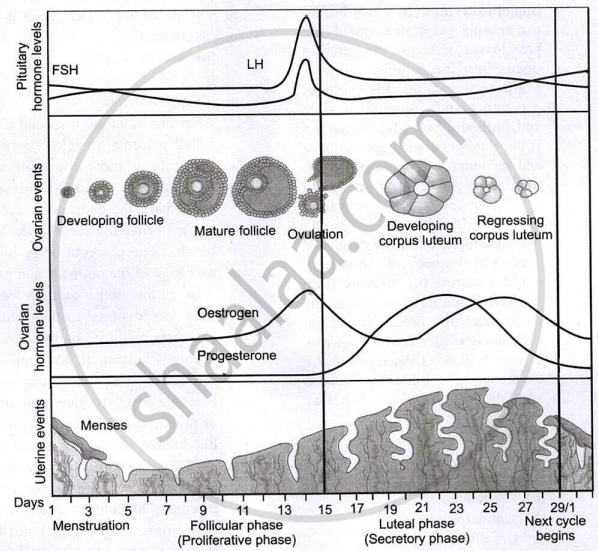
The ovarian or the menstrual cycle in human beings involves a number of cyclic changes that occur in the ovary and uterus under the influence of FSH and LH from anterior pituitary. The cycle occurs with a periodicity of about 28 days with ovulation occurring around the 14th day. If ovum is not fertilised, the corpus luteum formed after ovulation, degenerates. Consequently by the 28th day, the lining of the uterusthe endometrium breaks down and the cycle begins again. Refer to the figure given below with various phases of the menstrual cycle and answer the questions that follow.
|
- Which days of the menstrual cycle mark the proliferative phase?
- 1-5
- 15-23
- 6-14
- 13-17
- Identify the hormones that are at peak level during ovulatory phase
- progesterone
- FSH
- LH
- both FSH and LH
- Which of the following occurs during secretory phase?
- follicles mature
- endometrium breaks
- corpus luteum develops
- oestrogen level keeps increasing
- The breakdown of endometrium occurs during the following phase
- proliferative
- luteal
- follicular
- menstrual
- Increase in the thickness of uterine lining is directly related to increase in the following hormone
- progesterone
- FSH
- LH
- Oestrogen
Read the sources given and answer any four from the questions given below:
| The male reproductive system consists of certain accessory ducts such as rete testis, vasa efferentia, epididymis and vas deferens. Rete testis are the network of tubules which are located on the inner side of the testis. From here vasa efferentia emerge which are the small ducts that carry sperms to the epididymis. In epididymis, the sperms get concentrated and pass to vas deferens. Vas deferens opens into the common urethra. Male accessory glands include: prostate glands, seminal vesicle and bulbourethral glands. Semen is the fluid containing spermatozoа and secretions of accessory glands. Seminal vesicles add secretion containing spermatozoa activating substances like fructose, citrate and prostaglandins, etc. Prostate glands present at the neck of the urinary bladder secrete the alkaline fluid which is essential to neutralise the acidic secretions present in vagina. Bulbourethral glands also known as Cowper's glands located just above the prostate gland, add clear mucous and glycoproteins which act as lubricant. |
- Which one of the following is an accessory gland of human male reproductive system?
- vas deferens
- seminal vesicle
- vas efferentia
- prostaglandins
- At which site do the sperms get concentrated in the male reproductive system?
- seminal vesicles
- bulbourethral glands
- epididymis
- rete testis
- The glands which add glycoproteins to semen are
- Cowper's glands
- seminal vesicles
- epididymis
- prostate glands
- The ducts that carry sperms to the epididymis are
- rete testis
- urethra
- vas deferens
- vas efferentia
- The nature of prostate glands is
- alkaline
- slightly acidic
- neutral
- highly acidic
Read the sources given and answer any four from the questions given below:
| After implantation, a special tissue called placenta, develops between the embryo and the uterine wall of the mother. Placenta consists of foetal part, the chorion as well as the maternal tissue-the decidua basalis. The placenta helps in the exchange of the nutrients and gases between the mother and the foetus. It is also involved in the removal of wastes produced by the growing foetus. Placenta is connected to the foetus via umbilical cord. Placenta also produces a number of proteins and different hormones like human chorionic gonadotropin (hCG), human placental lactogen (hpl), oestrogen and progesterone. Because hCG comes from the embryonic chorion and not the mother, this hormone is tested for in all pregnancy tests. In the later stages of pregnancy, placenta also secretes a hormone called relaxin which facilitates childbirth by dilating the cervix at the time of parturition. |
- Placenta consists of the following tissues.
- only foetal tissue
- chorion
- decidua basalis
- both (b) and (c)
- Which of the following hormone is tested in pregnancy tests to confirm pregnancy?
- oestrogen
- hCG
- progesterone
- hpl
- Which of the following is not a function of placenta?
- remove wastes from maternal blood
- supply nutrients from mother to foetus
- supply oxygen to foetus
- remove wastes from foetus to maternal blood
- The hormone hCG is produced from the
- ovary
- uterine lining of mother
- chorion of embryo
- pituitary gland
- The function of relaxin is to
- maintain pregnancy
- stop ovulation
- dilate cervix
- maintain placenta
B. SUBJECTIVE QUESTIONS Very short answer type questions (1 mark)
Name the secondary sex organs in males.
Where does spermatogenesis occur?
What are Leydig cells?
What is the function of Leydig cells?
Name types of cells present in seminiferous tubules.
Name a single highly coiled tube present on the posterior surface of testis, leading into vas deferens.
The duct that forms a loop over urinary bladder and through which the sperms pass and transferred to urethra.
What is another name of bulbourethral glands?
What is the mature follicle in ovary known as?
Where does fertilisation occur?
The term given to inner lining of uterus.
Name three important stages of gametogenesis.
Name the sperm cell that undergoes 1st meiotic division.
What does secondary oocyte give rise to?
What is spermiogenesis?
Name the hormones released from anterior pituitary under the influence of GnRH from hypothalamus.
What is ABP?
From where is ABP released?
What is the function of ABP?
Name the cells produced from a primary oocyte.
What stage of egg is released during ovulation from Graafian follilcle?
T.S. of an ovary shows a circular structure having layers of cells and small cavities in between. What could it be?
Name the thick area that surrounds the secondary oocyte.
What is corona radiata?
In a 28-day cycle in an ovary, which days correspond to the follicular phase?
When does ovulation take place?
Name the structure formed from the cells of Graafian follicle after ovulation.
What is the role of corpus luteum?
Which cells release the hormone oestrogen?
The term given to the commencement of the menstrual cycle.
The term used for changes in the sperm before fertilising the ovum.
Name an important enzyme that dissolves the ground substance binding follicle cells of ovum.
Why are the divisions of human egg called holoblastic cleavage?
At which stage does implantation occur in the uterus?
What type of placenta is found in human embryo?
Name the following:
Two hormones secreted from placenta.
Where is amniotic cavity present?
Does the blood of foetus and mother contact/connect with each other directly?
Name the cavity present in gastrulation.
Name two hormones that induce contractions of uterus during birth.
Name the term used for first fluid released from the mother's, mammary glands.
What is acrosome?
Short answer type questions (2 marks)
Why are prostate glands and fallopian tubes said to be secondary sex organs?
What is the role of accessory or secondary glands in males?
What role does spermiogenesis play?
How does the inguinal hernia develop?
What is the composition of semen?
Which cells produce testosterone?
Why is proliferative phase also called follicular phase?
Why does endometrium thicken further during secretory phase?
What is the role of corpus luteum?
What is the significance of the fertilisation membrane?
How is polyspermy prevented in humans?
Why does the size of morula remain almost same as of that of ovum?
What is the significance of trophoblast layer?
What do you understand by haemochorial placenta?
What is the role of hCG?
Which hormone is called the pregnancy hormone and why?
What is parturition?
Name two hormones produced during parturition process.
What is the significance of colostrum?
Where are fimbriae present in human female reproductive system? Give their function.
What is the significance of fimbraie.
What do you understand by haemochorial placenta?
Expand the acronym.
hCG
Short answer type questions (3 marks)
Name the secondary sex organs in males.
What is the role of accessory or secondary glands in males?
Name the chemicals released by acrosome. What is their significance?
What are Leydig cells?
Where are Leydig cells present?
What is Leydig cells role in reproduction?
Name the extra-embryonic membranes. Give one significance of each.
Name the hormones produced by placenta. Give one important role of each one of these.
Name the muscular and the glandular layers of human uterus. Which one of these layers undergoes cyclic changes during menstrual cycle? Name the hormone essential for the maintenance of this layer.
What is follicular atresia?
Define the term menopause.
Define Menarche.
What is the significance of fallopian tubes in embryo development?
What is the significance of placenta in embryo development?
What is the significance of fallopian tubes in embryo development?
Complete the following by filling the blanks 1 to 6 with appropriate words:
The human female gonads are: 1. ______ A maturing egg in the ovary is present in a sac of cells called 2. ______ As the egg grows larger, the follicle enlarges and gets filled with a fluid and is now called 3. ______ follicle. The process of releasing the egg from the ovary is called 4. ______ The ovum is picked up by the oviduct funnel and fertilisation takes place in the 5. ______ In about a week blastocyst gets fixed in the endometrium of the uterus and this process is called 6. ______.
Where does fertilisation normally take place?
What is meant by implantation?
Where does implantation occur?
Mention the chromosome number of the egg and zygote in humans?
Explain the term 'gestation'.
How long does gestation last in humans?
In which part of the testis are sperms produced?
State the function of epididymis.
State the function of Seminal vesicle.
Name the cells that secrete Testosterone
Given below are some terms. Rewrite the terms in the correct order so as to be in a logical sequence.
Implantation, Parturition, Ovulation, Gestation, Fertilisation (leading to formation of foetus and birth).
What is the role of corpus luteum?
What is the role of placenta?
Give the role of the following hormone.
Oxytocin
Give the role of the following hormone.
Prolactin
Give the role of the following hormone.
Progesterone
Name the site of formation of sperms and ova in humans.
Give significance of Leydig's cells.
Give the significance of Graafian follicle.
Differentiate between the following:
Spermatogenesis and oogenesis
Differentiate between the following:
Proliferative phase and Secretory phase
Differentiate between the graafian follicle and corpus luteum.
Differentiate between the following:
Primary and Secondary sex organs
Differentiate between vas deferens and vasa efferentia.
Differentiate between the following pair:
Menarche and menopause
Differentiate between zona pellucida and corona radiata.
Difference between morula and blastula.
Answer in one sentence.
Give two differences between blastula and gastrula.
Differentiate between the following:
Trophoectoderm and Ectoderm
Long answer type questions (5 marks)
Explain spermatogenesis in detail.
Explain various stages of the ovarian cycle.
Describe the duct system that transports the sperms from the tubules to the exterior.
What is the role of hormones in the cyclic developments in the ovary and the uterus?
Explain oogenesis in detail.
Describe the anatomical details of oviduct.
Describe the anatomical details of uterus.
Explain the hormonal control of male reproductive system.
What is the role of GnRH in the female reproductive system?
How are various parts of sperm modified to perform specific functions?
List all the changes that occur in the ovum during fertilisation.
Describe the sequence of events from zygote till the implantation of human blastocyst in the uterus.
List the significance of extra-embryonic membranes.
Which changes take place during the first trimester of embryo development?
Explain the various stages of parturition.
Explain the statement 'placenta acts as an endocrine gland'.
Explain the fate of three primary germ layers.
Study the following flowchart. Name the hormones involved at each state. Explain their functions.
Hypothalamus→Pituitary→Testes→ Sperms
Mention the target cells of luteinising hormone in human males and females. Explain the effect and the changes which the hormone induces in each case.
Draw a diagrammatic sectional view of human ovary showing different stages of oogenesis along with corpus luteum.
Where is morula formed in humans? Explain the process of its development from zygote.
Draw a schematic diagram of a human sperm and label the cellular components. Give the functions of any three parts.
Where are the sperm heads found embedded to survive after spermatogenesis?
When and how does placenta develop in female?
How is the placenta connected to the embryo?
Placenta acts as an endocrine gland. Explain.
Diagram-based questions (5 marks)
The diagram refers to the structure of human sperm:
(i) Label the parts 1-4.
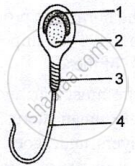
(ii) What are the number of chromosomes present in the nucleus of the sperm?
(iii) State the functions of parts 1, 3 and 4.
(iv) Where is sperm produced in man?
The figure represents the human female system. Study the diagram and answer the questions that follow:
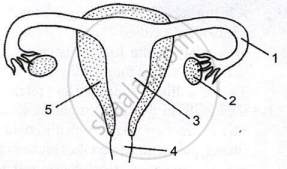
(i) Label the parts 1-5.
(ii) Where does fertilisation take place?
(iii) Name the structure where ovum is implanted.
The diagram shown is the lateral section of a testis of man. Study it carefully and answer the questions that follow:
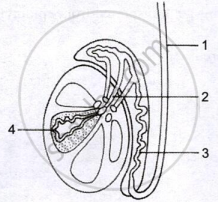
(i) Label the parts 1-4.
(ii) State the functions of the parts labelled 1 and 3.
(iii) Draw a labelled diagram of a sperm.
This is a diagrammatic representation of the ventral sectional view of the female reproductive system:
(i) Redraw and label the following parts:
(1) Right ovary (2) Uterus (3) Placenta (4) Embryo (5) Amnion (6) Oviduct funnel
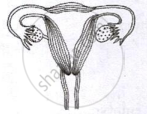
(ii) State the function of the following:
(1) Placenta; (2) Amniotic fluid.
(iii) Using the symbol ‘X’ indicate the region in the diagram where fertilisation occurs.
The diagram given is that of a developing human foetus in the womb. Study the same and then answer the questions that follow:
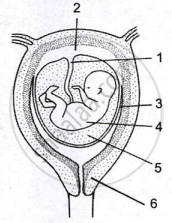
(i) Name the parts '1' to '6' indicated by guidelines.
(ii) What term is given to the period of development of the foetus in the womb?
(iii) How many days does the foetus take to be fully developed?
(iv) Mention one function of the part labelled '2'.
(v) What is the function of the part marked '5'?
E. BOARD QUESTIONS 1 mark
Define the following:
Spermatogenesis
How is the chromosome number maintained in sexually reproducing organisms?
Expand the following abbreviation:
PID
2 marks
Mention the location and the function of Leydig cells.
3 marks
Briefly describe the process of spermatogenesis.
OR
Give an account of hormonal control of oogenesis.
Draw a well labelled diagram of L.S. human testis.
OR
Draw a labeled diagram of a mature embryo sac.
5 marks
Describe the physicochemical events that take place during fertilization in humans.
Given below is the diagram depicting the menstrual cycle in human beings. Study it carefully and answer the questions that follow.

- Which phases are indicated by ‘C’ and ‘D’?
- Name the structures labelled ‘F’. What is its role?
- Explain the changes in the level of progesterone during phases ‘C’ and ‘D’.
- Which hormone present in the urine confirms pregnancy in human beings?
- Identify the structure labelled ‘E’. Name the hormone released by it.
Solutions for 3: Human Reproduction
Sarita Aggarwal solutions for बायोलॉजी [अंग्रेजी] कक्षा १२ आईएससी chapter 3 - Human Reproduction
Shaalaa.com has the CISCE Mathematics बायोलॉजी [अंग्रेजी] कक्षा १२ आईएससी CISCE solutions in a manner that help students grasp basic concepts better and faster. The detailed, step-by-step solutions will help you understand the concepts better and clarify any confusion. Sarita Aggarwal solutions for Mathematics बायोलॉजी [अंग्रेजी] कक्षा १२ आईएससी CISCE 3 (Human Reproduction) include all questions with answers and detailed explanations. This will clear students' doubts about questions and improve their application skills while preparing for board exams.
Further, we at Shaalaa.com provide such solutions so students can prepare for written exams. Sarita Aggarwal textbook solutions can be a core help for self-study and provide excellent self-help guidance for students.
Concepts covered in बायोलॉजी [अंग्रेजी] कक्षा १२ आईएससी chapter 3 Human Reproduction are .
Using Sarita Aggarwal बायोलॉजी [अंग्रेजी] कक्षा १२ आईएससी solutions Human Reproduction exercise by students is an easy way to prepare for the exams, as they involve solutions arranged chapter-wise and also page-wise. The questions involved in Sarita Aggarwal Solutions are essential questions that can be asked in the final exam. Maximum CISCE बायोलॉजी [अंग्रेजी] कक्षा १२ आईएससी students prefer Sarita Aggarwal Textbook Solutions to score more in exams.
Get the free view of Chapter 3, Human Reproduction बायोलॉजी [अंग्रेजी] कक्षा १२ आईएससी additional questions for Mathematics बायोलॉजी [अंग्रेजी] कक्षा १२ आईएससी CISCE, and you can use Shaalaa.com to keep it handy for your exam preparation.
