Advertisements
Chapters
1: Reproduction in Organisms
2: Sexual Reproduction in Flowering Plants
3: Human Reproduction
4: Reproductive Health-Problems and Strategies
Unit 2 – Genetics and Evolution
5: Principles of Inheritance and Variation
6: Chromosomes, Sex-Linked Inheritance and Human Genetic Disorders
7: Molecular Basis of Inheritance
8: Evolution-Origin of Life
9: Theory of Evolution and Evolution of Man
Unit 3 – Biology and Human Welfare
10: Human Health and Diseases
11: Adolescent Issues: Alcoholism and Drugs
12: Animal Breeding for Improvement in Food Production
13: Plant Breeding to Enhance Food Production
14: Microbes in Human Welfare
Unit 4 – Biotechnology
15: Biotechnology: Principles and Processes
16: Biotechnology and Its Applications
Unit 5 – Ecology and Environment
17: Organisms and Populations
▶ 18: Ecosystem
Chapter 19: Biodiversity and Conservation
Chapter 20: Environmental Issues
Advertisements
Solutions for Chapter 18: Ecosystem
Below listed, you can find solutions for Chapter 18 of CISCE Sarita Aggarwal for बायोलॉजी [अंग्रेजी] कक्षा १२ आईएससी.
Sarita Aggarwal solutions for बायोलॉजी [अंग्रेजी] कक्षा १२ आईएससी 18 Ecosystem EXERCISES [Pages 1016 - 1025]
A. OBJECTIVE QUESTIONS Multiple choice questions Choose the correct answer:
Which of the following is an abiotic component of the ecosystem?
bacteria
nutrients
plants
fungi
Of the incoming solar energy which percentage is reflected back into space?
20%
30%
40%
50%
Total energy stored by green plants is called ______.
NPP
community productivity
GPP
secondary productivity
Which of the following process helps in nutrient conservation?
mineralisation
immobilisation
leaching
nitrification
What fraction of assimilated energy is used in respiration by the herbivore?
20%
30%
40%
60%
Which of the following is not a part of detritus?
dried leaves
remains of animals
faecal matter
earthworm
Detritus food chain begins with ______.
dead organic matter
detritus feeders
earthworms
soil bacteria
The decomposition process does not involve ______.
humification
mineralisation
nitrogen fixation
fragmentation
Percentage energy (of total incident radiation) captured by photosynthetic process is ______.
50%
1–5%
0.8–4%
0.2–1%
A food chain always starts with ______.
respiration
photosynthesis
decomposition
nitrogen fixation
Which of the following can explain the energy stored in a food chain?
food chain
food web
pyramid of number
pyramid of biomass
What fraction of assimilated energy is used in respiration by the herbivore?
20%
30%
40%
60%
What fraction of herbivore energy is available to the next trophic level of carnivores?
10%
20%
30%
50%
Which pyramid is always upright, can never be inverted?
pyramid of number
pyramid of biomass
pyramid of energy
pyramid of aquatic system
Which one of the following has the sedimentary nutrient cycle?
carbon
phosphorus
hydrogen
nitrogen
Which of the following is a free living nitrogen fixing bacteria present in soil?
Azotobacter
Nitrosomonas
Rhizobium
Pseudomonas
Azospirillum is an example of ______.
free-living nitrogen fixing bacteria
associative symbiosis
mycorrhizae
cyanobacteria
Ammonifying bacteria convert ______.
wastes into ammonia
ammonia to nitrites
nitrites to ammonia
nitrates to ammonia
Denitrifying bacteria convert ______.
nitrites to nitrates
nitrates to molecular nitrogen
molecular nitrogen to nitrate
nitrate to nitrites
Atmospheric nitrogen can be fixed by ______.
all the plants
some animals
some bacteria
fungi
Main reservoir of phosphorus is ______.
rocks and natural phosphate deposits
atmosphere
bones and teeth
cell membranes
Absorption of phosphorus by higher plants is promoted by the presence of ______.
Rhizobium
Pseudomonas
Azospirillum
mycorrhizae
Which of the following are pioneer organisms of primary succession on a xerach?
grasses
lichen
shrubs
trees
The terminal stage of succession is represented by ______.
mosses
climax community
shrubs
late successional species
In a succession in hydrarch, the reed-swamp stage comes after ______.
phytoplankton stage
submerged plant stage
marsh-meadow stage
scrub stage
The succession occurring in water bodies is called ______.
primary succession
secondary succession
hydrarch
xerarch
Fill in the blanks
The pyramid of ______ is always upright.
Inverted pyramid is generally found in ______.
In oceans, the productivity is generally limited by ______.
Humus serves as a reservoir of ______.
Dead plant parts and animal remains are called ______.
In deep aquatic ecosystems, floating plants called ______ are the major autotrophs.
The nutrients present in the soil at any given time is referred as its ______.
Only about ______ % of PAR is utilised for photosynthesis.
Nitrosomonas converts ______ to ______.
Nitrates are converted to free molecular nitrogen by ______ a denitrying bacteria.
State whether the following is true or false.
Both abiotic and biotic factors form the structural components of an ecosystem.
State whether the following is true or false.
Zooplanktons and free-swimming organisms are the decomposers in a pond.
State whether the following is true or false.
Net primary productivity is equal to gross primary productivity plus the energy spent on respiration.
State whether the following is true or false.
Decomposition involves fragmentation, leaching and catabolism.
State whether the following is true or false.
Humification is a slow process and is followed by mineralisation.
State whether the following is true or false.
In an ecosystem energy flows in a single direction only from consumers to producers.
State whether the following is true or false.
In a food chain only 10% of energy is transferred to the next trophic level.
State whether the following is true or false.
In a tree-dominated ecosystem, the pyramid of numbers could be an inverted pyramid.
State whether the following is true or false.
In a primary succession, lichens are the pioneer organisms that invade a bare rock.
State whether the following is true or false.
Carbon present as carbonates in producers and consumers, acts as a reservoir of carbon in nature.
Match the following.
| Column A | Column B |
|---|---|
| 1. Xerarch succession | (a) Reed-swamp stage |
| 2. Hydrarch succession | (b) Bacteria and fungi |
| 3. Primary consumers | (c) Herbivores |
| 4. Secondary consumers | (d) Carnivores |
| 5. Detritus feeders | (e) Lichens as pioneer organisms |
Answer the following in one or two words.
A term for man-made ecosystems.
Answer the following in one or two words.
Animals that feed on herbivores.
Answer the following in one or two words.
The net stored energy in green plants after meeting the cost of respiration.
Answer the following in one or two words.
Detritus feeding invertebrates like earthworms.
Answer the following in one or two words.
Pyramid that represents the 'standing crop' of organisms at each trophic level at a particular time.
Answer the following in one or two words.
Conversion of nitrates back to free molecular nitrogen.
Answer the following in one or two words.
A process that leads to accumulation of humus.
Answer the following in one or two words.
Another term for above ground detritus.
Answer the following in one or two words.
Nutrient cycle whose reservoir exists in the earth's crust.
Answer the following in one or two words.
Ecological succession that occurs on a previously unoccupied site like a volcano.
In the questions given below, there are two statements marked as Assertion (A) and Reason (R). Read the statements and choose the correct option
Assertion (A): Despite occupying about 70% of the earth's surface, Oceans are a low productivity ecosystem.
Reason (R): In aquatic ecosystems, productivity is limited by light that decreases with increasing water depth.
Both assertion (A) and reason (R) are true, and reason is the correct explanation of assertion.
Both assertion (A) and reason (R) are true, but reason is not the correct explanation of assertion.
Assertion (A) is true but reason (R) is false.
Both assertion (A) and reason (R) are false.
Assertion (A): A network of food chains, existing together in an ecosystem is a form of food web.
Reason (R): An animal like tiger, a carnivore, cannot be a part of food web.
Both assertion (A) and reason (R) are true, and reason is the correct explanation of assertion.
Both assertion (A) and reason (R) are true, but reason is not the correct explanation of assertion.
Assertion (A) is true but reason (R) is false.
Both assertion (A) and reason (R) are false.
Assertion (A): Pyramid of energy may be upright or inverted.
Reason (R): Only 20% of energy goes to next trophic level.
Both assertion (A) and reason (R) are true, and reason is the correct explanation of assertion.
Both assertion (A) and reason (R) are true, but reason is not the correct explanation of assertion.
Assertion (A) is true but reason (R) is false.
Both assertion (A) and reason (R) are false.
Assertion (A): In a marine aquatic ecosystem, at any given time, the biomass of phytoplanktons (producers) is lower than the biomass of zooplanktons (primary consumers).
Reason (R): Phytoplanktons are consumed almost as rapidly as they are formed and thus have shorter life spans.
Both assertion (A) and reason (R) are true, and reason is the correct explanation of assertion.
Both assertion (A) and reason (R) are true, but reason is not the correct explanation of assertion.
Assertion (A) is true but reason (R) is false.
Both assertion (A) and reason (R) are false.
Assertion (A): A lake can undergo ecological succession and become a forest over a period of time.
Reason (R): A bare rock can become a forest through ecological succession.
Both assertion (A) and reason (R) are true, and reason is the correct explanation of assertion.
Both assertion (A) and reason (R) are true, but reason is not the correct explanation of assertion.
Assertion (A) is true but reason (R) is false.
Both assertion (A) and reason (R) are false.
Assertion (A): Secondary succession always involves a predictable species sequence and ends up with the same climax community as existed prior to the disturbance.
Reason (R): A pond can never be considered as a self-sustained ecosystem, as it lacks the structural and functional components of an ecosystem.
Both assertion (A) and reason (R) are true, and reason is the correct explanation of assertion.
Both assertion (A) and reason (R) are true, but reason is not the correct explanation of assertion.
Assertion (A) is true but reason (R) is false.
Both assertion (A) and reason (R) are false.
Assertion (A): The recycling of carbon is essentially a self-regulating feedback system in nature.
Reason (R): In the atmosphere the reservoir pool of carbon consists of free CO2.
Both assertion (A) and reason (R) are true, and reason is the correct explanation of assertion.
Both assertion (A) and reason (R) are true, but reason is not the correct explanation of assertion.
Assertion (A) is true but reason (R) is false.
Both assertion (A) and reason (R) are false.
Assertion (A): Gross primary productivity (GP) refers to the total energy stored by the green plants.
Reason (R): GP includes the energy a plant would spend on respiration.
Both assertion (A) and reason (R) are true, and reason is the correct explanation of assertion.
Both assertion (A) and reason (R) are true, but reason is not the correct explanation of assertion.
Assertion (A) is true but reason (R) is false.
Both assertion (A) and reason (R) are false.
Assertion (A): The total number of species in an ecotone is more than those present in an adjoining area.
Reason (R): Ecotone is a sharp transition zone between two or more diverse communities.
Both assertion (A) and reason (R) are true, and reason is the correct explanation of assertion.
Both assertion (A) and reason (R) are true, but reason is not the correct explanation of assertion.
Assertion (A) is true but reason (R) is false.
Both assertion (A) and reason (R) are false.
Assertion (A): Mosses and lichens are said to form the pioneer community in xerarch succession.
Reason (R): It is because during the course of succession these species get established later.
Both assertion (A) and reason (R) are true, and reason is the correct explanation of assertion.
Both assertion (A) and reason (R) are true, but reason is not the correct explanation of assertion.
Assertion (A) is true but reason (R) is false.
Both assertion (A) and reason (R) are false.
Read the sources given and answer any four from the questions given below:
|
A pyramid of biomass represents the total biomass or 'standing crop' (dry weight) of organisms at each trophic level at a particular time. The pyramid of biomass is always upright as given below but in some aquatic ecosystems it could be inverted also. Inverted pyramid means that the biomass of producers is less than that of the next trophic level, i.e., herbivores. It occurs in some aquatic ecosystems in which the producers are algae and phytoplanktons, which have short life-spans but rapid increasing rate. Hence the biomass of producers, i.e., phytoplanktons is smaller than the biomass of zooplanktons it supports. Also the biomass of zooplanktons is less than the biomass (dry weight) of large and long-lived fishes they support.
|
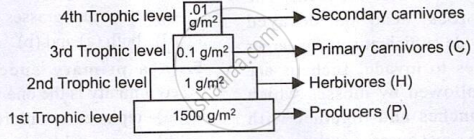
- In the above pyramid of biomass, which trophic level represents the more biomass than primary carnivores?
- producers and carnivores
- herbivores and secondary carnivores
- producers and herbivores
- both (a) and (c)
- In an aquatic ecosystem the pyramid of biomass is
- upright
- triangular
- inverted
- squarish
- The biomass of zooplanktons in an aquatic ecosystem is
- more than phytoplanktons
- less than phytoplanktons
- more than large fish in water
- both (b) and (c)
- The pyramid of biomass of an aquatic system is inverted, where the producers are algae and phytoplanktons because
- short life span and rapid increasing rate of zooplanktons than phytoplanktons
- short life span and rapid increasing rate of phytoplanktons than zooplanktons
- biomass of algae and phytoplanktons is maximum
- biomass of zooplanktons is more than that of phytoplanktons
- In the trophic levels the second trophic level is always occupied by
- carnivores
- herbivores
- producers
- decomposers
Read the sources given and answer any four from the questions given below:
| In a primary succession on a bare rock the first organisms often called pioneer organisms are lichens that invade the rocky area. The fungal component holds moisture and green algae provides food. The lichens form a crust over the bare rocks and begin to form soil from their organic remains and by stimulating chemical breakdown of the rocks. The erosion of rock, dead and decayed lichens provide sufficient soil for larger plant species to invade. Lichens are normally followed by mosses which grow in bunches and together with lichens, form a mat over the rock surface. This provides a suitable surface for the ferns and grasses to grow. Certain insects and small animals are also seen along with vegetation. Then the herbs, shrubs and trees replace the earlier vegetation and new animals continue to invade. Then dead shoots and fallen leaves enrich the soil. Ultimately these plants are succeeded by large seed-bearing plants which also support different kinds of animals. This final stable and selfgrowing community of trees is called as climax community. The changes in the biotic community from the pioneer to the climax community may take hundreds to thousands of years. |
- The pioneer organisms in a primary succession on a bare rock are
- fungi
- lichens
- grasses
- mosses
- The community of tall trees and different types of animals on a bare rock can be seen after
- 10 years
- 100 years
- 200 years
- much more than 200 years
- The sequence of communities on a bare rock is
- mosses-algae—lichens—fernstrees
- mosses-lichens—ferns—trees
- lichens—mossesferns—trees
- lichens—ferns—mosses—trees
- In a primary succession, small animals and certain insects are usually seen when
- algae spread on rock
- lichens spread on rock
- ferns and grasses grow
- both (a) and (b)
- In a primary succession, climax community is the one which is
- replaced by tall trees
- forms stable ecosystem
- gives rise to another primary succession
- both (b) and (c)
B. SUBJECTIVE QUESTIONS Very short answer type questions (1 mark)
What is an ecosystem?
Name two important structural components of ecosystem?
Name a man-made aquatic ecosystem?
What name is given to man made ecоsystems?
Name various types of consumers?
Which groups live directly on plants or autotrophs?
Do carnivores eat plants?
What do decomposers eat?
What is another name given to decomposers?
What does gross primary productivity refer to (GPP)?
What is NPP?
What is NPP equal to?
Is it GPP or NPP that serves as food for herbivores.
What is secondary productivity?
What is primary productivity?
How much of food energy taken by a herbivore is utilised in respiration and how much is assimilated as secondary productivity.
Name two ecosystems that are highly productive.
Name two ecosystems that are least productive.
What is detritus?
What are these animals called who feed on detritus?
Name two detritivores.
Name the process of decomposition in which extra cellular enzymes by bacteria and fungi decompose detritus.
What is mineralisation?
What is leaching?
How much of incident solar energy is available for photosynthesis?
What happens to the rest of solar energy?
How much of PAR is stored as NPP in plants?
At which trophic level are herbivores placed?
What occupies the 1st trophic level?
Give an arrow diagram of a simple grazing food chain.
What is a food chain?
What is food web?
How much percentage of energy is transferred from one trophic level to another?
What does pyramid of number indicate and what is its shape with reference to aquatic ecosystem?
What does an inverted pyramid of biomass represent?
Name the form in which carbon is present or stored in nature.
How is carbon dioxide returned to the atmosphere?
Where is phosphorus in living organisms found?
From where does phosphorous come in soil.
How is phosphate released from detritus into soil?
Why are all the pyramids upright in most of the ecosystems?
Short answer type questions (2 marks)
Define the term 'ecosystem'.
Who gave the term ecosystem?
Give examples of anthropogenic ecosystems.
List basic components of an ecosystem.
What are macrophages?
Why are consumers called heterotrophic?
How do decomposers, decompose the food?
What is meant by 'standing crop'?
Define the term:
Gross Primary Productivity
Define the term:
Net Primary Productivity
What is secondary productivity?
What is detritus?
Name three important processes that take place during decomposition.
Define the 1st law of thermodynamics.
Define the 2nd law of thermodynamics.
What percentage of incident solar radiation is available for photosynthesis?
What is another term for visible light?
How much of PAR is used in net primary productivity?
Explain the components of a simple detritus food chain.
How much energy is consumed in respiration in herbivores?
How much energy is consumed in respiration in carnivores?
What does an upright pyramid of number signify?
In which ecosystem is the pyramid of number inverted?
What type of pyramid of biomass is seen in an aquatic ecosystem?
What is meant by net production efficiency?
How many types of nutrient cycles are present in ecosystems?
Where is the reservoir of sedimentary nutrient cycles?
Why are nutrient cycles in nature called biogeochemical cycles?
What do you understand by wet deposition?
What do you understand by dry deposition?
What is the term retention mean in nutrient cycling?
Name the ultimate source of nitrogen in ecosystem?
What is associative symbiosis?
What is the role of Nitrosomonas in nitrogen cycle?
Name the most common denitrifying bacteria.
Name two free living nitrogen fixing bacteria.
Which bacteria release phosphate ions from detritus?
What do you mean by pioneer species?
Define xerarch.
What is ‘Sere’?
Name the pioneer community in a xerarch.
What is hydrarch?
Name the pioneer community in a hydrarch.
When does secondary succession takes place?
What is ‘Climax community’?
What do you understand by serai stages?
What happens in a reed-swamp stage?
What determines the species composition at the climax stage?
Short answer type questions (3 marks)
What is the significance of phytoplanktons in an ecosystem?
What is the significance of heterotrophs in an ecosystem?
What is the significance of saprophytes in an ecosystem?
Why are consumers called heterotrophic?
How do decomposers, decompose the food?
What are the reasons for low productivity in an ecosystem?
List different processes involved in decomposition.
What is primary productivity?
What is secondary productivity?
Differentiate between gross primary productivity and net primary productivity.
What is the fate of incident solar radiation on plants? Explain with reference to PAR and net primary productivity also.
How is a food chain related to trophic levels?
Name various trophic levels and their significance.
Make a simple grazing food chain and relate it to various trophic levels.
Draw a simple detritus food chain.
Why is there stepwise decline of energy in a food chain?
Give three important aspects of trophic levels.
What is the meaning of 10% law of energy transfer? Explain.
Explain the ecological pyramid with reference to number. Give an example.
Explain the ecological pyramid with reference to biomass. Give an example.
Explain the ecological pyramid with reference to energy. Give an example.
What is ecological succession?
Explain the following term with reference to ecological succession.
Seral stages
Explain the term:
xerarch succession
When does secondary succession takes place?
How is a pioneer community formed?
How is a climax community formed?
Name the ultimate source of nitrogen in ecosystem?
What is nitrogen fixation? Name various ways it is fixed in nature.
What is the term retention mean in nutrient cycling?
Name two free living nitrogen fixing bacteria.
Where is phosphorus found in nature?
How does phosphorus get decomposed?
Which type of phosphorus remain outside the natural cycle for long?
Differentiate between biotic and abiotic components.
Distinguish between Producers and Decomposers.
Differentiate between gross primary productivity and net primary productivity.
Differentiate between the following:
Humification and Mineralisation
Solutions for 18: Ecosystem
Sarita Aggarwal solutions for बायोलॉजी [अंग्रेजी] कक्षा १२ आईएससी chapter 18 - Ecosystem
Shaalaa.com has the CISCE Mathematics बायोलॉजी [अंग्रेजी] कक्षा १२ आईएससी CISCE solutions in a manner that help students grasp basic concepts better and faster. The detailed, step-by-step solutions will help you understand the concepts better and clarify any confusion. Sarita Aggarwal solutions for Mathematics बायोलॉजी [अंग्रेजी] कक्षा १२ आईएससी CISCE 18 (Ecosystem) include all questions with answers and detailed explanations. This will clear students' doubts about questions and improve their application skills while preparing for board exams.
Further, we at Shaalaa.com provide such solutions so students can prepare for written exams. Sarita Aggarwal textbook solutions can be a core help for self-study and provide excellent self-help guidance for students.
Concepts covered in बायोलॉजी [अंग्रेजी] कक्षा १२ आईएससी chapter 18 Ecosystem are .
Using Sarita Aggarwal बायोलॉजी [अंग्रेजी] कक्षा १२ आईएससी solutions Ecosystem exercise by students is an easy way to prepare for the exams, as they involve solutions arranged chapter-wise and also page-wise. The questions involved in Sarita Aggarwal Solutions are essential questions that can be asked in the final exam. Maximum CISCE बायोलॉजी [अंग्रेजी] कक्षा १२ आईएससी students prefer Sarita Aggarwal Textbook Solutions to score more in exams.
Get the free view of Chapter 18, Ecosystem बायोलॉजी [अंग्रेजी] कक्षा १२ आईएससी additional questions for Mathematics बायोलॉजी [अंग्रेजी] कक्षा १२ आईएससी CISCE, and you can use Shaalaa.com to keep it handy for your exam preparation.
