Advertisements
Online Mock Tests
Chapters
1: Real Numbers
Algebra
2: Polynomials
3: Linear Equations in Two Variables
4: Quadratic Equations
5: Arithmetic Progression
Coordinate Geometry
6: Coordinate Geometry
Geometry
▶ 7: Triangles
8: Circles
9: Constructions
Trigonometry
10: Trignometric Ratios
11: T-Ratios of Some Particular Angles
12: Trigonometric Ratios of Some Complemantary Angles
13: Trigonometric identities
14: Heights and Distances
Mensuration
15: Perimeter And Area of Plane Figures
16: Area of Circle, Sector and Segment
17: Volumes and Surface Areas of Solids
Statistics and Probability
18: Mean, Median, Mode of Grouped Data, Cumulative Frequency Graph and Ogive
19: Probability
Chapter 20: Additional Questions
![R.S. Aggarwal solutions for मैथमैटिक्स [अंग्रेजी] कक्षा १० chapter 7 - Triangles - Shaalaa.com](/images/mathematics-english-class-10_6:8f062ea57bdf49abb4f6d22550b39d56.jpg "R.S. Aggarwal solutions for मैथमैटिक्स [अंग्रेजी] कक्षा १० chapter 7 - Triangles")
Advertisements
Solutions for Chapter 7: Triangles
Below listed, you can find solutions for Chapter 7 of CBSE, Karnataka Board R.S. Aggarwal for मैथमैटिक्स [अंग्रेजी] कक्षा १०.
R.S. Aggarwal solutions for मैथमैटिक्स [अंग्रेजी] कक्षा १० 7 Triangles EXERCISE 7A [Pages 372 - 374]
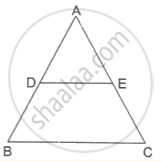
D and E are points on the sides AB and AC respectively of a ΔABC such that DE || BC. If AD = 3.6 cm, AB = 10 cm and AE = 4.5 cm, find EC and AC.
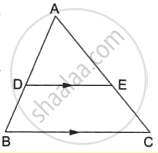
D and E are points on the sides AB and AC respectively of a ΔABC such that DE || BC. If AB = 13.3 cm, AC = 11.9 cm and EC = 5.1 cm, find AD.
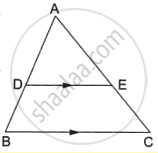
D and E are points on the sides AB and AC respectively of a ΔABC such that DE || BC. If `(AD)/(DB) = 4/7` and AC = 6.6 cm, find AE.
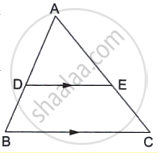
D and E are points on the sides AB and AC respectively of a ΔABC such that DE || BC. If `(AD)/(AB) = 8/15` and EC = 3.5 cm, find AE.
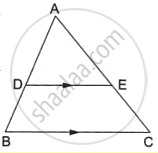
D and E are points on the sides AB and AC respectively of a ΔABC such that DE || BC. Find the value of x, when AD = x cm, DB = (x – 2) cm, AE = (x + 2) cm and EC = (x – 1) cm.
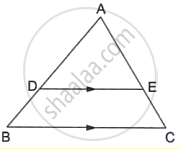
D and E are points on the sides AB and AC respectively of a ΔABC such that DE || BC. Find the value of x, when AD = 4 cm, DB = (x – 4) cm, AE = 8 cm and EC = (3x – 19) cm.
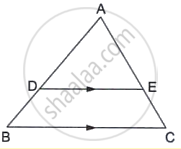
D and E are points on the sides AB and AC respectively of a ΔABC such that DE || BC. Find the value of x, when AD = (7x – 4) cm, AE = (5x – 2) cm, DB = (3x + 4) cm and EC = 3x cm.
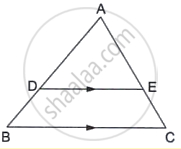
D and E are points on the sides AB and AC respectively of a ΔABC. In the following cases, determine whether DE || BC or not.
AD = 5.7 cm, DB = 9.5 cm, AE = 4.8 cm and EC = 8 cm.
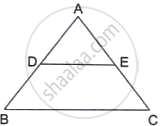
D and E are points on the sides AB and AC respectively of a ΔABC. In the following cases, determine whether DE || BC or not.
AB = 11.7 cm, AC = 11.2 cm, BD = 6.5 cm and AE = 4.2 cm.
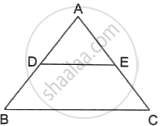
D and E are points on the sides AB and AC respectively of a ΔABC. In the following cases, determine whether DE || BC or not.
AB = 10.8 cm, AD = 6.3 cm, AC = 9.6 cm and EC = 4 cm.
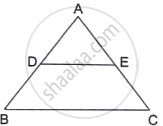
D and E are points on the sides AB and AC respectively of a ΔABC. In the following cases, determine whether DE || BC or not.
AD = 7.2 cm, AE = 6.4 cm, AB = 12 cm and AC = 10 cm.
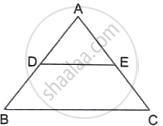
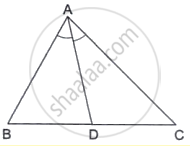
In a ΔABC, AD is the bisector of ∠A. If AB = 6.4 cm, AC = 8 cm and BD = 5.6 cm, find DC.
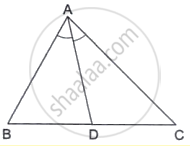
In a ΔABC, AD is the bisector of ∠A. If AB = 10 cm, AC = 14 cm and BC = 6 cm, find BD and DC.
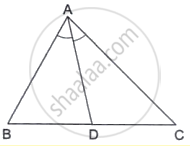
In a ΔABC, AD is the bisector of ∠A. If AB = 5.6 cm, BD = 3.2 cm and BC = 6 cm, find AC.
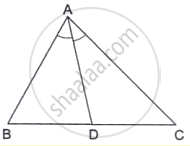
In a ΔABC, AD is the bisector of ∠A. If AB = 5.6 cm, AC = 4 cm and DC = 3 cm, find BC.
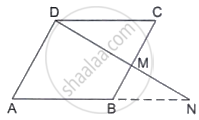
M is a point on the side BC of a parallelogram ABCD. DM when produced meets AB produced at N. Prove that
(i) `(DM)/(MN) = (DC)/(BN)`
(ii) `(DN)/(DM) = (AN)/(DC)`
Show that the line segment which joins the midpoints of the oblique sides of a trapezium is parallel to the parallel sides.
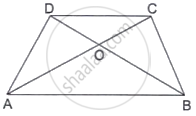
In the given figure, ABCD is a trapezium in which AB || DC and its diagonals intersect at O. If AO = (5x – 7), OC = (2x + 1), BO = (7x – 5) and OD = (7x + 1), find the value of x.
In a ΔABC, M and N are points on the sides AB and AC respectively such that BM = CN. If ∠B = ∠C, then show that MN || BC.
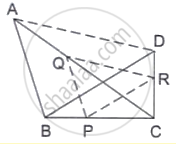
ΔABC and ΔDBC lie on the same side of BC, as shown in the figure. From a point P on BC, PQ || AB and PR || BD are drawn, meeting AC at Q and CD at R respectively. Prove that QR || AD.
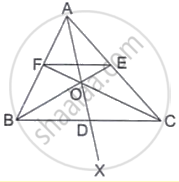
In the given figure, side BC of ΔABC is bisected at D and O is any point on AD. BO and CO produced meet AC and AB at E and F respectively, and AD is produced to X so that D is the midpoint of OX. Prove that AO : AX = AF : AB and show that EF || BC.
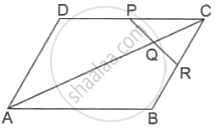
ABCD is a parallelogram in which P is the midpoint of DC and Q is a point on AC such that CQ = `1/4` AC. If PQ produced meets BC at R, prove that R is the midpoint of BC.
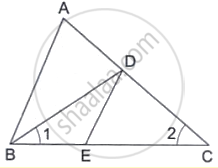
In the adjoining figure, ABC is a triangle in which AB = AC. If D and E are points on AB and AC respectively such that AD = AE, show that the points B, C, E and D are concyclic.
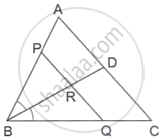
In ΔABC, the bisector of ∠B meets AC at D. A line PQ || AC meets AB, BC and BD at P, Q and R respectively. Show that BP × QR = BQ × PR.
R.S. Aggarwal solutions for मैथमैटिक्स [अंग्रेजी] कक्षा १० 7 Triangles EXERCISE 7B [Pages 399 - 403]
In the given pairs of triangles, find which pair of triangles is similar. State the similarity criterion and write the similarity relation in symbolic form:
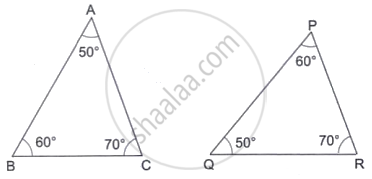
In the given pairs of triangles, find which pair of triangles is similar. State the similarity criterion and write the similarity relation in symbolic form:
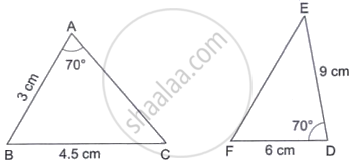
In the given pairs of triangles, find which pair of triangles is similar. State the similarity criterion and write the similarity relation in symbolic form:
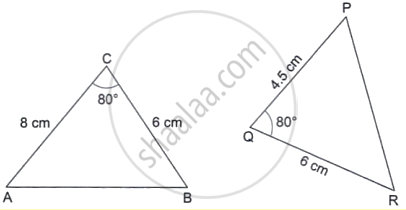
In the given pairs of triangles, find which pair of triangles is similar. State the similarity criterion and write the similarity relation in symbolic form:
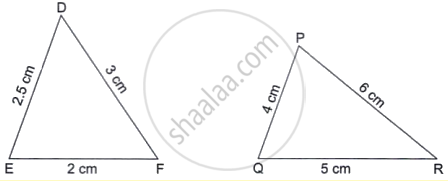
In the given pairs of triangles, find which pair of triangles is similar. State the similarity criterion and write the similarity relation in symbolic form:
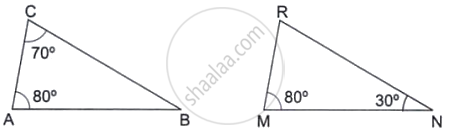
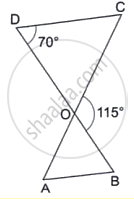
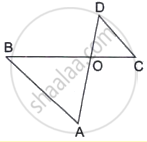
In the given figure, ΔODC ~ ΔOBA, ∠BOC = 115° and ∠CDO = 70°. Find (i) ∠DOC (ii) ∠DCO (iii) ∠OAB (iv) ∠OBA.
In the given figure, ΔOAB ~ ΔOCD. If AB = 8 cm, BO = 6.4 cm, OC = 3.5 cm and CD = 5 cm, find (i) OA (ii) DO.
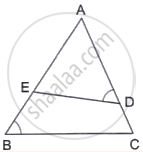
In the given figure, if ∠ADE = ∠B, show that ΔADE ~ ΔABC. If AD = 3.8 cm, AE = 3.6 cm, BE = 2.1 cm and BC = 4.2 cm, find DE.
The perimeters of two similar triangles ABC and PQR are 32 cm and 24 cm respectively. If PQ = 12 cm, find AB.
The corresponding sides of two similar triangles ABC and DEF are BC = 9.1 cm and EF = 6.5 cm. If the perimeter of ΔDEF is 25 cm, find the perimeter of ΔABC.
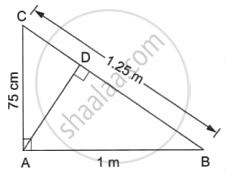
In the given figure, ∠CAB = 90° and AD ⊥ BC. Show that ΔBDA ~ ΔBAC. If AC = 75 cm, AB = 1 m and BC = 1.25 m, find AD.
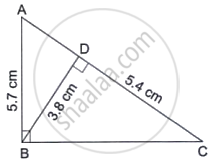
In the given figure, ∠ABC = 90° and BD ⊥ AC. If AB = 5.7 cm, BD = 3.8 cm and CD = 5.4 cm, find BC.
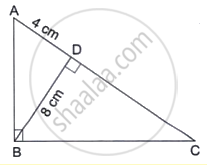
In the given figure, ∠ABC = 90° and BD ⊥ AC. If BD = 8 cm, AD = 4 cm, find CD.
P and Q are points on the sides AB and AC respectively of a ΔABC. If AP = 2 cm, PB = 4 cm, AQ = 3 cm and QC = 6 cm, show that BC = 3PQ.
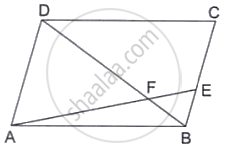
ABCD is parallelogram and E is a point on BC. If the diagonal BD intersects AE at F, prove that AF × FB = EF × FD.
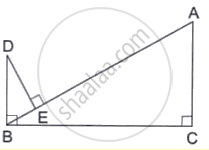
In the given figure, DB ⊥ BC, DE ⊥ AB and AC ⊥ BC. Prove that `(BE)/(DE) = (AC)/(BC)`.
A vertical pole of length 7.5 cm casts a shadow 5 m long on the ground and at the same time a tower casts a shadow 24 m long. Find the height of the tower.
In an isosceles ΔABC, the base AB is produced both ways in P and Q such that AP × BQ = AC2. Prove that ΔACP ~ ΔBCQ.
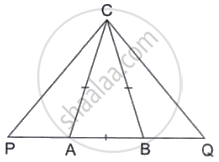
In the given figure, ∠1 = ∠2 and `(AC)/(BD) = (CB)/(CE)`. Prove that ΔACB ~ ΔDCE.
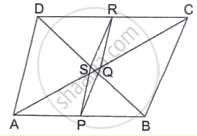
ABCD is a quadrilateral in which AD = BC. If P, Q, R, S be the midpoints of AB, AC, CD and BD respectively, show that PQRS is a rhombus.
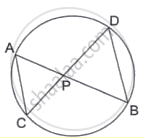
In a circle, two chords AB and CD intersect at a point P inside the circle. Prove that (a) ΔPAC ∼ ΔPDB (b) PA · PB = PC · PD.
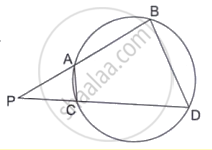
Two chords AB and CD of a circle intersect at a point P outside the circle. Prove that (a) ΔPAC ~ ΔPDB (b) PA · PB = PC · PD.
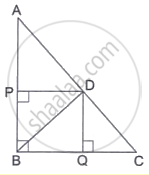
In a right triangle ABC, right angled at B, D is a point on hypotenuse such that BD ⊥ AC. If DP ⊥ AB and DQ ⊥ BC then prove that (a) DQ2 = DP · QC (b) DP2 = DQ · AP.
If AD and PM are medians of triangles ABC and PQR, respectively where ΔABC ~ ΔPQR, prove that `(AB)/(PQ) = (AD)/(PM)`.
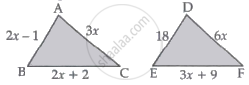
In the following figure, if ΔABC ∼ ΔDEF and their sides of lengths (in cm) are marked along them, then find the lengths of sides of each triangle.
R.S. Aggarwal solutions for मैथमैटिक्स [अंग्रेजी] कक्षा १० 7 Triangles EXERCISE 7C [Pages 417 - 418]
ΔABC ~ ΔDEF and their areas are respectively 64 cm2 and 121 cm2. If EF = 15.4 cm, find BC.
The areas of two similar triangles ABC and PQR are in the ratio 9 : 16. If BC = 4.5 cm, find the length of QR.
ΔABC ~ ΔPQR and ar(ΔABC) = 4ar(ΔPQR). If BC = 12 cm, find QR.
The areas of two similar triangles are 169 cm2 and 121 cm2 respectively. If the longest side of the larger triangle is 26 cm, find the longest side of the smaller triangle.
ΔABC ~ ΔDEF and their areas are respectively 100 cm2 and 49 cm2. If the altitude of ΔABC is 5 cm, find the corresponding altitude of ΔDEF.
The corresponding altitudes of two similar triangles are 6 cm and 9 cm respectively. Find the ratio of their areas.
The areas of two similar triangles are 81 cm2 and 49 cm2 respectively. If the altitude of the first triangle is 6.3 cm, find the corresponding altitude of the other.
The areas of two similar triangles are 64 cm2 and 100 cm2 respectively. If a median of the smaller triangle is 5.6 cm, find the corresponding median of the other.
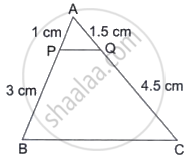
In the given figure, ABC is a triangle and PQ is a straight line meeting AB in P and AC in Q. If AP = 1 cm, PB = 3 cm, AQ = 1.5 cm, QC = 4.5 cm, prove that area of ΔAPQ is `1/16` of the area of ΔABC.
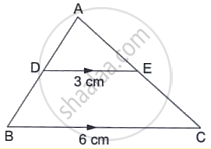
In the given figure, DE || BC. If DE = 3 cm, BC = 6 cm and ar(ΔADE) = 15 cm2, find the area of ΔABC.
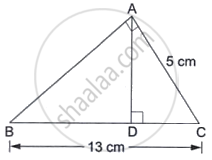
ΔABC is right angled at A and AD ⊥ BC. If BC = 13 cm and AC = 5 cm, find the ratio of the areas of ΔABC and ΔADC.
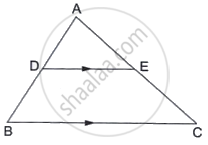
In the given figure, DE || BC and DE : BC = 3 : 5. Calculate the ratio of the areas of ΔADE and the trapezium BCED.
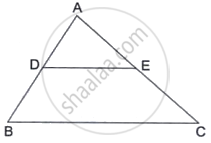
In ΔABC, D and E are the midpoints of AB and AC respectively. Find the ratio of the areas of ΔADE and ΔABC.
R.S. Aggarwal solutions for मैथमैटिक्स [अंग्रेजी] कक्षा १० 7 Triangles EXERCISE 7D [Pages 441 - 443]
The sides of certain triangles are given below. Determine which of them are right triangles.
9 cm, 16 cm, 18 cm
The sides of certain triangles are given below. Determine which of them are right triangles.
7 cm, 24 cm, 25 cm
The sides of certain triangles are given below. Determine which of them are right triangles.
1.4 cm, 4.8 cm, 5 cm
The sides of certain triangles are given below. Determine which of them are right triangles.
1.6 cm, 3.8 cm, 4 cm
The sides of certain triangles are given below. Determine which of them are right triangles.
(a – 1) cm, `2sqrta` cm, (a + 1) cm
A man goes 80 m due east and then 150 m due north. How far is he from the starting point?
A man goes 10 m due south and then 24 m due west. How far is he from the starting point?
A 13 m long ladder reaches a window of a building 12 m above the ground. Determine the distance of the foot of the ladder from the building.
A ladder is placed in such a way that its foot is at a distance of 15 m from a wall and its top reaches a window 20 m above the ground. Find the length of the ladder.
Two vertical poles of height 9 m and 14 m stand on a plane ground. If the distance between their feet is 12 m, find the distance between their tops.
A guy wire attached to a vertical pole of height 18 m is 24 m long and has a stake attached to the other end. How far from the base of the pole should the stake be driven so that the wire will be taut?
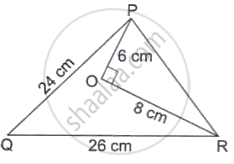
In the given figure, O is a point inside a ΔPQR such that ∠POR = 90°, OP = 6 cm and OR = 8 cm. If PQ = 24 cm and QR = 26 cm, prove that ΔPQR is right-angled.
ΔABC is an isosceles triangle with AB = AC = 13 cm. The length of altitude from A on BC is 5 cm. Find BC.
Find the length of altitude AD of an isosceles ΔABC in which AB = AC = 2a units and BC = a units.
ΔABC is an equilateral triangle of side 2a units. Find each of its altitudes.
Find the height of an equilateral triangle of side 12 cm.
Find the length of a diagonal of a rectangle whose adjacent sides are 30 cm and 16 cm.
Find the length of each side of a rhombus whose diagonals are 24 cm and 10 cm long.
In ΔABC, D is the midpoint of BC and AE ⊥ BC. If AC > AB, show that `AB^2 = AD^2 - BC · DE + 1/4 BC^2`.
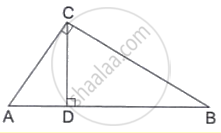
In the given figure, ∠ACB = 90° and CD ⊥ AB. Prove that `(BC^2)/(AC^2) = (BD)/(AD)`.
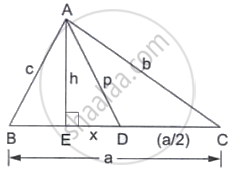
In the given figure, D is the midpoint of side BC and AE ⊥ BC. If BC = a, AC = b, AB = c, ED = x, AD = p and AE = h, prove that
(i) `b^2 = p^2 + ax + a^2/4`
(ii) `c^2 = p^2 - ax + a^2/4`
(iii) `(b^2 + c^2) = 2p^2 + 1/2 a^2`
(iv) `(b^2 - c^2) = 2ax`
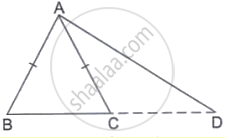
In ΔABC, AB = AC. Side BC is produced to D. Prove that (AD2 − AC2) = BD·CD.
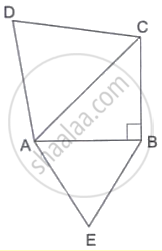
ABC is an isosceles triangle, right-angled at B. Similar triangles ACD and ABE are constructed on sides AC and AB. Find the ratio between the areas of ΔABE and ΔACD.
An aeroplane leaves an airport and flies due north at a speed of 1000 km per hour. At the same time, another aeroplane leaves the same airport and flies due west at a speed of 1200 km per hour. How far apart will be the two planes after `1 1/2` hours?
In a ΔABC, AD is a median and AL ⊥ BC.
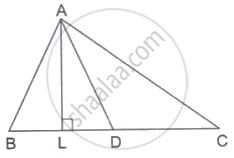
Prove that
(a) `AC^2 = AD^2 + BC · DL + ((BC)/2)^2`
(b) `AB^2 = AD^2 - BC · DL + ((BC)/2)^2`
(c) `AC^2 + AB^2 = 2AD^2 + 1/2 BC^2`
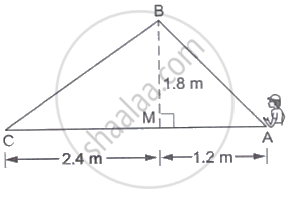
Naman is doing fly-fishing in a stream. The tip of his fishing rod is 1.8 m above the surface of the water and the fly at the end of the string rests on the water 3.6 m away from him and 2.4 m from the point directly under the tip of the rod. Assuming that the string (from the tip of his rod to the fly) is taut, how much string does he have out (see the adjoining figure)? If he pulls in the string at the rate of 5 cmcm per second, what will be the horizontal distance of the fly from him after 12 seconds?
R.S. Aggarwal solutions for मैथमैटिक्स [अंग्रेजी] कक्षा १० 7 Triangles EXERCISE 7E [Pages 446 - 448]
Very-Short-Answer and Short-Answer Questions:
State the two properties which are necessary for given two triangles to be similar.
State the basic proportionality theorem.
State and converse of Thale’s theorem.
State the midpoint theorem.
State the AAA-similarity criterion.
State the AA-similarity criterion.
State the SSS-criterion for similarity of triangles.
State the SAS-similarity criterion
State Pythagoras' theorem.
State the converse of Pythagoras' theorem.
If D, E, F are the respectively the midpoints of sides BC, CA and AB of ΔABC. Find the ratio of the areas of ΔDEF and ΔABC.
Two triangles ABC and PQR are such that AB = 3 cm, AC = 6 cm, ∠A = 70°, PR = 9 cm, ∠P = 70° and PQ = 4.5 cm. Show that ΔABC ∼ ΔPQR and state the similarity criterion.
In ΔABC ~ ΔDEF such that 2AB = DE and BC = 6 cm, find EF.
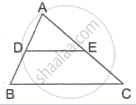
In the given figure, DE || BC such that AD = x cm, DB = (3x + 4) cm, AE = (x + 3) cm and EC = (3x + 19) cm. Find the value of x.
A ladder 10 m long reaches the window of a house 8 m above the ground. Find the distance of the foot of the ladder from the base of the wall.
Find the length of the altitude of an equilateral triangle of side 2a cm.
ΔABC ~ ΔDEF such that ar(ΔABC) = 64 cm2 and ar(ΔDEF) = 169 cm2. If BC = 4 cm, find EF.
In a trapezium ABCD, it is given that AB || CD and AB = 2CD. Its diagonals AC and BD intersect at the point O such that ar(ΔAOB) = 84 cm2. Find ar(ΔCOD).
The corresponding sides of two similar triangles are in the ratio 2 : 3. If the area of the smaller triangle is 48 cm2, find the area of the larger triangle.
In an equilateral triangle with side a, prove that area = `sqrt(3)/4 a^2`.
Find the length of each side of a rhombus whose diagonals are 24 cm and 10 cm long.
Two triangles DEF and GHK are such that ∠D = 48° and ∠H = 57°. If ΔDEF ∼ ΔGHK then find the measures of ∠F.
In the given figure, MN || BC and AM : MB = 1 : 2.
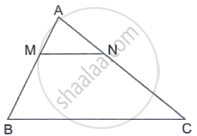
Find `("area"(ΔAMN))/("area"(ΔABC))`.
In triangle BMP and CNR it is given that PB = 5 cm, MP = 6 cm, BM = 9 cm and NR = 9 cm. If ΔBMP ∼ ΔCNR then find the perimeter of ΔCNR.
Each of the equal sides of an isosceles triangle is 25 cm. Find the length of its altitude if the base is 14 cm.
A man goes 12 m due south and then 35 m due west. How far is he from the starting point?
If the lengths of the sides BC, CA and AB of a ΔABC are a, b and c respectively and AD is the bisector ∠A then find the lengths of BD and DC.
In the given figure, ∠AMN = ∠MBC = 76°. If p, q and r are the lengths of AM, MB and BC respectively then express the length of MN in terms of p, q and r.
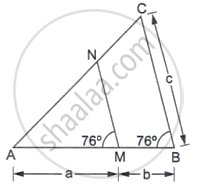
Find the length of each side of a rhombus are 40 cm and 42 cm. Find the length of each side of the rhombus.
For the following statement, state whether true (T) or false (F):
Two circles with different radii are similar.
For the following statement, state whether true (T) or false (F):
Any two rectangles are similar.
For the following statement, state whether true (T) or false (F):
If two triangles are similar then their corresponding angles are equal and their corresponding sides are equal.
For the following statement, state whether true (T) or false (F):
The length of the line segment joining the midpoints of any two sides of a triangle is equal to half the length of the third side.
For the following statement, state whether true (T) or false (F):
In a ΔABC, AB = 6 cm, ∠A = 45° and AC = 8 cm and in a ΔDEF, DF = 9 cm, ∠D = 45° and DE = 12 cm, then ΔABC ∼ ΔDEF.
For the following statement, state whether true (T) or false (F):
The polygon formed by joining the midpoints of the sides of a quadrilateral is a rhombus.
For the following statement, state whether true (T) or false (F):
The ratio of the perimeters of two similar triangles is the same as the ratio of their corresponding medians.
For the following statement, state whether true (T) or false (F):
If O is any point inside a rectangle ABCD then OA2 + OC2 = OB2 + OD2.
For the following statement, state whether true (T) or false (F):
The sum of the squares on the sides of a rhombus is equal to the sum of the squares on its diagonals.
R.S. Aggarwal solutions for मैथमैटिक्स [अंग्रेजी] कक्षा १० 7 Triangles MULTIPLE-CHOICE QUESTIONS (MCQ) [Pages 451 - 458]
Choose the correct answer in each of the following questions:
A man goes 24 m due west and then 10 m due north. How far is he from the starting point?
34 m
17 m
26 m
28 m
Two poles of height 13 m and 7 m respectively stand vertically on a plane ground at a distance of 8 m from each other. The distance between their tops is ______.
9 m
10 m
11 m
12 m
A vertical stick 1.8 m long casts a shadow 45 cm long on the ground. At the same time, what is the length of the shadow of a pole 6 m high?
2.4 m
1.35 m
1.5 m
13.5 m
A vertical pole 6 m long casts a shadow of length 3.6 m on the ground. What is the height of a tower which casts a shadow of length 18 m at the same time?
10.8 m
28.8 m
32.4 m
30 m
The shadow of a 5-m-long stick is 2 m long. At the same time the length of the shadow of a 12.5-m-high tree (in m) is ______.
3.0
3.5
4.5
5.0
A ladder 25 m long just reaches the top of a building 24 m high from the ground. What is the distance of the foot of the ladder from the building?
7 m
14 m
21 m
24.5 m
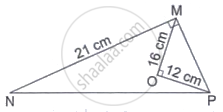
In the given figure, O is a point inside a ΔMNP such that ∠MOP = 90°, OM = 16 cm and OP = 12 cm. If MN = 21 cm and ∠NMP = 90° then NP = ?
25 cm
29 cm
33 cm
35 cm
The hypotenuse of a right triangle is 25 cm. The other two sides are such that one is 5 cm longer than the other. The lengths of these sides are ______.
10 cm, 15 cm
15 cm, 20 cm
12 cm, 17 cm
13 cm, 18 cm
The height of an equilateral triangle having each side 12 cm, is ______.
`6sqrt(2)` cm
`6sqrt(3)` cm
`3sqrt(6)` cm
`6sqrt(6)` cm
ΔАВС is an isosceles triangle with AB = AC = 13 cm and the length of altitude from A on BC is 5 cm. Then, BC = ?
12 cm
16 cm
18 cm
24 cm
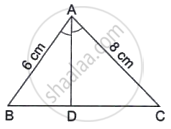
In a ΔABC it is given that AB = 6 cm, AC = 8 cm and AD is the bisector of ∠A. Then, BD : DC = ?
3 : 4
9 : 16
4 : 3
`sqrt(3) : 2`
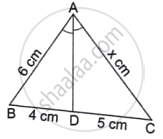
In a ΔABC it is given that AD is the internal bisector of ∠A. If BD = 4 cm, DC = 5 cm and AB = 6 cm, then AC = ?
4.5 cm
8 cm
9 cm
7.5 cm
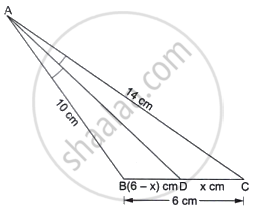
In a ΔABC, it is given that AD is the internal bisector of ∠A. If AB = 10 cm, AC = 14 cm and BC = 6 cm, then CD = ?
4.8 cm
3.5 cm
7 cm
10.5 cm
In a triangle, the perpendicular from the vertex to the base bisects the base. The triangle is ______.
right-angled
isosceles
scalene
obtuse-angled
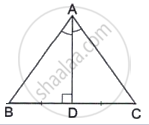
In an equilateral triangle ABC, if AD ⊥ BC then which of the following is true?
2AB2 = 3AD2
4AB2 = 3AD2
3AB2 = 4AD2
3AB2 = 2AD2
In a rhombus of side 10 cm, one of the diagonals is 12 cm long. The length of the second diagonal is ______.
20 cm
18 cm
16 cm
22 cm
The lengths of the diagonals of a rhombus are 24 cm and 10 cm. The length of each side of the rhombus is ______.
12 cm
13 cm
14 cm
17 cm
If the diagonals of a quadrilateral divide each other proportionally then it is a ______.
parallelogram
trapezium
rectangle
square
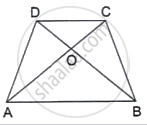
In the given figure, ABCD is a trapezium whose diagonals AC and BD intersect at O such that OA = (3x – 1) cm, OB = (2x + 1) cm, OC = (5x – 3) cm and OD = (6x – 5) cm. Then, x = ?
2
3
2.5
4
The line segments joining the midpoints of the adjacent sides of quadrilateral form ______.
a parallelogram
a rectangle
a square
a rhombus
If the bisector of an angle of a triangle bisects the opposite side then the triangle is ______.
scalene
equilateral
isosceles
right-angled
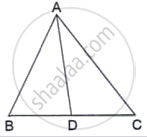
In ΔABC it is given that `(AB)/(AC) = (BD)/(DC)`. If ∠B = 70° and ∠C = 50° then ∠BAD = ?
30°
40°
45°
50°
In ΔABC, DE || BC so that AD = 2.4 cm, AE = 3.2 cm and EC = 4.8 cm. Then, AB = ?
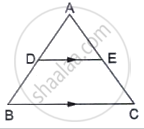
3.6 cm
6 cm
6.4 cm
7.2 cm
In a ΔABC, if DE is drawn parallel to BC, cutting AB and AC at D and E respectively such that AB = 7.2 cm, AC = 6.4 cm and AD = 4.5 cm. Then, AE = ?
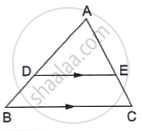
5.4 cm
4 cm
3.6 cm
3.2 cm
In ΔABC, DE || BC so that AD = (7x – 4) cm, AE = (5x – 2) cm, DB = (3x + 4) cm and EC = 3x cm. Then, we have
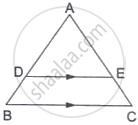
x = 3
x = 5
x = 4
x = 2.5
Ιn ΔΑBC, DE || BC such that `(AD)/(DB) = 3/5`. If AC = 5.6 cm then AE = ?
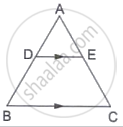
4.2 cm
3.1 cm
2.8 cm
2.1 cm
ΔАВС ~ ΔDEF and the perimeters of ΔABC and ΔDEF are 30 cm and 18 cm respectively. If BC = 9 cm then EF = ?
6.3 cm
5.4 cm
7.2 cm
4.5 cm
ΔАВС ~ ΔDEF such that AB = 9.1 cm and DE = 6.5 cm. If the perimeter of ΔDEF is 25 cm, what is the perimeter of ΔАВС?
35 cm
28 cm
42 cm
40 cm
In ΔABC, it is given that AB = 9 cm, BC = 6 cm and CA = 7.5 cm. Also, ΔDEF is given such that EF = 8 cm and ΔDEF ~ ΔABC. Then, perimeter of ΔDEF is ______.
22.5 cm
25 cm
27 cm
30 cm
∆ABC and ∆BDE are two equilateral triangles such that D is the mid-point of BC. The ratio of the areas of triangles ABC and BDE is ______.
2 : 1
1 : 2
4 : 1
1 : 4
It is given that ΔАBС ~ ΔDFE. If ∠A = 30°, ∠C = 50°, AB = 5 cm, AC = 8 cm and DF = 7.5 cm then which of the following is true?
DE = 12 cm, ∠F = 50°
DE = 12 cm, ∠F = 100°
EF = 12 cm, ∠D = 100°
EF = 12 cm, ∠D = 30°
In the given figure, ∠BAC = 90° and AD ⊥ BC. Then,
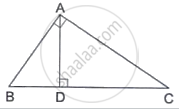
BC · CD = BC2
AB · AC = BC2
BD · CD = AD2
AB · AC = AD2
In ΔABC, AB = `6sqrt(3)` cm, AC = 12 cm and BC = 6 cm. Then, ∠B is ______.
45°
60°
90°
120°
In ΔABC and ΔDEF, it is given that `(AB)/(DE) = (BC)/(FD)` then ______.
∠B = ∠E
∠A = ∠D
∠B = ∠D
∠A = ∠F
In ΔDEF and ΔPQR, it is given that ∠D = ∠Q and ∠R = ∠E, then which of the following is not true?
`(EF)/(PR) = (DF)/(PQ)`
`(DE)/(PQ) = (EF)/(RP)`
`(DE)/(QR) = (DF)/(PQ)`
`(EF)/(RP) = (DE)/(QR)`
If ΔABC ~ ΔEDF and ΔABC is not similar to ΔDEF, then which of the following is not true?
BC . EF = AC . FD
AB . EF = AC . DE
BC . DE = AB . EF
BC . DE = AB . FD
In ΔABC and ΔDEF, it is given that ∠B = ∠E, ∠F = ∠C and AB = 3DE, then the two triangles are ______.
congruent but not similar
similar but not congruent
neither congruent nor similar
similar as well as congruent
If in two triangles ABC and PQR, `(AB)/(QR) = (BC)/(PR) = (CA)/(PQ)`, then ______.
ΔPQR ~ ΔCAB
ΔPQR ~ ΔABC
ΔCBA ~ ΔPQR
ΔBCA ~ ΔPQR
In the given figure, two line segments AC and BD intersect each other at the point P such that PA = 6 cm, PB = 3 cm, PC = 2.5 cm, PD = 5 cm, ∠APB = 50° and ∠CDP = 30° then ∠PBA = ?
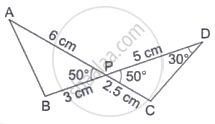
50°
30°
60°
100°
Corresponding sides of two similar triangles are in the ratio 4 : 9. Areas of these triangles are in the ratio
2 : 3
4 : 9
9 : 4
16 : 81
It is given that ΔАВС ~ ΔРQR and `(BC)/(QR) = 2/3` then `(ar(ΔPQR))/(ar(ΔABC))` = ?
`2/3`
`3/2`
`4/9`
`9/4`
In an equilateral ∆ABC, D is the midpoint of AB and E is the midpoint of AC. Then, ar(∆ABC): ar(∆ADE) = ?
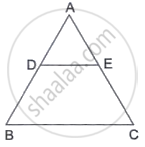
2 : 1
4 : 1
1 : 2
1 : 4
In ΔABC and ΔDEF, we have `(AB)/(DE) = (BC)/(EF) = (AC)/(DF) = 5/7`, then ar(ΔABC) : ar(ΔDEF) = ?
5 : 7
25 : 49
49 : 25
125 : 343
ΔАВС ~ ΔDEF such that ar(ΔАBC) = 36 cm2 and ar(ΔDEF) = 49 cm2. Then, the ratio of their corresponding sides is ______.
36 : 49
6 : 7
7 : 6
`sqrt(6) : sqrt(7)`
Two isosceles triangles have their corresponding angles equal and their areas are in the ratio 25 : 36. The ratio of their corresponding heights is ______.
25 : 36
36 : 25
5 : 6
6 : 5
The line segments joining the midpoints of the sides of a triangle form four triangles, each of which is ______.
congruent to the original triangle
similar to the original triangle
an isosceles triangle
an equilateral triangle
If ΔABC ~ ΔQRP, `(ar(ΔABC))/(ar(ΔPQR)) = 9/4`, AB = 18 cm and BC = 15 cm then PR = ?
8 cm
10 cm
12 cm
`20/3` cm
In the given figure, O is the point of intersection of two chords AB and CD such that OB = OD and ∠AOC = 45°. Then, ΔОAC and ΔODB are ______.
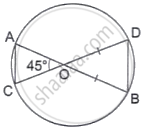
equilateral and similar
equilateral but not similar
isosceles and similar
isosceles but not similar
In an isosceles ΔАBC, if AC = BC and AB2 = 2AC2 then C = ?
30°
45°
60°
90°
In ΔABC, if AB = 16 cm, BC = 12 cm and AC = 20 cm, then ΔABC is ______.
acute-angled
right-angled
obtuse-angled
not possible
True/False Type
Which of the following is a true statement?
Two similar triangles are always congruent.
Two figures are similar if they have the same shape and size.
Two triangles are similar if their corresponding sides are proportional.
Two polygons are similar if their corresponding sides are proportional.
Which of the following is a false statement?
If the areas of two similar triangles are equal then the triangles are congruent.
The ratio of the areas of two similar triangles is equal to the ratio of their corresponding sides.
The ratio of the areas of two similar triangles is equal to the ratio of squares of their corresponding medians.
The ratio of the areas of two similar triangles is equal to the ratio of squares of their corresponding altitudes.
Matching of columns
Match the following columns:
| Column I | Column II |
| (a) In a given ΔABC, DE || BC and `(AD)/(DB) = 3/5`. If AC = 5.6 cm then AE = ..... cm. |
(p) 6 |
| (b) If ΔABC ~ ΔDEF such that 2AB = 3DE and BC = 6 cm then EF = ...... cm. |
(q) 4 |
| (c) If ΔABC ~ ΔPQR such that ar(ΔABC) : ar(ΔPQR) = 9 : 16 and ВС = 4.5 cm then QR = ...... cm. |
(r) 3 |
| (d) In the given figure, AB || CD and OA = (2x + 4) cm, OB = (9x – 21) cm, OC = (2x – 1) cm and OD = 3 cm. Then x = ? 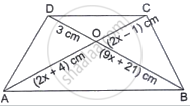 |
(s) 2.1 |
Match the following columns:
| Column I | Column II |
| (a) A man goes 10 m due east and then 20 m due north. His distance from the starting point is ...... m. |
(p) `25sqrt(3)` |
| (b) In an equilateral triangle with each side 10 cm, the altitude is ...... cm. |
(q) `5sqrt(3)` |
| (c) The area of an equilateral triangle having each side 10 cm is ...... cm2. |
(r) `10sqrt(5)` |
| (d) The length of diagonal of a rectangle having length 8 m and breadth 6 m is ...... m. |
(s) 10 |
R.S. Aggarwal solutions for मैथमैटिक्स [अंग्रेजी] कक्षा १० 7 Triangles TEST YOURSELF [Pages 462 - 464]
MCQ
ΔАВС ~ ΔDEF and their perimeters are 32 cm and 24 cm respectively. If AB = 10 cm then DE = ?
8 cm
7.5 cm
15 cm
`5sqrt(3)` cm
In the given figure, DE || BC. If DE = 5 cm, BC = 8 cm and AD = 3.5 cm then AB = ?
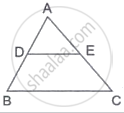
5.6 cm
4.8 cm
5.2 cm
6.4 cm
Two poles of height 6 m and 11 m stand vertically upright on a plane ground. If the distance between their feet is 12 m then the distance between their tops is ______.
12 m
13 m
14 m
15 m
The areas of two similar triangles are 25 cm2 and 36 cm2 respectively. If the altitude of the first triangle is 3.5 cm then the corresponding altitude of the other triangle is ______.
5.6 cm
6.3 cm
4.2 cm
7 cm
Short-Answer Questions
If ΔАВC ~ ΔDEF such that 2AB = DE and BC = 6 cm, find EF.
In the given figure, DE || BC such that AD = x cm, DB = (3x + 4) cm, AE = (x + 3) cm and EC = (3x + 19) cm. Find the value of x.
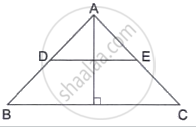
A ladder 10 m long reaches the window of a house 8 m above the ground. Find the distance of the foot of the ladder from the base of the wall.
Find the length of the altitude of an equilateral triangle of side 2a cm.
ΔABC ~ ΔDEF such that ar(ΔABC) = 64 cm2 and ar(ΔDEF) = 169 cm2. If BC = 4 cm, find EF.
In a trapezium ABCD, it is given that AB || CD and AB = 2CD. Its diagonals AC and BD intersect at the point O such that ar(ΔAOB) = 84 cm2. Find ar(ΔCOD).
The corresponding sides of two similar triangles are in the ratio 2 : 3. If the area of the smaller triangle is 48 cm2, find the area of the larger triangle.
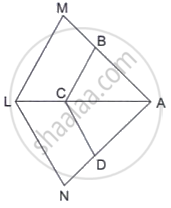
In the given figure, LM || CB and LN || CD. Prove that `(AM)/(AB) = (AN)/(AD)`.
Prove that the internal bisector of an angle of a triangle divides the opposite side internally in the ratio of the sides containing the angle.
In an equilateral triangle with side a, prove that area = `sqrt(3)/4 a^2`.
Find the length of each side of a rhombus whose diagonals are 24 cm and 10 cm long.
Prove that the ratio of the perimeters of two similar triangles is the same as the ratio of their corresponding sides.
Long-Answer Questions
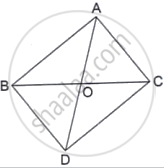
In the given figure, ΔABC and ΔDBC have the same base BC. If AD and BC intersect at O, prove that `(ar(ΔABC))/(ar(ΔDBC)) = (AO)/(DO)`.
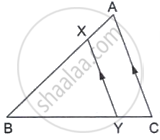
In the given figure, XY || AC and XY divides ΔABC into two regions, equal in area. Show that `(AX)/(AB) = ((2 - sqrt(2)))/2`.
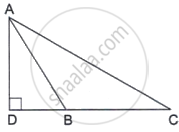
In the given figure, ∆ABC is an obtuse triangle, obtuse-angled at B. If AD ⊥ CB (produced) prove that AC2 = AB2 + BC2 + 2BC · BD.
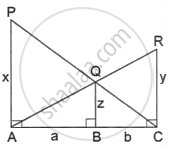
In the given figure, each one of PA, QB and RC is perpendicular to AC. If AP = x, QB = z, RC = y, AB = a and BC = b, show that `1/x + 1/y = 1/z`.
Solutions for 7: Triangles
R.S. Aggarwal solutions for मैथमैटिक्स [अंग्रेजी] कक्षा १० chapter 7 - Triangles
Shaalaa.com has the CBSE, Karnataka Board Mathematics मैथमैटिक्स [अंग्रेजी] कक्षा १० CBSE, Karnataka Board solutions in a manner that help students grasp basic concepts better and faster. The detailed, step-by-step solutions will help you understand the concepts better and clarify any confusion. R.S. Aggarwal solutions for Mathematics मैथमैटिक्स [अंग्रेजी] कक्षा १० CBSE, Karnataka Board 7 (Triangles) include all questions with answers and detailed explanations. This will clear students' doubts about questions and improve their application skills while preparing for board exams.
Further, we at Shaalaa.com provide such solutions so students can prepare for written exams. R.S. Aggarwal textbook solutions can be a core help for self-study and provide excellent self-help guidance for students.
Concepts covered in मैथमैटिक्स [अंग्रेजी] कक्षा १० chapter 7 Triangles are .
Using R.S. Aggarwal मैथमैटिक्स [अंग्रेजी] कक्षा १० solutions Triangles exercise by students is an easy way to prepare for the exams, as they involve solutions arranged chapter-wise and also page-wise. The questions involved in R.S. Aggarwal Solutions are essential questions that can be asked in the final exam. Maximum CBSE, Karnataka Board मैथमैटिक्स [अंग्रेजी] कक्षा १० students prefer R.S. Aggarwal Textbook Solutions to score more in exams.
Get the free view of Chapter 7, Triangles मैथमैटिक्स [अंग्रेजी] कक्षा १० additional questions for Mathematics मैथमैटिक्स [अंग्रेजी] कक्षा १० CBSE, Karnataka Board, and you can use Shaalaa.com to keep it handy for your exam preparation.
