Advertisements
Advertisements
प्रश्न
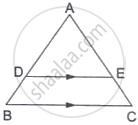
In ΔABC, DE || BC so that AD = (7x – 4) cm, AE = (5x – 2) cm, DB = (3x + 4) cm and EC = 3x cm. Then, we have
विकल्प
x = 3
x = 5
x = 4
x = 2.5
MCQ
Advertisements
उत्तर
x = 4
Explanation:
Given DE || BC, we have `(AD)/(DB) = (AE)/(EC)` (Basic proportionality theorem).
Using the given values `(7x - 4)/(3x + 4) = (5x - 2)/(3x)`
Cross-multiply: 21x2 – 12x = 15x2 + 14x – 8
⇒ 6x2 – 26x + 8 = 0
⇒ 3x2 – 13x + 4 = 0
Solve: `x = (13 ± 11)/6`
⇒ x = 4 or x = `1/3`.
x = `1/3` makes AE = 5x – 2 negative, so discard.
Hence, x = 4.
shaalaa.com
क्या इस प्रश्न या उत्तर में कोई त्रुटि है?
