Advertisements
Online Mock Tests
Chapters
1: Real Numbers
Algebra
2: Polynomials
3: Linear Equations in Two Variables
4: Quadratic Equations
5: Arithmetic Progression
Coordinate Geometry
6: Coordinate Geometry
Geometry
7: Triangles
8: Circles
9: Constructions
Trigonometry
10: Trignometric Ratios
11: T-Ratios of Some Particular Angles
12: Trigonometric Ratios of Some Complemantary Angles
13: Trigonometric identities
▶ 14: Heights and Distances
Mensuration
15: Perimeter And Area of Plane Figures
16: Area of Circle, Sector and Segment
17: Volumes and Surface Areas of Solids
Statistics and Probability
18: Mean, Median, Mode of Grouped Data, Cumulative Frequency Graph and Ogive
19: Probability
20: Additional Questions
![R.S. Aggarwal solutions for मैथमैटिक्स [अंग्रेजी] कक्षा १० chapter 14 - Heights and Distances - Shaalaa.com](/images/mathematics-english-class-10_6:8f062ea57bdf49abb4f6d22550b39d56.jpg "R.S. Aggarwal solutions for मैथमैटिक्स [अंग्रेजी] कक्षा १० chapter 14 - Heights and Distances")
Advertisements
Solutions for Chapter 14: Heights and Distances
Below listed, you can find solutions for Chapter 14 of CBSE, Karnataka Board R.S. Aggarwal for मैथमैटिक्स [अंग्रेजी] कक्षा १०.
R.S. Aggarwal solutions for मैथमैटिक्स [अंग्रेजी] कक्षा १० 14 Heights and Distances EXERCISE 14 [Pages 656 - 661]
A tower stands vertically on the ground. From a point on the ground which is 20 m away from the foot of the tower, the angle of elevation of its top is found to be 60°. Find the height of the tower. [Take `sqrt(3) = 1.732`.]
A kite is flying at a height of 75 m from the level ground, attached to a string inclined at 60° to the horizontal. Find the length of the string, assuming that there is no slack in it. [Take `sqrt(3) = 1.732`.]
An observer 1.5 m tall is 30 m away from a chimney. The angle of elevation of the top of the chimney from his eye is 60°. Find the height of the chimney.
The angles of elevation of the top of a tower from two points at distance of 5 metres and 20 metres from the base of the tower and in the same straight line with it, are complementary. Find the height of the tower.
The angle of elevation of the top of a tower at a distance of 120 m from a point A on the ground is 45°. If the angle of elevation of the top of a flagstaff fixed at the top of the tower, at A is 60° then find the height of the flagstaff. [Use `sqrt(3) = 1.732`.]
From a point on the ground 40 m away from the foot of a tower, the angle of elevation of the top of the tower is 30°. The angle of elevation of the top of a water tank (on the top of the tower) is 45°. Find (i) the height of the tower, (ii) the depth of the tank.
A vertical tower stands on a horizontal plane and is surmounted by a vertical flagstaff of height 6 m. At a point on the plane, the angle of elevation of the bottom of the flagstaff is 30° and that of the top of the flagstaff is 60°. Find the height of the tower. [Use `sqrt(3) = 1.732`.]
A statue 1.46 m tall, stands on the top of a pedestal. From a point on the ground, the angle of elevation of the top of the statue is 60° and from the same point, the angle of elevation of the top of the pedestal is 45°. Find the height of the pedestal. [Use `sqrt(3) = 1.73`.]
The angle of elevation of the top of an unfinished tower at a distance of 75 m from its base is 30°. How much higher must the tower be raised so that the angle of elevation of its top at the same point may be 60°?
On a horizontal plane there is a vertical tower with a flagpole on the top of the tower. At a point, 9 metres away from the foot of the tower, the angle of elevation of the top and bottom of the flagpole are 60° and 30° respectively. Find the height of the tower and the flagpole mounted on it. [Take `sqrt(3) = 1.73`.]
Two poles of equal heights are standing opposite to each other on either side of the road which is 80 m wide. From a point P between them on the road, the angle of elevation of the top of one pole is 60° and the angle of depression from the top of another pole at P is 30°. Find the height of each pole and distances of the point P from the poles.
Two men are on opposite side of tower. They measure the angles of elevation of the top of the tower as 30° and 45° respectively. If the height of the tower is 50 metres, find the distance between the two men. [Take `sqrt(3) = 1.732`.]
From the top of a tower 100 m high, a man observes two cars on the opposite sides of the tower and in same straight line with its base, with angles of depression 30° and 45° respectively. Find the distance between the cars. [Take `sqrt(3) = 1.732`.]
A straight highway leads to the foot of a tower. A man standing on the top of the tower observes a car at an angle of depression of 30°, which is approaching the foot of the tower with a uniform speed. Six seconds later, the angle of depression of the car is found to be 60°. Find the time taken by the car to reach the foot of the tower from this point.
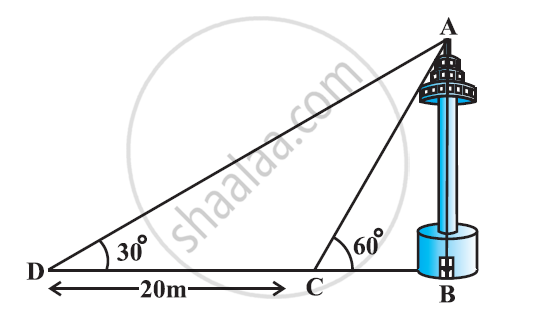
A TV tower stands vertically on a bank of a canal. From a point on the other bank directly opposite the tower the angle of elevation of the top of the tower is 60°. From another point 20 m away from this point on the line joining this point to the foot of the tower, the angle of elevation of the top of the tower is 30°. Find the height of the tower and the width of the canal.
The angle of elevation of the top of a building from the foot of a tower is 30°. The angle of elevation of the top of the tower from the foot of the building is 60°. If the tower is 60 m high, find the height of the building.
The horizontal distance between two towers is 60 metres. The angle of depression of the top of the first tower when seen from the top of the second tower is 30°. If the height of the second tower is 90 metres, find the height of the first tower. [Use `sqrt(3) = 1.732`.]
The angle of elevation of the top of a chimney from the foot of a tower is 60° and the angle of depression of the foot of the chimney from the top of the tower is 30°. If the height of the tower is 40 metres, find the height of the chimney.
According to pollution control norms, the minimum height of a smoke-emitting chimney should be 100 metres. State if the height of the above-mentioned chimney meets the pollution norms. What value is discussed in this question?
From the top of a 7 m high building, the angle of elevation of the top of a cable tower is 60° and the angle of depression of its foot is 45°. Determine the height of the tower.
The angle of depression from the top of a tower of a point A on the ground is 30°. On moving a distance of 20 metres from the point A towards the foot of the tower to a point B, the angle of elevation of the top of the tower from the point B is 60°. Find the height of the tower and its distance from the point A.
The angle of elevation of the top of a vertical tower from a point on the ground is 60°. From another point 10 m vertically above the first, its angle of elevation is 30°. Find the height of the tower.
The angles of depression of the top and bottom of a tower as seen from the top of a `60 sqrt(3)`-m-high cliff are 45° and 60° respectively. Find the height of the tower.
A man on the deck of a ship, 16 m above water level, observes that the angle of elevation and depression respectively of the top and bottom of a cliff are 60° and 30°. Calculate the distance of the cliff from the ship and height of the cliff. [Take `sqrt(3) = 1.732`.]
The angle of elevation of the top Q of a vertical tower PQ from a point X on the ground is 60°. At a point Y, 40 m vertically above X, the angle of elevation is 45°. Find the height of tower PQ. [Take `sqrt(3) = 1.73`.]
The angle of elevation of an aeroplane from a point on the ground is 45°. After flying for 15 seconds, the elevation changes to 30°. If the aeroplane is flying at a height of 2500 metres, find the speed of the aeroplane.
The angle of elevation of the top of a tower from a point on the same level as the foot of the tower is 30°. On advancing 150 m towards the foot of the tower, the angle of elevation becomes 60°. Show that the height of the tower is 129.9 metres. [Given `sqrt(3) = 1.732`.]
As observed from the top of a lighthouse, 100 m above sea level, the angle of depression of a ship, sailing directly towards it, changes from 30° to 60°. Determine the distance travelled by the ship during the period of observation. [Use `sqrt(3) = 1.732`.]
From a point on a bridge across a river, the angles of depression of the banks on opposite sides of the river are 30° and 45° respectively. If the bridge is at a height of 2.5 m from the banks, find the width of the river. [Take `sqrt(3) = 1.732`.]
The angles of elevation of the top of a tower from two points at a distance of 4 m and 9 m from the base of the tower and in the same straight line with it are complementary. Prove that the height of the tower is 6 m.
A ladder of length 6 metres makes an angle of 45° with the floor while leaning against one wall of a room. If the foot of the ladder is kept fixed on the floor and it is made to lean against the opposite wall of the room, it makes an angle of 60° with the floor. Find the distance between two walls of the room.
From the top of a vertical tower, the angles of depression of two cars in the same straight line with the base of the tower, at an instant are found to be 45° and 60°. If the cars are 100 m apart and are on the same side of the tower, find the height of the tower.
An electrician has to repair an electric fault on a pole of height 4 metres. He needs to reach a point 1 metre below the top of the pole to undertake the repair work. What should be the length of the ladder that he should use, which when inclined at an angle of 60° to the horizontal would enable him to reach the required position? [Use `sqrt(3) = 1.73`.]
From the top of a building AB, 60 m high, the angles of depression of the top and bottom of a vertical lamp-post CD are observed to be 30° and 60° respectively. Find
- the horizontal distance between AB and CD,
- the height of the lamp-post,
- the difference between the heights of the building and the lamp-post.
A man observes a car from the top of a tower, which is moving towards the tower with a uniform speed. If the angle of depression of the car changes from 30° to 45° in 12 minutes, find the time taken by the car now to reach the tower.
An aeroplane is flying at a height of 300 m above the ground. Flying at this height, the angles of depression from the aeroplane of two points on both banks of a river in opposite directions are 45° and 60° respectively. Find the width of the river. [Use `sqrt(3) = 1.732`.]
From a point on the ground the angles of elevation of the bottom and top of a communication tower fixed on the top of a 20-m-high building are 45° and 60° respectively. Find the height of the tower. [Take `sqrt(3) = 1.732`.]
From the top of a hill, the angles of depression of two consecutive kilometre stones due east are found to be 45° and 30° respectively. Find the height of the hill. [Take `sqrt(3) = 1.732`.]
If at some time of the day the ratio of the height of a vertically standing pole to the length of its shadow on the ground is `sqrt(3) : 1` then find the angle of elevation of the sun at that time.
A man in a boat rowing away from a lighthouse 100 m high takes 2 minutes to change the angle of elevation of the top of the lighthouse from 60° to 30°. Find the speed of the boat in metres per minute. [Use `sqrt3` = 1.732]
The angles of depression of the top and bottom of a 8 m tall building from the top of a tower are 30° and 45° respectively. Find the height of the tower and the distance between the tower and the building.
R.S. Aggarwal solutions for मैथमैटिक्स [अंग्रेजी] कक्षा १० 14 Heights and Distances MULTIPLE-CHOICE QUESTIONS (MCQ) [Pages 671 - 674]
Choose the correct answer in each of the following questions:
If the height of a vertical pole is equal to the length of its shadow on the ground, the angle of elevation of the sun is ______.
0°
30°
45°
60°
If the height of a vertical pole is `sqrt(3)` times the length of its shadow on the ground then the angle of elevation of the sun at that time is ______.
30°
45°
60°
75°
If the length of the shadow of a tower is `sqrt(3)` times its height then the angle of elevation of the sun is ______.
45°
30°
60°
90°
If a pole 12 m high casts a shadow `4sqrt(3)` m long on the ground then the sun’s elevation is ______.
60°
45°
30°
90°
The shadow of a 5-m-long stick is 2 m long. At the same time, the length of the shadow of a 12.5-m-high tree is ______.
3 m
3.5 m
4.5 m
5 m
A ladder makes an angle of 60° with the ground when placed against a wall. If the foot of the ladder is 2 m away from the wall, the length of the ladder is ______.
`4/sqrt(3)`m
`4sqrt(3)` m
`2sqrt(2)` m
4 m
A ladder 15 m long makes an angle of 60° with the wall. Find the height of the point, where the ladder touches the wall.
`15sqrt(3)` m
`(15sqrt(3))/2` m
`15/2` m
15 m
From a point on the ground 30 m away from the foot of a tower, the angle of elevation of the top of the tower is 30°. The height of the tower is ______.
30 m
`10sqrt(3)` m
10 m
`30sqrt(3)` m
The angle of depression of a car parked on the road from the top of a 150-m-high tower is 30°. The distance of the car from the tower is ______.
`50sqrt(3)` m
`150sqrt(3)` m
`150sqrt(2)` m
75 m
A kite is flying at a height of 30 m from the ground. The length of string from the kite to the ground is 60 m. Assuming that there is no slack in the string, the angle of elevation of the kite at the ground is ______.
45°
30°
60°
90°
From the top of a cliff 20 m high, the angle of elevation of the top of a tower is found to be equal to the angle of depression of the foot of the tower. The height of the tower is ______.
20 m
40 m
60 m
80 m
If a 1.5-m-tall girl stands at a distance of 3 m from a lamp-post and casts a shadow of length 4.5 m on the ground, then the height of the lamp-post is ______.
1.5 m
2 m
2.5 m
2.8 m
The length of the shadow of a tower standing on level ground is found to be 2x metres longer when the sun's elevation is 30° than when it was 45°. The height of the tower is ______.
`(2sqrt(3)x)` m
`(3sqrt(2)x)` m
`(sqrt(3) - 1)x` m
`(sqrt(3) + 1)x` m
The lengths of a vertical rod and its shadow are in the ratio `1 : sqrt(3)`. The angle of elevation of the sun is ______.
30°
45°
60°
90°
A pole casts a shadow of length `2sqrt(3)` m on the ground when the sun’s elevation is 60°. The height of the pole is ______.
`4sqrt(3)` m
6 m
12 m
3 m
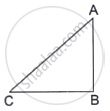
In the given figure, a tower AB is 20 m high and BC, its shadow on the ground is `20sqrt(3)` m long. The sun's altitude is ______.
30°
45°
60°
none of these
The tops of two towers of heights and standing on a level ground subtend angles of 30° and 60° respectively at the centre of the line joining their feet. Then, x : y is ______.
1 : 2
2 : 1
1 : 3
3 : 1
The angle of elevation of the top of a tower from a point on the ground 30 m away from the foot of the tower is 30°. The height of the tower is ______.
30 m
`10sqrt(3)` m
20 m
`10sqrt(2)` m
The string of a kite is 100 m long and it makes an angle of 60° with the horizontal. If there is no slack in the string, the height of the kite from the ground is ______.
`50sqrt(3)` m
`100sqrt(3)` m
`50sqrt(2)` m
100 m
If the angles of elevation of the top of a tower from two points at distances a and b from the base and in the same straight line with it are complementary then the height of the tower is ______.
`sqrt(a/b)`
`sqrt(ab)`
`sqrt(a + b)`
`sqrt(a - b)`
On the level ground, the angle of elevation of a tower is 30°. On moving 20 m nearer, the angle of elevation is 60°. The height of the tower is ______.
10 m
`10sqrt(3)` m
15 m
20 m
In a rectangle, the angle between a diagonal and a side is 30° and the length of this diagonal is 8 cm. The area of the rectangle is ______.
16 cm2
`16/sqrt(3)` cm2
`16sqrt(3)` cm2
`8sqrt(3)` cm2
From the top of a hill, the angles of depression of two consecutive kilometre stones due east are found to be 30° and 45°. The height of the hill is ______.
`1/2 (sqrt(3) - 1)` km
`1/2 (sqrt(3) + 1)` km
`(sqrt(3) - 1)` km
`(sqrt(3) + 1)` km
If the elevation of the sun changes from 30° to 60° then the difference between the lengths of shadows of a pole 15 m high, is ______.
7.5 m
15 m
`10sqrt(3)` m
`5sqrt(3)` m
An observer 1.5 m tall is 28.5 m away from a tower and the angle of elevation of the top of the tower from the eye of the observer is 45°. The height of the tower is ______.
27 m
30 m
28.5 m
none of these
Solutions for 14: Heights and Distances
R.S. Aggarwal solutions for मैथमैटिक्स [अंग्रेजी] कक्षा १० chapter 14 - Heights and Distances
Shaalaa.com has the CBSE, Karnataka Board Mathematics मैथमैटिक्स [अंग्रेजी] कक्षा १० CBSE, Karnataka Board solutions in a manner that help students grasp basic concepts better and faster. The detailed, step-by-step solutions will help you understand the concepts better and clarify any confusion. R.S. Aggarwal solutions for Mathematics मैथमैटिक्स [अंग्रेजी] कक्षा १० CBSE, Karnataka Board 14 (Heights and Distances) include all questions with answers and detailed explanations. This will clear students' doubts about questions and improve their application skills while preparing for board exams.
Further, we at Shaalaa.com provide such solutions so students can prepare for written exams. R.S. Aggarwal textbook solutions can be a core help for self-study and provide excellent self-help guidance for students.
Concepts covered in मैथमैटिक्स [अंग्रेजी] कक्षा १० chapter 14 Heights and Distances are .
Using R.S. Aggarwal मैथमैटिक्स [अंग्रेजी] कक्षा १० solutions Heights and Distances exercise by students is an easy way to prepare for the exams, as they involve solutions arranged chapter-wise and also page-wise. The questions involved in R.S. Aggarwal Solutions are essential questions that can be asked in the final exam. Maximum CBSE, Karnataka Board मैथमैटिक्स [अंग्रेजी] कक्षा १० students prefer R.S. Aggarwal Textbook Solutions to score more in exams.
Get the free view of Chapter 14, Heights and Distances मैथमैटिक्स [अंग्रेजी] कक्षा १० additional questions for Mathematics मैथमैटिक्स [अंग्रेजी] कक्षा १० CBSE, Karnataka Board, and you can use Shaalaa.com to keep it handy for your exam preparation.
