Advertisements
Advertisements
प्रश्न
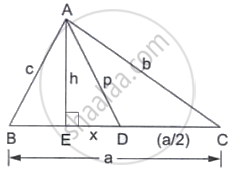
In the given figure, D is the midpoint of side BC and AE ⊥ BC. If BC = a, AC = b, AB = c, ED = x, AD = p and AE = h, prove that
(i) `b^2 = p^2 + ax + a^2/4`
(ii) `c^2 = p^2 - ax + a^2/4`
(iii) `(b^2 + c^2) = 2p^2 + 1/2 a^2`
(iv) `(b^2 - c^2) = 2ax`
Advertisements
उत्तर
(i) In right-angled triangle AEC, applying Pythagoras theorem, we have:
`AC^2=AE^2+EC^2`
⇒ `B^2=h^2(x+a/2)^2=h^2+x^2+a^2/4+ax`.......(1)
In right – angled triangle AED, we have:
`AD^2=AE^2+ED^2`
⇒ `p^2=h^2+x^2` .............(2)
Therefore, from (i) and (ii),
`b^2=p^2+ax+a^2/x`
(ii) In right-angled triangle AEB, applying Pythagoras, we have:
`AB^2=AE^2+EB^2`
⇒ `c^2=h^2+(a/2-x)^2 (∵ BD=a/2 and BE=BD-x)`
⇒ `C^2=h^2+x^2-a^2/4 (∵ h^2+x^2=p^2)`
⇒`c^2=p^2-ax+a^2/x`
(iii) Adding (i) and (ii), we get:
⇒` b^2+c^2=p^2+ax+a^2/4+p^2-ax+a^2/4`
`=2p^2+ax-ax+(a^2+a^2)/4`
=`2p^2+a^2/2`
(iv) Subtracting (ii) from (i), we get:
`b^2-c^2=p^2+ax+a^2/4-(p^2-ax+a^2/4)`
`=p^2-p^2+ax+ax+a^2/4-a^2/4`
`=2ax`
