Please select a subject first
Advertisements
Advertisements
For a general reaction A → B, plot of concentration of A vs time is given in figure. Answer the following question on the basis of this graph.
(i) What is the order of the reaction?
(ii) What is the slope of the curve?
(iii) What are the units of rate constant?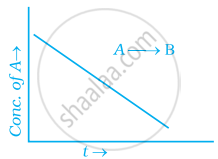
Concept: undefined >> undefined
Why is the probability of reaction with molecularity higher than three very rare?
Concept: undefined >> undefined
Advertisements
Why does the rate of any reaction generally decreases during the course of the reaction?
Concept: undefined >> undefined
Why can’t molecularity of any reaction be equal to zero?
Concept: undefined >> undefined
Why molecularity is applicable only for elementary reactions and order is applicable for elementary as well as complex reactions?
Concept: undefined >> undefined
Why can we not determine the order of a reaction by taking into consideration the balanced chemical equation?
Concept: undefined >> undefined
Match the graph given in Column I with the order of reaction given in Column II. More than one item in Column I may link to the same item of Column II.
| Column I | Column II | |
| (i) | 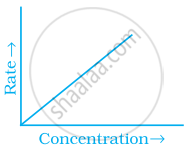 |
|
| (ii) | 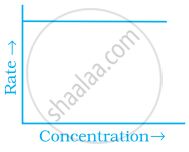 |
(a) 1st order |
| (iii) | 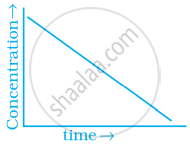 |
(b) Zero-order |
| (iv) | 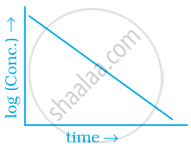 |
Concept: undefined >> undefined
Assertion: Order of the reaction can be zero or fractional.
Reason: We cannot determine order from balanced chemical equation.
Concept: undefined >> undefined
Assertion: Order and molecularity are same.
Reason: Order is determined experimentally and molecularity is the sum of the stoichiometric coefficient of rate determining elementary step.
Concept: undefined >> undefined
Assertion: The enthalpy of reaction remains constant in the presence of a catalyst.
Reason: A catalyst participating in the reaction, forms different activated complex and lowers down the activation energy but the difference in energy of reactant and product remains the same.
Concept: undefined >> undefined
Assertion: Rate constants determined from Arrhenius equation are fairly accurate for simple as well as complex molecules.
Reason: Reactant molecules undergo chemical change irrespective of their orientation during collision.
Concept: undefined >> undefined
Arrange the following diagrams in correct sequence of steps involved in the mechanism of catalysis, in accordance with modern adsorption theory.

(a)

(b)

(c)

(d)

(e)
Concept: undefined >> undefined
In qualitative analysis when \[\ce{H2S}\] is passed through an aqueous solution of salt acidified with dil. \[\ce{HCl}\], a black precipitate is obtained. On boiling the precipitate with dil. \[\ce{HNO3}\], it forms a solution of blue colour. Addition of excess of aqueous solution of ammonia to this solution gives ______.
Concept: undefined >> undefined
A brown ring is formed in the ring test for \[\ce{NO3^{-}}\] ion. It is due to the formation of ______.
Concept: undefined >> undefined
In the preparation of HNO3, we get NO gas by catalytic oxidation of ammonia. The moles of NO produced by the oxidation of two moles of NH3 will be ______.
Concept: undefined >> undefined
\[\ce{PCl5}\] reacts with finely divided silver on heating and a white silver salt is obtained, which dissolves on adding excess aqueous \[\ce{NH3}\] solution. Write the reactions involved to explain what happens.
Concept: undefined >> undefined
The electronic configuration of \[\ce{Cu(II)}\] is 3d9 whereas that of \[\ce{Cu(I)}\] is 3d10. Which of the following is correct?
Concept: undefined >> undefined
Which of the following complexes formed by \[\ce{Cu^2+}\] ions is most stable?
Concept: undefined >> undefined
When 0.1 mol \[\ce{CoCl3 (NH3)5}\] is treated with excess of \[\ce{AgNO3}\], 0.2 mol of \[\ce{AgCl}\] are obtained. The conductivity of solution will correspond to ______.
Concept: undefined >> undefined
When 1 mol \[\ce{CrCl3.6H2O}\] is treated with excess of \[\ce{AgNO3}\], 3 mol of \[\ce{AgCl}\] are obtained. The formula of the complex is ______.
Concept: undefined >> undefined
