Advertisements
Advertisements
How does one understand this motional emf by invoking the Lorentz force acting on the free charge carriers of the conductor? Explain.
Concept: Force Between Two Parallel Currents (Ampere’s Law)
Obtain the expression for the magnetic energy stored in an inductor of self-inductance L to build up a current I through it.
Concept: Solenoid
The figure shows three infinitely long straight parallel current carrying conductors. Find the
- magnitude and direction of the net magnetic field at point A lying on conductor 1,
- magnetic force on conductor 2.

Concept: Force Between Two Parallel Currents (Ampere’s Law)
Depict the behaviour of magnetic field lines in the presence of a diamagnetic material?
Concept: Motion in a Magnetic Field
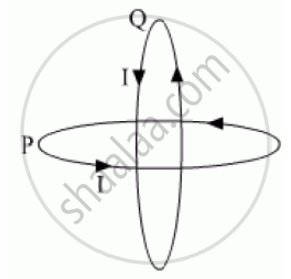
Two identical coils P and Q each of radius R are lying in perpendicular planes such that they have a common centre. Find the magnitude and direction of the magnetic field at the common centre of the two coils, if they carry currents equal to I and \[\sqrt{3}\] I respectively.

Concept: Motion in a Magnetic Field
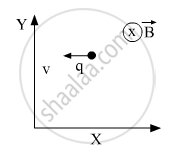
A point charge q moving with speed v enters a uniform magnetic field B that is acting into the plane of the paper as shown. What is the path followed by the charge q and in which plane does it move?
Concept: Motion in a Magnetic Field
If an electric field \[\vec{E}\] is also applied such that the particle continues moving along the original straight line path, what should be the magnitude and direction of the electric field \[\vec{E}\] ?
Concept: Motion in a Magnetic Field
With the help of a neat and labelled diagram, explain the principle and working of a moving coil galvanometer ?
Concept: Moving Coil Galvanometer
Define current sensitivity of a galvanometer.
Concept: Moving Coil Galvanometer
State Kirchhoff's rules and explain on what basis they are justified.
Concept: Kirchhoff’s Laws
Given the resistances of 1 Ω, 2 Ω, 3 Ω, how will be combine them to get an equivalent resistance of (11/3) Ω?
Concept: Kirchhoff’s Laws
Given the resistances of 1 Ω, 2 Ω, 3 Ω, how will be combine them to get an equivalent resistance of (11/5) Ω?
Concept: Kirchhoff’s Laws
Why does a galvanometer when connected in series with a capacitor show a momentary deflection, when it is being charged or discharged?
How does this observation lead to modifying the Ampere's circuital law?
Hence write the generalised expression of Ampere's law.
Concept: Moving Coil Galvanometer
A wire AB is carrying a steady current of 12 A and is lying on the table. Another wire CD carrying 5 A is held directly above AB at a height of 1 mm. Find the mass per unit length of the wire CD so that it remains suspended at its position when left free. Give the direction of the current flowing in CD with respect to that in AB. [Take the value of g = 10 ms−2]
Concept: Solenoid
A wire AB is carrying a steady current of 10 A and is lying on the table. Another wire CD carrying 6 A is held directly above AB at a height of 2 mm. Find the mass per unit length of the wire CD so that it remains suspended at its position when left free. Give the direction of the current flowing in CD with respect to that in AB. [Take the value of g = 10 ms−2]
Concept: Solenoid
A wire AB is carrying a steady current of 6 A and is lying on the table. Another wire CD carrying 4 A is held directly above AB at a height of 1 mm. Find the mass per unit length of the wire CD so that it remains suspended at its position when left free. Give the direction of the current flowing in CD with respect to that in AB. [Take the value of g = 10 ms−2]
Concept: Solenoid
Two identical circular wires P and Q each of radius R and carrying current ‘I’ are kept in perpendicular planes such that they have a common centre as shown in the figure. Find the magnitude and direction of the net magnetic field at the common centre of the two coils.
Concept: Motion in a Magnetic Field
A rectangular loop of wire of size 4 cm × 10 cm carries a steady current of 2 A. A straight long wire carrying 5 A current is kept near the loop as shown. If the loop and the wire are coplanar, find
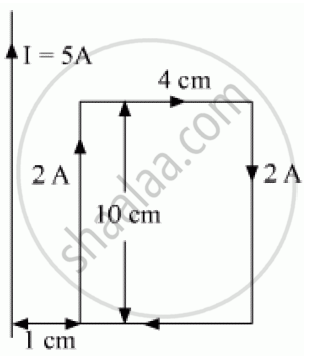
(i) the torque acting on the loop and
(ii) the magnitude and direction of the force on the loop due to the current carrying wire.
Concept: Torque on a Rectangular Current Loop in a Uniform Magnetic Field
A rectangular loop of wire of size 2 cm × 5 cm carries a steady current of 1 A. A straight long wire carrying 4 A current is kept near the loop as shown. If the loop and the wire are coplanar, find (i) the torque acting on the loop and (ii) the magnitude and direction of the force on the loop due to the current carrying wire.
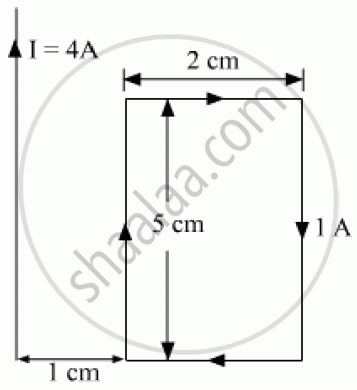
Concept: Torque on a Rectangular Current Loop in a Uniform Magnetic Field
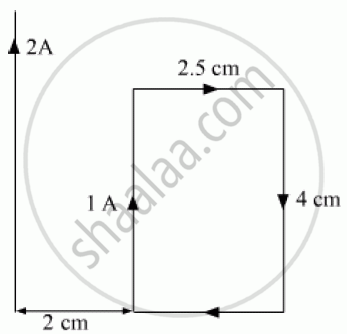
A rectangular loop of wire of size 2.5 cm × 4 cm carries a steady current of 1 A. A straight wire carrying 2 A current is kept near the loop as shown. If the loop and the wire are coplanar, find the (i) torque acting on the loop and (ii) the magnitude and direction of the force on the loop due to the current carrying wire.
Concept: Torque on a Rectangular Current Loop in a Uniform Magnetic Field
