Advertisements
Advertisements
प्रश्न
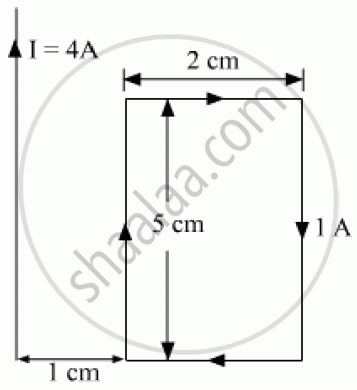
A rectangular loop of wire of size 2 cm × 5 cm carries a steady current of 1 A. A straight long wire carrying 4 A current is kept near the loop as shown. If the loop and the wire are coplanar, find (i) the torque acting on the loop and (ii) the magnitude and direction of the force on the loop due to the current carrying wire.
Advertisements
उत्तर
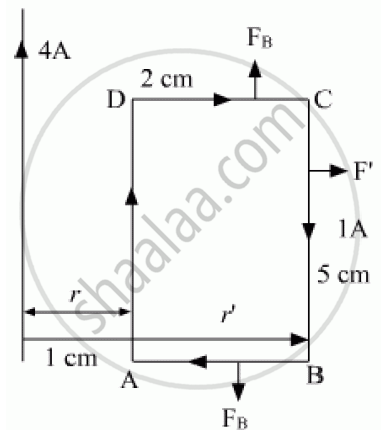
(1) `vectau=vecM xx vecB = MBsintheta`
Here M and B have the same direction
θ = 0
`|vectau| = MBsintheta =0`
`(2) \text{We know } vecF_B = ivecl xx vecB`
On line AB, and CD magnetic forces are equal and opposite. So they cancel out each other. Magnetic force on line AD.
`vecF = ivecl xx vecB` (Attractive)
=ilB [l =5 cm =0.05 cm]
`because B= (mu_0I)/(2pir)`
`|vecF| = (uiIl)/(2pir)` (Attractive)
Magnetic force on line CB.
`vecF = ivecl xx vecB` [Repulsive]
`=>F' = |vecF'| =ilB'`
`because B' =(mu_0I)/(2pir')`
`F' = (mu_0iIl)/(2pir')` [repulsive]
So, net force
`F_n = F-F'`
`=(mu_0iIl)/(2pi) [1/r - 1/r']`
Given I = 4A
I = 1 A
R = 1 cm = 0.01 m
r′ = (1 + 2) cm = 0.03 m
l = 5 cm = 0.05 m
Plugging in the values
`F = 2 xx 10^-7 (4) (1)(0.05)[1/(0.01) - 1/(0.03)]`
`= 8 xx 10^-7 xx 5 [1/1 - 1/3]`
`= 40 xx 10^-7 [2/3]`
`= 26.66 xx 10^-7`
APPEARS IN
संबंधित प्रश्न
A rectangular loop of wire of size 4 cm × 10 cm carries a steady current of 2 A. A straight long wire carrying 5 A current is kept near the loop as shown. If the loop and the wire are coplanar, find
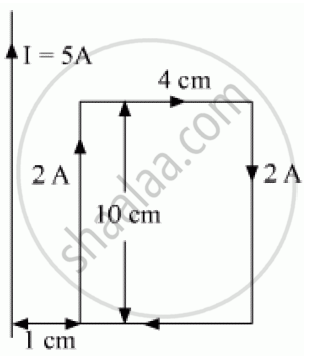
(i) the torque acting on the loop and
(ii) the magnitude and direction of the force on the loop due to the current carrying wire.
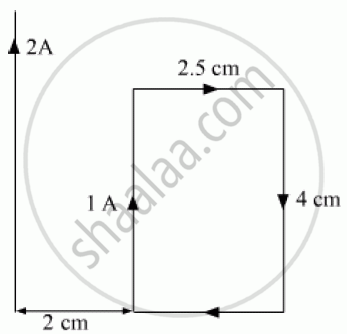
A rectangular loop of wire of size 2.5 cm × 4 cm carries a steady current of 1 A. A straight wire carrying 2 A current is kept near the loop as shown. If the loop and the wire are coplanar, find the (i) torque acting on the loop and (ii) the magnitude and direction of the force on the loop due to the current carrying wire.
A rectangular loop of size l × b carrying a steady current I is placed in a uniform magnetic field `vecB`. Prove that the torque `vectau`acting on the loop is give by `vectau =vecm xx vecB,`where `vecm` is the magnetic moment of the loop.
Consider the motion of a charged particle in a uniform magnetic field directed into the paper. If velocity v of the particle is in the plane of the paper the charged particle will ______.
A rectangular conducting loop consists of two wires on two opposite sides of length l joined together by rods of length d. The wires are each of the same material but with cross-sections differing by a factor of 2. The thicker wire has a resistance R and the rods are of low resistance, which in turn are connected to a constant voltage source V0. The loop is placed in uniform a magnetic field B at 45° to its plane. Find τ, the torque exerted by the magnetic field on the loop about an axis through the centres of rods.
When a current-carrying loop is placed in a uniform magnetic field, what does it experience?
A vector quantity that measures the strength and orientation of a current loop as a magnetic source is called the:
The magnetic dipole moment of a coil of N turns, carrying current I and enclosing area A, is:
In a rectangular loop ABCD placed in a uniform magnetic field \[\vec{B}\], the sides AB and CD are parallel to \[\vec{B}\]. The force on each of these sides is:
In a rectangular loop in a uniform magnetic field, the sides BC and AD are perpendicular to \[\vec{B}\]. The magnitude of the force on each of these sides is:
