Advertisements
Advertisements
प्रश्न
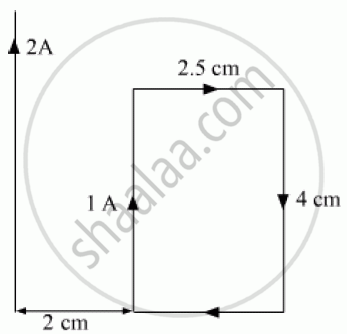
A rectangular loop of wire of size 2.5 cm × 4 cm carries a steady current of 1 A. A straight wire carrying 2 A current is kept near the loop as shown. If the loop and the wire are coplanar, find the (i) torque acting on the loop and (ii) the magnitude and direction of the force on the loop due to the current carrying wire.
Advertisements
उत्तर

(1) `vectau = vecM xx vecB = MBsintheta`
Here M and B have the same direction
θ = 0°
`|vectau| = MBsin theta =0`
(2) We know `vecF_B = i vecI xx vecB`
On line AB, and CD magnetic forces are equal and opposite. So they cancel out each other. Magnetic force on line AD.
`vecF = ivecl xx vecB` (Attractive)
=ilB [l= 4cm = 0.04m]
`because B=(mu_0I) /(2pir)`
`|vecF| = (muiIl)/(2pir)` (Attractive)
Magnetic force on line CB.
`vecF = ivecl xx vecB'` (Repulsive)
`=> F'=|vecF| = ilB'`
`because B' = (mu_0I)/(2pir')`
`F' = (mu_0iIl)/(2pir')` (Repulsive)
So, net force
`F_n = F -F'`
`=(mu_0iIl)/(2pi) [1/r - 1/(r')]`
Given
I = 2A
I = 1 A
r = 2 cm = 0.02 m
r′ = (2 + 2.5) cm = 4.5 cm
= 0.045 m
l = 4 cm = 0.04 m
Plug-in these values in above equation
`F_n = ((4pi xx 10_7)(2)(1)(0.04))/(2pi) [1/0.02 - 1/0.045]`
`= 4 xx 10^-7 xx [1/2 - 1/4.5]`
`= 16 xx 10^-7[0.5 -0.22]`
`= 16 xx 10^-7 [0.278]`
`= 4.45 xx 10^-7 N `
The direction of the force on the loop will be towards left.
APPEARS IN
संबंधित प्रश्न
A rectangular loop of wire of size 2 cm × 5 cm carries a steady current of 1 A. A straight long wire carrying 4 A current is kept near the loop as shown. If the loop and the wire are coplanar, find (i) the torque acting on the loop and (ii) the magnitude and direction of the force on the loop due to the current carrying wire.
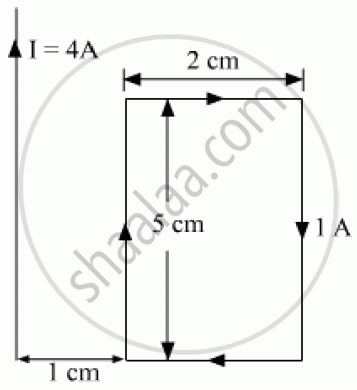
Figure shows a square loop of edge a made of a uniform wire. A current i enters the loop at the point A and leaves it at the point C. Find the magnetic field at the point P which is on the perpendicular bisector of AB at a distance a/4 from it.
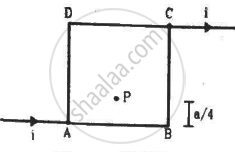
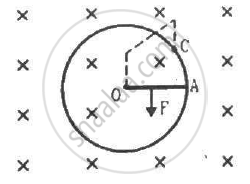
Figure shows a conducting circular loop of radius a placed in a uniform, perpendicular magnetic field B. A thick metal rod OA is pivoted at the centre O. The other end of the rod touches the loop at A. The centre O and a fixed point C on the loop are connected by a wire OC of resistance R. A force is applied at the middle point of the rod OAperpendicularly, so that the rod rotates clockwise at a uniform angular velocity ω. Find the force.
A planar loop of rectangular shape is moved within the region of a uniform magnetic field acting perpendicular to its plane. What is the direction and magnitude of the current induced in it?
A uniform magnetic field of 3000 G is established along the positive z-direction. A rectangular loop of sides 10 cm and 5 cm carries a current of 12 A. What is the torque on the loop in the different cases shown in fig.? What is the force on each case? Which case corresponds to stable equilibrium?

When a current-carrying loop is placed in a uniform magnetic field, what does it experience?
In a rectangular loop in a uniform magnetic field, the sides BC and AD are perpendicular to \[\vec{B}\]. The magnitude of the force on each of these sides is:
The torque on a current-carrying loop in a uniform magnetic field is maximum when:
The torque acting on a coil of N turns, area A and current I, placed at an angle θ to a uniform magnetic field B, is:
The vector form of the torque on a magnetic dipole in a uniform magnetic field is:
