Definitions [8]
If a directed line makes angles \[\alpha\], \[\beta\], and \[\gamma\] with the positive x-, y-, and z-axes respectively, then these are called the direction angles of the line.
The cosines of these angles are called the direction cosines of the line.
So, the direction cosines are written as (l, m, n).
\[ \boxed{\,l^{2} + m^{2} + n^{2} = 1\,} \]
Any three numbers proportional to the direction cosines of a line are called the direction ratios of the line.
If (a, b, c) are direction ratios, then:
A plane is a surface such that if two points are taken in it, the straight line joining them lies wholly in the surface.
General Equation of a Plane:
\[ax+by+cz+d=0\]
Plane Passing Through the Origin:
\[ax+by+cz=0\]
If a line passes through a point whose position vector is \[\vec{a}\] and is parallel to a given vector \[\vec{b}\], then its vector equation is:
\[\vec{r}=\vec{a}+\lambda\vec{b}\]
Where λ is a scalar parameter.
Line Through the Origin:
\[\vec{r}=\lambda\vec{b}\]
Coplanar:
Two straight lines are coplanar if they are either parallel or intersecting.
Skew Lines:
Two straight lines (in space) which are neither parallel nor intersecting are called skew lines.
If a straight line passes through two points whose position vectors are \[\vec{a}\] and \[\vec{b}\], then the vector equation of the line is:
\[\vec{r}=\vec{a}+\lambda(\vec{b}-\vec{a})\]
or
\[\vec{r}=(1-\lambda)\vec{a}+\lambda\vec{b}\]
A straight line in space is uniquely determined if
- It passes through a given point and has a given direction;
- It passes through two given points.
Formulae [20]
If the direction cosines of the two lines are
\[(l_1, m_1, n_1)\] and \[(l_2, m_2, n_2)\], then:
If the direction ratios are \[(a_1, b_1, c_1)\] and \[(a_2, b_2, c_2)\], then:
If the direction ratios of two lines are:
First line: \[(a_1, b_1, c_1)\]
Second line: \[(a_2, b_2, c_2)\]
then the cosine of the angle \[\theta\] between them is:
If the lines are \[ \vec{r} = \vec{a}_{1} + \lambda\vec{b}_{1} \] and \[ \vec{r} = \vec{a}_{2} + \mu\vec{b}_{2}, \]
then \[ \vec{a}_{1}, \vec{a}_{2} \] are position vectors of points on the lines and \[ \vec{b}_{1}, \vec{b}_{2} \] are their direction vectors.
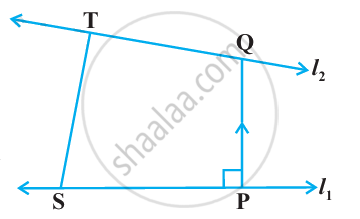
Vector Form:
\[\mathbf{d}=\left|\frac{(\overline{\mathbf{b}}_{1}\times\overline{\mathbf{b}}_{2}).(\overline{\mathbf{a}}_{2}-\overline{\mathbf{a}}_{1})}{\left|\overline{\mathbf{b}}_{1}\times\overline{\mathbf{b}}_{2}\right|}\right|\]
Cartesian Form:
\[\mathbf{d}=\left|\frac{ \begin{vmatrix} x_2-x_1 & y_2-y_1 & z_2-z_1 \\ \mathbf{a}_1 & \mathbf{b}_1 & \mathbf{c}_1 \\ \mathbf{a}_2 & \mathbf{b}_2 & \mathbf{c}_2 \end{vmatrix}}{\sqrt{\left(\mathbf{a}_1\mathbf{b}_2-\mathbf{a}_2\mathbf{b}_1\right)^2+\left(\mathbf{a}_1\mathbf{c}_2-\mathbf{a}_2\mathbf{c}_1\right)^2+\left(\mathbf{b}_1\mathbf{c}_2-\mathbf{b}_2\mathbf{c}_1\right)^2}}\right|\]
\[SD=\left|\frac{\left(a_{2}-a_{1}\right)\times b}{\left|b\right|}\right|\]
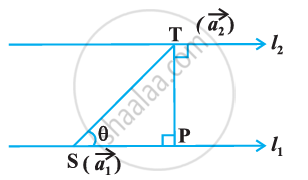
Vector form:
If the planes are: \[\vec{r}\cdot\vec{n}_1=d_1\quad\mathrm{and}\quad\vec{r}\cdot\vec{n}_2=d_2\]
Then the plane through their intersection is:
\[(\vec{r}\cdot\vec{n}_1-d_1)+\lambda(\vec{r}\cdot\vec{n}_2-d_2)=0\]
Vector Form:
\[\sin\theta=\frac{\overrightarrow{b}.\overrightarrow{n}}{|\overrightarrow{b}|.|\overrightarrow{n}|}\]
Cartesian Form:
\[\sin\theta=\frac{al+bm+cn}{\sqrt{a^2+b^2+c^2}\sqrt{l^2+m^2+n^2}}\]
Vector form:
If planes are: \[\vec{r}\cdot\vec{n}_1=q_1,\quad\vec{r}\cdot\vec{n}_2=q_2\] then:
\[\cos\theta=\frac{\vec{n}_1\cdot\vec{n}_2}{|\vec{n}_1||\vec{n}_2|}\]
Cartesian Form:
\[\cos\theta=\frac{a_1a_2+b_1b_2+c_1c_2}{\sqrt{a_1^2+b_1^2+c_1^2}\sqrt{a_2^2+b_2^2+c_2^2}}\]
\[\vec{r}\cdot\hat{n}=p\]
If the plane passes through the origin:
\[\vec{r}\cdot\hat{n}=0\]
Corresponding Cartesian form:
\[lx+my+nz=p\]
1. Cartesian → Vector Form
If the Cartesian equation of a line is:
\[\frac{x-x_1}{a}=\frac{y-y_1}{b}=\frac{z-z_1}{c}\]
Then its vector form is:
\[\vec{r}=(x_1\hat{i}+y_1\hat{j}+z_1\hat{k})+\lambda(a\hat{i}+b\hat{j}+c\hat{k})\]
2. Vector → Cartesian Form
If the vector equation of a line is:
\[\vec{r}=\vec{a}+\lambda\vec{m}\]
Then the Cartesian form is:
\[\frac{x-x_1}{a}=\frac{y-y_1}{b}=\frac{z-z_1}{c}\]
1. Symmetric (Standard) Form of a Line
If a line passes through (x1,y1,z1) and has direction cosines (l,m,n) then its equation is:
\[\frac{x-x_{1}}{l}=\frac{y-y_{1}}{m}=\frac{z-z_{1}}{n}=r\]
2. Parametric Form (Coordinates of any Point)
\[x=x_1+lr,\quad y=y_1+mr, \quad z=z_1+nr\]
3. Line with Given Direction Ratios
\[\frac{x-x_1}{a}=\frac{y-y_1}{b}=\frac{z-z_1}{c}\]
If the plane passes through (x1,y1,z1) then:
\[a(x-x_1)+b(y-y_1)+c(z-z_1)=0\]
Vector form:
\[(\vec{r}-\vec{a})\cdot\vec{n}=0\]
Cartesian form:
\[a(x-x_1)+b(y-y_1)+c(z-z_1)=0\]
If
-
p = length of the perpendicular from the origin to the plane
-
(l,m,n) = direction cosines of the normal to the plane
Then the equation of the plane is:
\[lx+my+nz=p\]
If the plane passes through (x1,y1,z1) (x2,y2,z2),(x3,y3,z3), then its equation is:
\[\begin{vmatrix}
x-x_1 & y-y_1 & z-z_1 \\
x_2-x_1 & y_2-y_1 & z_2-z_1 \\
x_3-x_1 & y_3-y_1 & z_3-z_1
\end{vmatrix}=0\]
\[\frac{x-x_1}{x_2-x_1}=\frac{y-y_1}{y_2-y_1}=\frac{z-z_1}{z_2-z_1}\]
- Distance between P(x₁, y₁, z₁) and Q(x₂, y₂, z₂):
-
Distance of point (x, y, z) from origin
\[OP=\sqrt{x^2+y^2+z^2}\]
For points A(x₁, y₁, z₁) and B(x₂, y₂, z₂) divided in ratio m₁ : m₂
(a) Internal Division
\[\left(\frac{m_1x_2+m_2x_1}{m_1+m_2},\frac{m_1y_2+m_2y_1}{m_1+m_2},\frac{m_1z_2+m_2z_1}{m_1+m_2}\right)\]
(b) External Division
\[\left(\frac{m_1x_2-m_2x_1}{m_1-m_2},\frac{m_1y_2-m_2y_1}{m_1-m_2},\frac{m_1z_2-m_2z_1}{m_1-m_2}\right)\]
(c) Mid-Point Formula
\[\left(\frac{x_1+x_2}{2},\frac{y_1+y_2}{2},\frac{z_1+z_2}{2}\right)\]
\[\frac{x}{a}+\frac{y}{b}+\frac{z}{c}=1\]
Vector form:
\[\frac{|\vec{a}\cdot\vec{n}-d|}{|\vec{n}|}\]
Cartesian form:
\[\frac{|ax_1+by_1+cz_1+d|}{\sqrt{a^2+b^2+c^2}}\]
Key Points
-
Direction Cosines (DCs) of a line: \[(l, m, n) = (\cos \alpha, \cos \beta, \cos \gamma)\].
-
Main identity: \[l^2 + m^2 + n^2 = 1\].
-
Direction Ratios (DRs): Are proportional to DCs.
-
Relation between DRs and DCs: If DRs are (a, b, c), then DCs are proportional to (a, b, c) divided by \[\sqrt{a^2 + b^2 + c^2}\].
-
DRs for two points: For points \[P(x_1, y_1, z_1)\] and \[Q(x_2, y_2, z_2)\], DRs are \[(x_2 - x_1, y_2 - y_1, z_2 - z_1)\].
-
Through point \(\vec a\) and parallel to \(\vec b\): \(\vec r = \vec a + \lambda \vec b\).
-
Parametric form: \(x = x_1 + \lambda a,; y = y_1 + \lambda b,; z = z_1 + \lambda c\).
-
Cartesian form: \(\frac{x-x_1}{a} = \frac{y-y_1}{b} = \frac{z-z_1}{c}\).
-
The angle between two lines depends only on their directions.
-
If lines do not pass through the origin, imagine parallel lines through the origin.
-
The dot-product formula is the main method for solving these questions.
-
In symmetric form, denominators give direction ratios.
-
Zero dot product means perpendicular lines.
-
Proportional direction ratios mean parallel lines.
-
The required angle is generally the acute angle.
-
Intersecting lines: SD = 0
-
Parallel lines: \[SD = \frac{|(\vec{a}_2 - \vec{a}_1) \times \vec{b}|}{|\vec{b}|}\]
-
Skew lines: \[SD = \frac{|(\vec{a}_2 - \vec{a}_1) \cdot (\vec{b}_1 \times \vec{b}_2)|}{|\vec{b}_1 \times \vec{b}_2|}\]
-
XY-plane → z = 0
-
YZ-plane → x = 0
-
ZX-plane → y = 0
If the general equation of a plane is:
ax + by + cz + d = 0
Rewrite as:
ax + by + cz = −d
Then divide throughout by −d, to get:
\[\frac{x}{\frac{-d}{a}}+\frac{y}{\frac{-d}{b}}+\frac{z}{\frac{-d}{c}}=1\]
Important Questions [43]
- If a line has the direction ratios −18, 12, −4, then what are its direction cosines?
- If a line makes angles of 90°, 135° and 45° with the x, y and z axes respectively, then its direction cosines are ______.
- If the equation of a line is x = ay + b, z = cy + d, then find the direction ratios of the line and a point on the line.
- Write the Distance of the Point (3, −5, 12) from X-axis?
- Find the Direction Cosines of the Line Joining the Points P(4,3,-5) and (-2,1,-8) .
- If a line makes angles α, β and γ with the coordinate axes, find the value of cos2α + cos2β + cos2γ.
- Write the direction ratios of the following line : x = −3, (y−4)/3 =( 2 −z)/1
- If a line makes angles 90°, 135°, 45° with the x, y and z axes respectively, find its direction cosines.
- Find the coordinates of the foot of the perpendicular drawn from point (5, 7, 3) to the line x-153=y-298=z-5-5.
- Find the vector equation of a line passing through the point (2, 3, 2) and parallel to the line vec("r")=(-2hat"i"+3hat"j")+lambda(2hat"i"-3hat"j"+6hat"k"). Also, find the distance
- Equation of line passing through origin and making 30°, 60° and 90° with x, y, z axes respectively, is ______
- Equation of a line passing through point (1, 2, 3) and equally inclined to the coordinate axis, is ______.
- The Cartesian equation of a line AB is: 2x-12=y+22=z-33. Find the direction cosines of a line parallel to line AB.
- Find the Cartesian equation of the line which passes through the point (−2, 4, −5) and is parallel to the line
- Show that the Lines 5 − X − 4 = Y − 7 4 = Z + 3 − 5 and X − 8 7 = 2 Y − 8 2 = Z − 5 3 Are Coplanar.
- Find the Value of P for Which the Following Lines Are Perpendicular :
- Find the Value of λ for Which the Following Lines Are Perpendicular to Each Other: X − 5 5 λ + 2 = 2 − Y 5 = 1 − Z − 1 ; X 1 = Y + 1 2 2 λ = Z − 1 3
- Find the Value of λ, So that the Lines 1 − X 3 = 7 Y − 14 λ = Z − 3 2 and 7 − 7 X 3 λ = Y − 5 1 = 6 − Z 5 Are at Right Angles. Also, Find Whether the Lines Are Intersecting Or Not.
- Find the vector equation of a line passing through a point with position vector 2i^-j^+k^ and parallel to the line joining the points -i^+4j^+k^ and -i^+2j^+2k^.
- Find the Equation of a Plane Which Passes Through the Point (3, 2, 0) and Contains the Line X − 3 1 = Y − 6 5 = Z − 4 4 .
- Find the coordinates of the point where the line through the points A(3, 4, 1) and B(5, 1, 6) crosses the XZ plane. Also find the angle which this line makes with the XZ plane.
- Find the vector and Cartesian equations of the line through the point (1, 2, −4) and perpendicular to the two lines.
- If the Cartesian equations of a line are (3-x)/5=(y+4)/7=(2z-6)/4 , write the vector equation for the line.
- A line passes through (2, −1, 3) and is perpendicular to the lines r=(i+j-k)+lambda(2i-2j+k) and vecr=(2i-j-3k)+mu(i+2j+2k) . Obtain its equation in vector and Cartesian from.
- Find the Value of P, So that the Lines l_1:(1-x)/3=(7y-14)/p=(z-3)/2 and l_2=(7-7x)/3p=(y-5)/1=(6-z)/5 Are Perpendicular to Each Other.
- Find the vector and cartesian equations of the line passing through the point (2, 1, 3) and perpendicular to the lines (x-1)/1=(y-2)/2=(z-3)/3 and x/(-3)=y/2=z/5
- Find the Vector and Cartesian Equations of a Line Passing Through (1, 2, –4) and Perpendicular to the Two Lines `(X - 8)By3 = (Y + 19)By(-16) = (Z - 10)By7` and `(X - 15)By3 = (Y - 29)By8 = (Z - 5)By(-5)`
- A Line Passes Through the Point with Position Vector 2 ^ I − 3 ^ J + 4 ^ K and is in the Direction of 3 ^ I + 4 ^ J − 5 ^ K . Find Equations of the Line in Vector and Cartesian Form.
- Prove that the Lines Through a (0, −1, −1) and B (4, 5, 1) Intersects the Line Through C (3, 9, 4) and D (−4, 4, 4). Also, Find Their Point of Intersection.
- Prove that the Line → R = ( ^ I + ^ J − ^ K ) + λ ( 3 ^ I − ^ J ) and → R = ( 4 ^ I − ^ K ) + μ ( 2 ^ I + 3 ^ K ) Intersect and Find Their Point of Intersection.
- Find the Shortest Distance Between the Following Pairs of Lines Whose Vector Are: → R = ( ^ I + ^ J ) + λ ( 2 ^ I − ^ J + ^ K ) and , → R = 2 ^ I + ^ J − ^ K + μ ( 3 ^ I − 5 ^ J + 2 ^ K )
- Find the Angle Between the Lines → R = ( 2 ^ I − 5 ^ J + ^ K ) + λ ( 3 ^ I + 2 ^ J + 6 ^ K ) and → R = 7 ^ I − 6 ^ K + μ ( ^ I + 2 ^ J + 2 ^ K )
- Equation of a line passing through (1, 1, 1) and parallel to z-axis is ______
- Find the equations of the diagonals of the parallelogram PQRS whose vertices are P(4, 2, – 6), Q(5, – 3, 1), R(12, 4, 5) and S(11, 9, – 2).
- The angle between the lines 2x = 3y = – z and 6x = – y = – 4z is ______.
- Find the angle between the following two lines: λr→=2i^-5j^+k^+λ(3i^+2j^+6k^) μr→=7i^-6k^+μ(i^+2j^+2k^)
- Find the Shortest Distance Between the Lines `Vecr = (4hati - Hatj) + Lambda(Hati+2hatj-3hatk)` and `Vecr = (Hati - Hatj + 2hatk) + Mu(2hati + 4hatj - 5hatk)`
- Find the Distance Between the Planes 2x - Y + 2z = 5 and 5x - 2.5y + 5z = 20
- Show that the following two lines are coplanar: (x−a+d)/(α−δ)= (y−a)/α=(z−a−d)/(α+δ) and (x−b+c)/(β−γ)=(y−b)/β=(z−b−c)/(β+γ)
- Find the distance between the lines: λr→=(i^+2j^-4k^)+λ(2i^+3j^+6k^); μr→=(3i^+3j^-5k^)+μ(4i^+6j^+12k^)
- Find the shortest distance between the following lines: λr→=3i^+5j^+7k^+λ(i^-2j^+k^) and μr→=(-i^-j^-k^)+μ(7i^-6j^+k^).
- Show that lines: r=i+j+k+λ(i-hat+k) r=4j+2k+μ(2i-j+3k) are coplanar Also, find the equation of the plane containing these lines.
- Read the following passage and answer the questions given below. Two motorcycles A and B are running at the speed more than the allowed speed on the roads represented by the lines
