Advertisements
Advertisements
Question
Find the equations of the diagonals of the parallelogram PQRS whose vertices are P(4, 2, – 6), Q(5, – 3, 1), R(12, 4, 5) and S(11, 9, – 2). Use these equations to find the point of intersection of diagonals.
Advertisements
Solution
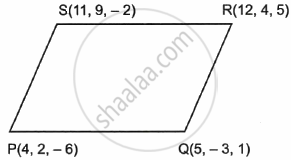
Equation of diagonal PR is i.e., P(4, 2, – 6) and R(12, 4, 5) is
`(x - 4)/(12 - 4) = (y - 2)/(4 - 2) = (z + 6)/(5 + 6)`
`\implies (x - 4)/8 = (y - 2)/2 = (z + 6)/11` ...(i)
Equation of diagonal QS is i.e., Q(5, – 3, 1) and S(11, 9, – 2) is
`(x - 5)/(11 - 5) = (y + 3)/(9 + 3) = (z - 1)/(-2 - 1)`
`\implies (x - 5)/6 = (y + 3)/12 = (z - 1)/-3` ...(ii)
For finding point of intersection.
Let `(x - 4)/8 = (y - 2)/2 = (z + 6)/11` = λ
x = 8λ + 4, y = 2λ + 2, z = 11λ – 6
Since, the lines (i) and (ii) are intersecting, the point (x, y, z) must satisfy the second line.
∴ `(8λ + 4 - 5)/6 = (2λ + 2 + 3)/12 = (11λ - 6 - 1)/-3`
`\implies (8λ - 1)/6 = (2λ + 5)/12 = (11λ - 7)/-3`
`\implies (8λ - 1)/6 = (2λ + 5)/12`
`\implies` 16λ – 2 = 2λ + 5
`\implies` 14λ = 7
λ = `1/2`
∴ Point of intersection is
x = `8 xx 1/2 + 4` = 8
y = `2 xx 1/2 + 2` = 3
z = `11 xx 1/2 - 6` = `11/2 - 6` = `(-1)/2`
Thus, the diagonals intersect at `(8, 3, (-1)/2)`
RELATED QUESTIONS
A line passes through (2, −1, 3) and is perpendicular to the lines `vecr=(hati+hatj-hatk)+lambda(2hati-2hatj+hatk) and vecr=(2hati-hatj-3hatk)+mu(hati+2hatj+2hatk)` . Obtain its equation in vector and Cartesian from.
Let `A(bara)` and `B(barb)` be any two points in the space and `R(barr)` be a point on the line segment AB dividing it internally in the ratio m : n, then prove that `bar r=(mbarb+nbara)/(m+n)`. Hence find the position vector of R which divides the line segment joining the points A(1, –2, 1) and B(1, 4, –2) internally in the ratio 2 : 1.
Find the Cartesian equation of the line which passes through the point (−2, 4, −5) and parallel to the line given by `(x+3)/3 = (y-4)/5 = (z+8)/6`.
Find the vector and the Cartesian equations of the lines that pass through the origin and (5, −2, 3).
Find in vector form as well as in cartesian form, the equation of the line passing through the points A (1, 2, −1) and B (2, 1, 1).
Show that the points whose position vectors are \[- 2 \hat{i} + 3 \hat{j} , \hat{i} + 2 \hat{j} + 3 \hat{k} \text{ and } 7 \text{ i} - \text{ k} \] are collinear.
Find the angle between the following pair of line:
\[\frac{x - 2}{3} = \frac{y + 3}{- 2}, z = 5 \text{ and } \frac{x + 1}{1} = \frac{2y - 3}{3} = \frac{z - 5}{2}\]
Find the angle between the pairs of lines with direction ratios proportional to 5, −12, 13 and −3, 4, 5
Find the angle between two lines, one of which has direction ratios 2, 2, 1 while the other one is obtained by joining the points (3, 1, 4) and (7, 2, 12).
Find the equation of the line passing through the point (1, −1, 1) and perpendicular to the lines joining the points (4, 3, 2), (1, −1, 0) and (1, 2, −1), (2, 1, 1).
If the lines \[\frac{x - 1}{- 3} = \frac{y - 2}{2 \lambda} = \frac{z - 3}{2} \text{ and } \frac{x - 1}{3\lambda} = \frac{y - 1}{1} = \frac{z - 6}{- 5}\] are perpendicular, find the value of λ.
Find the foot of the perpendicular from (1, 2, −3) to the line \[\frac{x + 1}{2} = \frac{y - 3}{- 2} = \frac{z}{- 1} .\]
Find the shortest distance between the following pairs of lines whose vector equations are: \[\overrightarrow{r} = \left( 8 + 3\lambda \right) \hat{i} - \left( 9 + 16\lambda \right) \hat{j} + \left( 10 + 7\lambda \right) \hat{k} \]\[\overrightarrow{r} = 15 \hat{i} + 29 \hat{j} + 5 \hat{k} + \mu\left( 3 \hat{i} + 8 \hat{j} - 5 \hat{k} \right)\]
Find the shortest distance between the lines \[\overrightarrow{r} = \hat{i} + 2 \hat{j} + 3 \hat{k} + \lambda\left( \hat{i} - 3 \hat{j} + 2 \hat{k} \right) \text{ and } \overrightarrow{r} = 4 \hat{i} + 5 \hat{j} + 6 \hat{k} + \mu\left( 2 \hat{i} + 3 \hat{j} + \hat{k} \right)\]
Write the cartesian and vector equations of Z-axis.
Write the formula for the shortest distance between the lines
\[\overrightarrow{r} = \overrightarrow{a_1} + \lambda \overrightarrow{b} \text{ and } \overrightarrow{r} = \overrightarrow{a_2} + \mu \overrightarrow{b} .\]
Write the vector equation of a line given by \[\frac{x - 5}{3} = \frac{y + 4}{7} = \frac{z - 6}{2} .\]
Find the angle between the lines 2x=3y=-z and 6x =-y=-4z.
The direction ratios of the line perpendicular to the lines \[\frac{x - 7}{2} = \frac{y + 17}{- 3} = \frac{z - 6}{1} \text{ and }, \frac{x + 5}{1} = \frac{y + 3}{2} = \frac{z - 4}{- 2}\] are proportional to
The equation of the line passing through the points \[a_1 \hat{i} + a_2 \hat{j} + a_3 \hat{k} \text{ and } b_1 \hat{i} + b_2 \hat{j} + b_3 \hat{k} \] is
The shortest distance between the lines \[\frac{x - 3}{3} = \frac{y - 8}{- 1} = \frac{z - 3}{1} \text{ and }, \frac{x + 3}{- 3} = \frac{y + 7}{2} = \frac{z - 6}{4}\]
The equation of a line is 2x -2 = 3y +1 = 6z -2 find the direction ratios and also find the vector equation of the line.
If y – 2x – k = 0 touches the conic 3x2 – 5y2 = 15, find the value of k.
Choose correct alternatives:
If the equation 4x2 + hxy + y2 = 0 represents two coincident lines, then h = _______
If 2x + y = 0 is one of the line represented by 3x2 + kxy + 2y2 = 0 then k = ______
Find the joint equation of pair of lines through the origin which is perpendicular to the lines represented by 5x2 + 2xy - 3y2 = 0
The lines `(x - 1)/2 = (y + 1)/2 = (z - 1)/4` and `(x - 3)/1 = (y - k)/2 = z/1` intersect each other at point
A line passes through \[(5,2,-4)\] and is parallel to \[3\hat{i}+2\hat{j}-8\hat{k}\]. Which is its vector equation?
