Advertisements
Advertisements
Question
Find the coordinates of the foot of the perpendicular drawn from point (5, 7, 3) to the line `(x - 15)/3 = (y - 29)/8 = (z - 5)/-5`.
Advertisements
Solution
Given point is P(5, 7, 3) and line is
`(x - 15)/3 = (y - 29)/8 = (z - 5)/-5` = k
Let any point Q on this line with coordinates (3k + 15, 8k + 29, – 5k + 5).
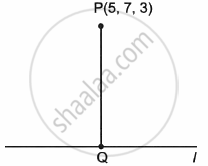
Now direction ratio of line PQ is
(3k + 15 – 5), (8k + 29 – 7), (– 5k + 5 – 3)
= 3k + 10, 8k + 22, – 5k + 2
and direction ratio of given line l are (3, 8, – 5)
∵ PQ ⊥ l
∴ 3(3k + 10) + 8(8k + 22) – 5(– 5k + 2) = 0
9k + 30 + 64k + 176 + 25k – 10 = 0
98k + 196 = 0
k = `(-196)/98` = – 2
Hence foot of perpendicular drawn on the given line is [3 × (– 2) + 15, 8 × (– 2) + 29, – 5 × (– 2) + 5] = (9, 13, 15).
APPEARS IN
RELATED QUESTIONS
Find the direction cosines of the line
`(x+2)/2=(2y-5)/3; z=-1`
If a line has the direction ratios −18, 12, −4, then what are its direction cosines?
Show that the points (2, 3, 4), (−1, −2, 1), (5, 8, 7) are collinear.
If l1, m1, n1 and l2, m2, n2 are the direction cosines of two mutually perpendicular lines, show that the direction cosines of the line perpendicular to both of these are m1n2 − m2n1, n1l2 − n2l1, l1m2 − l2m1.
If the lines `(x-1)/(-3) = (y -2)/(2k) = (z-3)/2 and (x-1)/(3k) = (y-1)/1 = (z -6)/(-5)` are perpendicular, find the value of k.
Find the direction cosines of the line passing through two points (−2, 4, −5) and (1, 2, 3) .
Write the distance of the point (3, −5, 12) from X-axis?
If a line makes angles α, β and γ with the coordinate axes, find the value of cos2α + cos2β + cos2γ.
Write the coordinates of the projection of point P (x, y, z) on XOZ-plane.
If the x-coordinate of a point P on the join of Q (2, 2, 1) and R (5, 1, −2) is 4, then its z-coordinate is
The angle between the two diagonals of a cube is
If a line makes angles α, β, γ, δ with four diagonals of a cube, then cos2 α + cos2 β + cos2γ + cos2 δ is equal to
Verify whether the following ratios are direction cosines of some vector or not
`1/5, 3/5, 4/5`
Verify whether the following ratios are direction cosines of some vector or not
`1/sqrt(2), 1/2, 1/2`
Find the direction cosines of a vector whose direction ratios are
0, 0, 7
If (a, a + b, a + b + c) is one set of direction ratios of the line joining (1, 0, 0) and (0, 1, 0), then find a set of values of a, b, c
P is a point on the line segment joining the points (3, 2, –1) and (6, 2, –2). If x co-ordinate of P is 5, then its y co-ordinate is ______.
If α, β, γ are the angles that a line makes with the positive direction of x, y, z axis, respectively, then the direction cosines of the line are ______.
A line makes equal angles with co-ordinate axis. Direction cosines of this line are ______.
The vector equation of the line passing through the points (3, 5, 4) and (5, 8, 11) is `vec"r" = 3hat"i" + 5hat"j" + 4hat"k" + lambda(2hat"i" + 3hat"j" + 7hat"k")`
Find the equations of the two lines through the origin which intersect the line `(x - 3)/2 = (y - 3)/1 = z/1` at angles of `pi/3` each.
The line `vec"r" = 2hat"i" - 3hat"j" - hat"k" + lambda(hat"i" - hat"j" + 2hat"k")` lies in the plane `vec"r".(3hat"i" + hat"j" - hat"k") + 2` = 0.
The d.c's of a line whose direction ratios are 2, 3, –6, are ______.
A line in the 3-dimensional space makes an angle θ `(0 < θ ≤ π/2)` with both the x and y axes. Then the set of all values of θ is the interval ______.
If a line makes angles of 90°, 135° and 45° with the x, y and z axes respectively, then its direction cosines are ______.
A directed line makes angles \[\alpha\], \[\beta\], and \[\gamma\] with the positive x-, y-, and z-axes respectively. What are these angles called?
If \[\alpha\], \[\beta\], and \[\gamma\] are the direction angles of a line, which ordered triple gives its direction cosines?
Which identity must be satisfied by the direction cosines \[(l,m,n)\] of a line?
A line passes through \[P(x_1,y_1,z_1)\] and \[Q(x_2,y_2,z_2)\]. Which is one set of direction ratios of the line?
