Advertisements
Advertisements
प्रश्न
Find the coordinates of the foot of the perpendicular drawn from point (5, 7, 3) to the line `(x - 15)/3 = (y - 29)/8 = (z - 5)/-5`.
Advertisements
उत्तर
Given point is P(5, 7, 3) and line is
`(x - 15)/3 = (y - 29)/8 = (z - 5)/-5` = k
Let any point Q on this line with coordinates (3k + 15, 8k + 29, – 5k + 5).
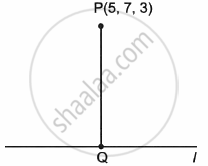
Now direction ratio of line PQ is
(3k + 15 – 5), (8k + 29 – 7), (– 5k + 5 – 3)
= 3k + 10, 8k + 22, – 5k + 2
and direction ratio of given line l are (3, 8, – 5)
∵ PQ ⊥ l
∴ 3(3k + 10) + 8(8k + 22) – 5(– 5k + 2) = 0
9k + 30 + 64k + 176 + 25k – 10 = 0
98k + 196 = 0
k = `(-196)/98` = – 2
Hence foot of perpendicular drawn on the given line is [3 × (– 2) + 15, 8 × (– 2) + 29, – 5 × (– 2) + 5] = (9, 13, 15).
APPEARS IN
संबंधित प्रश्न
Find the angle between the lines whose direction ratios are 4, –3, 5 and 3, 4, 5.
Show that the points (2, 3, 4), (−1, −2, 1), (5, 8, 7) are collinear.
Find the Direction Cosines of the Sides of the triangle Whose Vertices Are (3, 5, -4), (-1, 1, 2) and (-5, -5, -2).
Show that the points (2, 3, 4), (−1, −2, 1), (5, 8, 7) are collinear.
Show that the line through the points (1, −1, 2) and (3, 4, −2) is perpendicular to the line through the points (0, 3, 2) and (3, 5, 6).
Find the angle between the lines whose direction ratios are proportional to a, b, c and b − c, c − a, a− b.
Find the angle between the lines whose direction cosines are given by the equations
2l + 2m − n = 0, mn + ln + lm = 0
What are the direction cosines of Z-axis?
Write the ratio in which the line segment joining (a, b, c) and (−a, −c, −b) is divided by the xy-plane.
Write the inclination of a line with Z-axis, if its direction ratios are proportional to 0, 1, −1.
Write the angle between the lines whose direction ratios are proportional to 1, −2, 1 and 4, 3, 2.
Write the coordinates of the projection of point P (x, y, z) on XOZ-plane.
For every point P (x, y, z) on the x-axis (except the origin),
A parallelopiped is formed by planes drawn through the points (2, 3, 5) and (5, 9, 7), parallel to the coordinate planes. The length of a diagonal of the parallelopiped is
If the x-coordinate of a point P on the join of Q (2, 2, 1) and R (5, 1, −2) is 4, then its z-coordinate is
The distance of the point P (a, b, c) from the x-axis is
Ratio in which the xy-plane divides the join of (1, 2, 3) and (4, 2, 1) is
If O is the origin, OP = 3 with direction ratios proportional to −1, 2, −2 then the coordinates of P are
Verify whether the following ratios are direction cosines of some vector or not
`4/3, 0, 3/4`
Find the direction cosines of a vector whose direction ratios are
1, 2, 3
Find the direction cosines of a vector whose direction ratios are
0, 0, 7
Find the direction cosines and direction ratios for the following vector
`3hat"i" + hat"j" + hat"k"`
Find the direction cosines and direction ratios for the following vector
`5hat"i" - 3hat"j" - 48hat"k"`
If (a, a + b, a + b + c) is one set of direction ratios of the line joining (1, 0, 0) and (0, 1, 0), then find a set of values of a, b, c
The area of the quadrilateral ABCD, where A(0,4,1), B(2, 3, –1), C(4, 5, 0) and D(2, 6, 2), is equal to ______.
The d.c's of a line whose direction ratios are 2, 3, –6, are ______.
