Advertisements
Advertisements
प्रश्न
With the help of a neat circuit diagram, explain the working of a photodiode.
Advertisements
उत्तर

a. A photodiode is a special purpose P-N junction diode fabricated with a transparent window to allow light to fall on the diode.
b. When the photodiode is illuminated with light (photons) with energy h greater than the energy gap Eg of the semiconductor, then electron-hole pairs are generated due to the absorption of photons.
c. The diode is fabricated such that the generation of electron-hole pairs takes place in or near the depletion region of the diode.
d. Due to electric field of the junction, electrons and holes are separated before they recombine.
e. The direction of the electric field is such that electrons reach N-side and holes reach Pside. Electrons are collected on N-side and holes are collected on P-side giving rise to an e.m.f.
f. When an external load is connected, current flows. The magnitude of the photocurrent depends on the intensity of incident light.
g. It is easier to observe the change in the current with change in the light intensity, if a reverse bias is applied. Thus, photodiode can be used as a photodetector to detect optical signals.
संबंधित प्रश्न
Meeta's father was driving her to school. At the traffic signal, she noticed that each traffic light was made of many tiny lights instead of a single bulb. When Meeta asked this question to her father, he explained the reason for this.
Answer the following questions based on above information:
(i) What were the values displayed by Meeta and her father?
(ii) What answer did Meeta's father give?
(iii) What are the tiny lights in traffic signals called and how do these operate?
How is a Zener diode fabricated?
Explain with the help of a diagram, how depletion region and potential barrier are formed in a junction diode.
If a small voltage is applied to a p-n junction diode, how will the barrier potential be affected when it is (i) forward biased
If a small voltage is applied to a p-n junction diode, how will the barrier potential be affected when it is(ii) reveres biased?
Using the necessary circuit diagrams, show how the V-I characteristics of a p-n junction are obtained in
Forward biasing
How are these characteristics made use of in rectification?
Using the necessary circuit diagrams, show how the V-I characteristics of a p-n junction are obtained in
Reverse biasing
How are these characteristics made use of in rectification?
Carbon, silicon and germanium have four valence electrons each. These are characterised by valence and conduction bands separated by energy band gap respectively equal to (Eg)C, (Eg)Si and (Eg)Ge. Which of the following statements is true?
A p-n photodiode is fabricated from a semiconductor with band gap of 2.8 eV. Can it detect a wavelength of 6000 nm?
The width of depletion region of p-n junction diode is _______.
(A) 0.5 nm to 1 nm
(B) 5 nm to 10 nm
(C) 50 nm to 500 nm
(D) 500 nm to 1000 nm
State its any ‘two’ uses of photodiode.
Describe, with the help of a circuit diagram, the working of a photodiode.
Sunil and his parents were travelling to their village in their car. On the way his mother noticed some grey coloured panels installed on the roof of a low building. She enquired from Sunil what those panels were and Sunil told his mother that those were solar panels.
(a) What were the values displayed by Sunil and his mother? State one value for each.
(b) In what way would the use of solar panels prove to be very useful?
(c) Name the semiconductor device used in solar panels. Briefly explain with the help of a diagram, how this device works
Why is zener diode fabricated by heavily doping both p- and n-sides of the junction?
How is a photodiode fabricated?
Briefly explain its working. Draw its V - I characteristics for two different intensities of illumination ?
Draw V − I characteristics of a p-n junction diode. Answer the following questions, giving reasons:
(i) Why is the current under reverse bias almost independent of the applied potential up to a critical voltage?
(ii) Why does the reverse current show a sudden increase at the critical voltage?
Name any semiconductor device which operates under the reverse bias in the breakdown region.
The current in the forward bias is known to be more (~mA) than the current in the reverse bias (~μA). What is the reason, then, to operate the photodiode in reverse bias?
Draw the circuit diagram of a full wave rectifier using p-n junction diode.
Explain its working and show the output, input waveforms.
Describe briefly, with the help of a diagram, the role of the two important processes involved in the formation of a p-n junction.
What happens to the width of depletion player of a p-n junction when it is (i) forward biased, (ii) reverse biased?
Draw the circuit diagram of an illuminated photodiode in reverse bias. How is photodiode used to measure light intensity?
Draw the circuit arrangement for studying the V-I characteristics of a p-n junction diode in reverse bias. Plot the V-I characteristics in this case.
Write the important considerations which are to be taken into account while fabricating a p-n junction diode to be used as a Light Emitting Diode (LED). What should be the order of band gap of an LED, if it is required to emit light in the visible range? Draw a circuit diagram and explain its action.
Draw the V-I characteristics of an LED. State two advantages of LED lamps over convertional incandescent lamps.
Write the important considerations which are to be taken into account while fabricating a p-n junction diode to be used as a Light Emitting Diode (LED). What should be the order of the band gap of an LED, if it is required to emit light in the visible range? Draw a circuit diagram and explain its action.
What is a solar cell?
Draw solar cell V-I characteristics.
Explain the three processes involved in the working of a solar cell.
Name the device which converts the change in intensity of illumination to change in electric current flowing through it. Plot I-V characteristics of this device for different intensities. State any two applications of this device.
A p-n photodiode is fabricated from a semiconductor with a band gap of 2.5 eV. lt can detect a signal of wavelength ______.
Which one of the following is not the advantage of LED?
Consider the following statements (A) and (B) and identify the correct answer.
- A Zener diode is connected in reverse bias when used as a voltage regulator.
- The potential barrier of the p-n junction lies between 0.1 V to 0.3 V.
Read the following paragraph and answer the questions.
|
LED is a heavily doped P-N junction which under forward bias emits spontaneous radiation. When it is forward-biased, due to recombination of holes and electrons at the junction, energy is released in the form of photons. In the case of Si and Ge diode, the energy released in recombination lies in the infrared region. LEDs that can emit red, yellow, orange, green and blue light are commercially available. The semiconductor used for fabrication of visible LEDs must at least have a band gap of 1.8 eV. The compound semiconductor Gallium Arsenide – Phosphide is used for making LEDs of different colours.
|

- Why are LEDs made of compound semiconductor and not of elemental semiconductors?
- What should be the order of bandgap of an LED, if it is required to emit light in the visible range?
- A student connects the blue coloured LED as shown in the figure. The LED did not glow when switch S is closed. Explain why?

OR
iii. Draw V-I characteristic of a p-n junction diode in
(i) forward bias and (ii) reverse bias
Why a photo-diode is operated in reverse bias whereas the current in the forward bias is much larger than that in the reverse bias? Explain. Mention its two uses.
Briefly explain how emf is generated in a solar cell.
Draw solar cells of I-V characteristics.
Draw the circuit diagram of an illuminated photodiode and its I-V characteristics.
How can a photodiode be used to measure light intensity?
The value of power dissipated across the Zener diode (Vz = 15 V) connected in the circuit as shown in the figure is x × 10–1 watt. The value of x, to the nearest integer, is ______.

What energy conversion takes place in a solar cell?
Identify the special purpose diodes 'A', 'B' and 'C' from the given symbols.
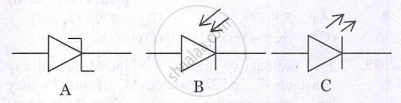
Select the wrong statement in the case of LED.
Consider the following statements A and B and identify the correct answer:
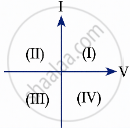
- For a solar-cell, the I-V characteristics lies in the IV quadrant of the given graph.
- In a reverse biased pn junction diode, the current measured in (A), is due to majority charge carriers.
