Advertisements
Advertisements
प्रश्न
Read the following paragraph and answer the questions.
|
LED is a heavily doped P-N junction which under forward bias emits spontaneous radiation. When it is forward-biased, due to recombination of holes and electrons at the junction, energy is released in the form of photons. In the case of Si and Ge diode, the energy released in recombination lies in the infrared region. LEDs that can emit red, yellow, orange, green and blue light are commercially available. The semiconductor used for fabrication of visible LEDs must at least have a band gap of 1.8 eV. The compound semiconductor Gallium Arsenide – Phosphide is used for making LEDs of different colours.
|

- Why are LEDs made of compound semiconductor and not of elemental semiconductors?
- What should be the order of bandgap of an LED, if it is required to emit light in the visible range?
- A student connects the blue coloured LED as shown in the figure. The LED did not glow when switch S is closed. Explain why?

OR
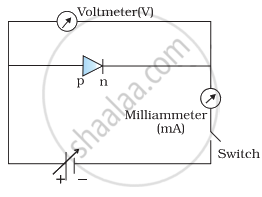
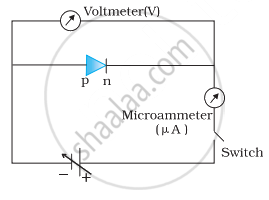
iii. Draw V-I characteristic of a p-n junction diode in
(i) forward bias and (ii) reverse bias
संक्षेप में उत्तर
Advertisements
उत्तर
- LEDs are made up of compound semiconductors and not by the elemental conductor because the band gap in the elemental conductor has a value that can detect the light of a wavelength which lies in the infrared (IR) region.
- 1.8 eV to 3 eV
- LED is reversed-biased that is why it is not glowing.
OR
iii. (i) forward bias -
(ii) reverse bias
shaalaa.com
क्या इस प्रश्न या उत्तर में कोई त्रुटि है?
