Advertisements
Advertisements
प्रश्न
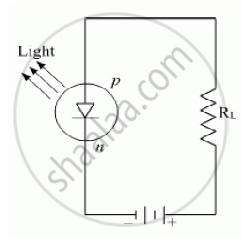
How does a light emitting diode (LED) work? Give two advantages of LED’s over the conventional incandescent lamps.
Advertisements
उत्तर
When we apply sufficient voltage to LED, electron move across the junction into the p-region and get attracted to the holes there. Thus, electrons and holes recombine. During each recombination, electric potential energy is converted into electromagnetic energy and a photon of light with a characteristic frequency is emitted, this is how LED works.
Advantage of LEDs over incandescent lamps
(1) Since LEDs do not have a filament that can burn out, they last longer.
(2) They do not get hot during use.
संबंधित प्रश्न
Using the necessary circuit diagrams, show how the V-I characteristics of a p-n junction are obtained in
Forward biasing
How are these characteristics made use of in rectification?
The current in the forward bias is known to be more (~mA) than the current in the reverse bias (~μA). What is the reason, then, to operate the photodiode in reverse bias?
Describe briefly, with the help of a diagram, the role of the two important processes involved in the formation of a p-n junction.
What happens to the width of depletion player of a p-n junction when it is (i) forward biased, (ii) reverse biased?
Draw the V-I characteristics of an LED. State two advantages of LED lamps over convertional incandescent lamps.
The wavelength and intensity of light emitted by a LED depend upon ______.
With reference to Semiconductor Physics,
Name the process that causes depletion region in a p-n junction.
What is the magnitude of the potential barrier across a Ge p-n junction?
Consider the following statements (A) and (B) and identify the correct answer.
- A Zener diode is connected in reverse bias when used as a voltage regulator.
- The potential barrier of the p-n junction lies between 0.1 V to 0.3 V.
If the resistance R1 is increased (Figure), how will the readings of the ammeter and voltmeter change?

