English

How Does a Light Emitting Diode (Led) Work? Give Two Advantages of Led’S Over the Conventional Incandescent Lamps. - Physics

Advertisements
Advertisements

Question

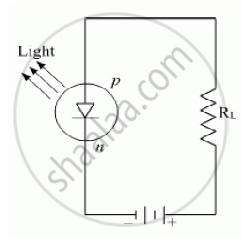
How does a light emitting diode (LED) work? Give two advantages of LED’s over the conventional incandescent lamps.

Advertisements

Solution

When we apply sufficient voltage to LED, electron move across the junction into the p-region and get attracted to the holes there. Thus, electrons and holes recombine. During each recombination, electric potential energy is converted into electromagnetic energy and a photon of light with a characteristic frequency is emitted, this is how LED works.

Advantage of LEDs over incandescent lamps

(1) Since LEDs do not have a filament that can burn out, they last longer.

(2) They do not get hot during use.
shaalaa.com
  Is there an error in this question or solution?
2011-2012 (March) Foreign Set 1

RELATED QUESTIONS

Colour of light emitted by LED depends upon__________________ .

  1. its forward bias
  2. its reverse bias
  3. the band gap of the material of semiconductor
  4. its size

If a small voltage is applied to a p-n junction diode, how will the barrier potential be affected when it is(ii) reveres biased?


With what considerations in view, a photodiode is fabricated? State its working with the help of a suitable diagram.

Even though the current in the forward bias is known to be more than in the reverse bias, yet the photodiode works in reverse bias. What is the reason?


Briefly explain its working. Draw its V - I characteristics for two different intensities of illumination ?


The current in the forward bias is known to be more (~mA) than the current in the reverse bias (~μA). What is the reason, then, to operate the photodiode in reverse bias?


Describe briefly, with the help of a diagram, the role of the two important processes involved in the formation of a p-n junction.


What happens to the width of depletion player of a p-n junction when it is (i) forward biased, (ii) reverse biased?


Explain the three processes involved in the working of a solar cell.


Consider the following statements (A) and (B) and identify the correct answer.

  1. A Zener diode is connected in reverse bias when used as a voltage regulator.
  2. The potential barrier of the p-n junction lies between 0.1 V to 0.3 V.

Why a photo-diode is operated in reverse bias whereas the current in the forward bias is much larger than that in the reverse bias? Explain. Mention its two uses.


Share
Notifications

Englishहिंदीमराठी


      Forgot password?
Use app×