Advertisements
Advertisements
प्रश्न
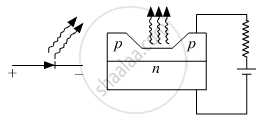
Write the important considerations which are to be taken into account while fabricating a p-n junction diode to be used as a Light Emitting Diode (LED). What should be the order of the band gap of an LED, if it is required to emit light in the visible range? Draw a circuit diagram and explain its action.
Advertisements
उत्तर
For the formation of LED direct bandgap semiconductors like GaAs, CdS, etc should be used which emits light. The p-n junction should be operated in forwarding bias. Most of the Light is produced in p-area of the device so while fabricating LED this area is kept close to the surface of the diode so that the minimum amount of energy is absorbed. One can use different materials for producing different colored Lights. The semiconductor used for the fabrication of visible LEDs must at least have a bandgap of 1.8 eV. The order of the band gap if it is required to emit light in the visible range is about 3 eV to 1.8 eV.
APPEARS IN
संबंधित प्रश्न
Meeta's father was driving her to school. At the traffic signal, she noticed that each traffic light was made of many tiny lights instead of a single bulb. When Meeta asked this question to her father, he explained the reason for this.
Answer the following questions based on above information:
(i) What were the values displayed by Meeta and her father?
(ii) What answer did Meeta's father give?
(iii) What are the tiny lights in traffic signals called and how do these operate?
How is a Zener diode fabricated?
If a small voltage is applied to a p-n junction diode, how will the barrier potential be affected when it is(ii) reveres biased?
With what considerations in view, a photodiode is fabricated? State its working with the help of a suitable diagram.
Even though the current in the forward bias is known to be more than in the reverse bias, yet the photodiode works in reverse bias. What is the reason?
Using the necessary circuit diagrams, show how the V-I characteristics of a p-n junction are obtained in
Reverse biasing
How are these characteristics made use of in rectification?
How does a light emitting diode (LED) work? Give two advantages of LED’s over the conventional incandescent lamps.
The plate resistance of a triode is 8 kΩ and the transconductance is 2.5 millimho. (a) If the plate voltage is increased by 48 V and the grid voltage is kept constant, what will be the increase in the plate current? (b) With plate voltage kept constant at this increased value, by how much should the grid voltage be decreased in order to bring the plate current back to its initial value?
What is a solar cell?
Explain photodiode.
Consider the following statements (A) and (B) and identify the correct answer.
- A Zener diode is connected in reverse bias when used as a voltage regulator.
- The potential barrier of the p-n junction lies between 0.1 V to 0.3 V.
