Advertisements
Advertisements
प्रश्न
What happens when D-glucose is treated with the following reagent?
HI
Advertisements
उत्तर
When D-glucose is heated with HI for a long time, n-hexane is formed.
\[\begin{array}{cc}
\ce{CHO}\phantom{...............................................}\\
|\phantom{..................................................}\\
\ce{(CHOH)4 ->[HI][\Delta] \underset{n-hexane}{CH3 - CH2 - CH2 - CH2 - CH2 - CH3}}\\
|\phantom{..................................................}\\
\ce{\underset{{D-glucose}}{CH2OH}}\phantom{..........................................}
\end{array}\]
APPEARS IN
संबंधित प्रश्न
How many moles of acetic anhydride will be required to form glucose pentaacetate from 2M of glucose?
(a) 2
(b) 5
(c) 10
(d) 2.5
Maltose is a
(a) Polysaccharide
(b) Disaccharide
(c) Trisaccharide
(d) Monosaccharide
Enlist the properties of glucose that can not be explained on the basis of open chain structure of it
Differentiable between the following:
Amylose and Amylopectin
Fill in the blanks by choosing the appropriate word/words from those given in the brackets:
(iodoform, acetaldehyde, positive, greater, acidic, acetone, disaccharide, negative, increases, glucose, decreases, chloroform, polysaccharide, lactose, lesser, basic, cationic hydrolysis, anionic hydrolysis)
Sucrose is a _________ and yields upon hydrolysis, a mixture of ________ and fructose.
What do you observe when glucose is treated with bromine water?
Write the reaction involved when D-glucose is treated with the following reagent:
Br2 water
Write the reactions involved when D-glucose is treated with the following reagent:
H2N-OH
The number of asymmetric carbon atom(s) below the figure is/are

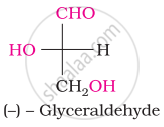
Glucose does not give Schiff’s test because of the formation of cyclic ____________.
Which one of the following compounds is different from the rest?
The number of chiral carbon atoms present in cyclic structure α-D(+) glucose:
The α-D glucose and β-D glucose differ from each other due to difference in carbon atom with respect to its ____________.
Choose the correct relationship for glucose and fructose:
Glucose with excess of phenyl hydrazine forms ______.
Give a reason for the following observations:
Penta-acetate of glucose does not react with hydroxylamine.
