Advertisements
Advertisements
प्रश्न
The character of King Richard I is presented in Ivanhoe not only with all his admirable qualities but also with his shortcomings. Elaborate with close reference to the text.
Advertisements
उत्तर
King Richard I is a real, historical guy. He ruled England from 1189 to 1199 and led the Third Crusade of Christian knights to the Middle East to fight against the Muslims holding Palestine. He spent most of his life at war with various people – the French, the peoples of the Middle East, his own dad. With all this fighting, King Richard built up a reputation for chivalry – for living according to the honor codes of medieval knighthood – that has lasted for over eight centuries. (You can read more about the real Richard.) As a character in Ivanhoe, it's almost as if King Richard is two different people. There is that historical King Richard, the one we just described, who draws Ivanhoe out of England to fight by his side in the Crusades. That King Richard doesn't appear much in the book, because he's being held captive in Germany and then making his way back to England. (This really happened; he was held for ransom by Leopold V of Austria.) It's the absence of that King Richard that makes Ivanhoe possible, since it frees up his brother, Prince John, to bully the Saxons and generally make things more difficult for Ivanhoe and his family. King Richard's other face in the novel is that of the Black Knight. That guy loves jests and drinking songs and hanging around with jokers like Wamba and Friar Tuck. He doesn't always take a lot of initiative against the Normans, which is how he gets his other nickname, the Black Sluggard ("sluggard" means "lazy person"). For example, at the tournament at Ashby-de-la-Zouche, he doesn't really participate until he sees Ivanhoe about to get killed in a three-on-one fight with Athelstane, Reginald Front-de-Boeuf, and Brian de Bois-Guilbert.
Still, when the Black Knight does jump into a fight, his mighty arm seems invincible. Later, when he joins the outlaws of Sherwood to storm Torquilstone. As Rebecca comments, "it is fearful, yet magnificent, to behold how the arm and heart of one man can triumph over hundreds". This is a guy who knows how to kick back and have a good time, but he's also ready to battle evil one-on-one when he sees it. Scott points outright to this conflict between our ideal of the heroic King Richard and the reality of his poor performance on the home front. When Richard tells the outlaws of Sherwood his true identity, he settles in for a long party with the guys. He doesn't want to take back his throne and responsibilities as king. It takes the encouragement of Locksley (Robin Hood) and Ivanhoe for King Richard I to get a move on and put down his brother John's rebellion. King Richard I always comes off better in ballads and legends than he does in history books.
APPEARS IN
संबंधित प्रश्न
Sounds are tiny vibrations that can travel through air and other materials. The loudness of a sound is measured in decibels (db).
Typical sound level in decibels:
(1) Silence 0db
(2) Rustle of leaves 10 db
(3) Breathing 10 db
(4) Radio music inside home 50-60 db
(5) Loud television 70 db
(6) Road traffic Noise 60-90 db
(7) Powerful rock music 100 db
(8) Motor cycle 105 db
(9) Heavy truck traffic 90-100 db
(10) Wind in the trees 20 db
OR
Read the following information and prepare a fact life:
Delhi, capital of India, has an area of 1,483 sq.km. Haryana and U.P are its neighbours. It has a literacy rate of 81.7%: (males 87.3 %, females 74.7%). People generally speak Hindi, Punjabi, Urdu and English. It is known for its Roshnara festival Shalimar, Qutab, mango festivals, garden Tourism and winter carnival.
What impression do you get of the children after reading the poem?
What bells are being referred to here? Why are they rung?
Thus I entered, and thus I go!
In triumphs, people have dropped down dead,
"Paid by the world, what dost thou owe
Me?"....God might question; now instead,
'Tis God shall repay: I am safer so.
Read the above lines and answer the question that follow.
Explain with reference to the context.
You had been waiting outside the examination hall. Describe what you saw and the sounds you heard when you arrived at the place. What were your feelings? Describe how the scene changed once you entered the hall and the examination started.
Your uncle has promised to give you a gift of Rs. 1000/-. Write a letter thanking him for the offer, tell him how you plan to spend the money; and why you wish to spend it in this way.
There are two voices in the poem. Who do they belong to? Which lines indicate this?
What does the phrase “strange to tell” mean?
‘A bird in hand is worth two in the bush’.
- Explain the above statement in the literal sense.
- Explain it in the context in which it is mentioned in the story.
- Is there a corresponding proverb in your own language?
The use of personal pronoun ‘I’ is evident and prominent in this poem. Give reasons.
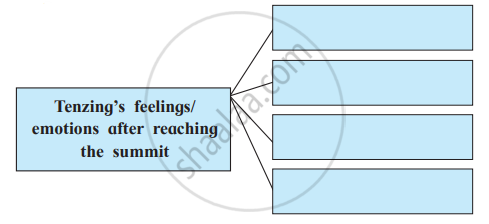
Complete the web highlighting the feelings/emotions of Tenzing after reaching the summit.
Complete the flow chart showing the events on the day of the assault.

‘Earth has not anything to show more fair.’
This line expresses the poet’s feelings. The sight he saw from the bridge is beautiful. There are a few more lines similar to the above. With the help of your partner find them and discuss what they express.
Write the appreciation of the poem.
- About the poem/poet/title
- Theme
- Poetic devices, language, style
- Special features/novelties/focusing elements
- Values, message
- Your opinion about the poem
The present review concludes with two words 'Heartwarming and enjoyable'. Write your opinion about 100 to 150 words.
Start a collection of proverbs. A proverb is a short, well-known sentence or phrase that gives advice or tells you what is generally true. For example, ‘A stitch in time saves nine’ means ‘If one does something in time or immediately, it saves a lot of work later’. A proverb is also known as a saying. Here are some proverbs for your collection.
- Appearances can be deceptive.
- Do not judge by appearance; a rich heart may be under a poor coat.
- All that glitters is not gold.
- You can’t tell a book by its cover.
- Clothes do not make the man.
Compare the Indian Monsoon season to a powerful king of a prosperous kingdom. Write down a few similarities. Use them to compose a poem of your own.
Answer the following question :
What are the most savage controversies about?
Have you experienced any unexpected turn of events in your life? What happened? How did you feel about it at that moment? How do you feel about it now?
Write an article for your school magazine describing your experience in about 150 words.
Here is a report on Uncle Lal’s farm.
Father took me to visit Uncle Lal’s dairy farm. I saw all of Uncle Lal's cows. He has fifty cows. They eat grass in the big green farms. In the evening the farmers bring them to the barn to be milked. Uncle Lal sells his milk in the city.
When writing a report, remember to do these things
|
In groups of four, write a report on different brands of ice creams available in your area.
You may use the following clues.
- Start with a short introduction that contains the topic.
- Then list the ice cream brands available in your area.
- Next, say which are the common flavors of ice cream in each of the brands.
- Under each brand, find out which flavors are being sold the most. Also, find out their prices.
- Finally, write which do you think is the most popular ice cream.
Find out when the International Day of Friendship is celebrated.
State whether the following statement are true or false
The cop suddenly slowed his walk, when he heard the barking of dogs.
State whether the following statement are true or false
The friends parted one night after watching a movie together.
Fill in the following forms with imaginary details.

‘Just one more installment and BABY’S REALLY OURS!’ This tells us that the couple
Which one of the following is correctly matched?
Do you like cartoons and cartoon films? Which one do you like best?
Show how Carol Ann Duffy presents a disturbing picture of confinement and exploitation in the poem, The Dolphins. Write your answer in about 200-250 words.
Write a composition (300-350 words) of the following:
Your teacher has asked you to form a group and work on a particular project. Write an account of how you worked together and what each of you learned from the experience.
Write a composition (in approximately 400 – 450 words) on the following subject.
Write an original short story that ends with the words "..….That is when they realised that sometimes, the most extraordinary stories begin with the simplest of moments."
