Advertisements
Advertisements
प्रश्न
How does G. K. Chesterton in his essay On Running after one's Hat, romanticize difficult situations by dwelling on the notion that "An inconvenience is only an adventure wrongly considered'"?
Advertisements
उत्तर
In our day to day life, we come across many situations good or bad. Every unfavourable situation whether it’s big or trivial, irritates most of us, most of the time. This research paper throws light on our attitude towards petty affairs in our daily routine. We start losing patience and getting irritated even for the least significant things. We unnecessarily stress ourselves very often. Instead of doing so if we take these least important things lightly, we can get rid of this irritation and distress. The study points out that instead of grumbling at these petty inconvenient situations, how can we enjoy these moments. It may sound strange but the fact is that it really happens. While encountering routine inconveniences, many people curse the system, the people concerned, the time, and even their own destiny and so on, on the other hand, some of us who are fun-loving, enjoy these moments. G.K. Chesterton’s essay ‘On Running After One’s Hat’ enriched with humour, is the perfect example of it. It helps us in accomplishing this task. Through this essay, he tries to convey a message to people that it is better to view annoying situations that occur (when not in our control) in our daily life with a little optimism. He gives several examples of annoying situations that people may find themselves involved in. Chesterton was of the opinion that even a very minor incident can provide us with pleasure in life if we have a positive attitude. There is an opportunity for fun and enjoyment in everything. Everything depends upon our attitude. It is our attitude that makes things convenient or inconvenient. He is of the opinion that when you have no choice and no control over the happenings, it’s better to handle them lightheartedly and with optimistic, romantic and comic vision. In “On Running After One’s Hat” and “The Romantic in the Rain” he argues that one should joyously and poetically transform the irritations of everyday life. In this lesson, he says that no matter it was flooded in London but he took this situation as the additional splendour of great sheets of water, where there must be something quite incomparable in the landscape (or waterscape) of in this romantic town. Some consider such romantic views of flood or fire slightly lacking in reality. But really this romantic view of such inconveniences is quite as practical as the other. The true optimist who sees in such things an opportunity for enjoyment is quite as logical and much more sensible than the ordinary. In the end, he says that everything depends upon the emotional point of view.
APPEARS IN
संबंधित प्रश्न
Explain the phrase ‘bliss of solitude’ in the context in which it has been used.
The eight other runners pulled up on their heels
The ones who had trained for so long to complete
one by one they all turned around and went back to help him
And brought the young boy to his feet.
Then all the nine runners joined hands and continued
The hundred-yard dash now reduced to a walk
And a banner above that said (Special Olympics)
Could not have been more on the mark.
That's how the race ended, with nine gold medals
They came to the finish line holding hands still
And a standing ovation and nine beaming faces
Said more than these words ever will.
Read the lines given above and answer the following question:
How did the spectators react to this gesture of the eight contestants?
Discuss trans-culturation as represented in Seattle’s speech.
Is the story Didactic and gives a moral?
How does Ray Bradbury develop the mood in “All Summer in a Day”?
Referring closely to the play, trace Don John's plots against Claudio and Don Pedro from their earliest beginnings. How do the plots end?
Give an account of how lies were against Snowball after his expulsion, in order to paint him as a traitor.
There has been heavy rain in your city/town. You went to school but found that it was closed because of the rain. Describe the sights and sounds near the school and narrate how you finally reached home and spent the rest of the day.
The sound words
Give reasons for the following.
Satyajit attending the village wedding.
Find out information about the Mahavastra of Maharashtra - Paithani.
Write an appreciation of the sonnet. Refer to the points to be covered for appreciation.
- About the poem/poet/title
- Theme
- Poetic devices, language, style
- Special features/novelties/focusing elements
- Values, message
- Your opinion about the poem
“Lend thy ears to all but few thy tongue”…. is a famous quote by William Shakespeare. Justify.
Write about your feelings and reactions in 4-5 lines.
You may describe your feelings and reactions using other words than those given here
Prepare and present a short speech on the following.
How I accomplished a difficult task.
Fill in the blank with choosing the preposition from the option.
He noticed the creeper ______ the foot of the tree.
Use the option to fill in the blank.
The children ______ happy.
Use the option to fill in the blank.
The flowers ______kept in a vase.
Fill in the blank with choosing the preposition from the option.
This tree was the home a flock ______ wild geese.
Describe the grandfather as seen in the portrait.
State whether the following statement are true or false
The friends grew up together in the city of New York.
Compare and contrast the character of Jimmy Wells and Bob with suitable references from the story to support your view.
Write conversation on the following situation.
Between a father and a son on choice of a career
Summarizing is to briefly sum up the various points from the notes made from the below passage.
The Sherpas were nomadic people who first migrated from Tibet approximately 600 years ago, through the Nangpa La pass and settled in the Solukhumbu District, Nepal. These nomadic people then gradually moved westward along salt trade routes. During 14th century, Sherpa ancestors migrated from Kham. The group of people from the Kham region, east of Tibet, was called “Shyar Khamba”. The inhabitants of Shyar Khamba, were called Sherpa. Sherpa migrants travelled through Ü and Tsang, before crossing the Himalayas. According to Sherpa oral history, four groups migrated out of Solukhumbu at different times, giving rise to the four fundamental Sherpa clans: Minyagpa, Thimmi, Sertawa and Chawa. These four groups have since split into the more than 20 different clans that exist today.
Sherpas had little contact with the world beyond the mountains and they spoke their own language. AngDawa, a 76-year-old former mountaineer recalled “My first expedition was to Makalu [the world’s fifth highest mountain] with Sir Edmund Hillary’’. We were not allowed to go to the top. We wore leather boots that got really heavy when wet, and we only got a little salary, but we danced the Sherpa dance, and we were able to buy firewood and make campfires, and we spent a lot of the time dancing and singing and drinking. Today Sherpas get good pay and good equipment, but they don’t have good entertainment. My one regret is that I never got to the top of Everest. I got to the South Summit, but I never got a chance to go for the top.
The transformation began when the Sherpa Tenzing Norgay and the New Zealander Edmund Hillary scaled Everest in 1953. Edmund Hillary took efforts to build schools and health clinics to raise the living standards of the Sherpas. Thus life in Khumbu improved due to the efforts taken by Edmund Hillary and hence he was known as ‘Sherpa King’.
Sherpas working on the Everest generally tend to perish one by one, casualties of crevasse falls, avalanches, and altitude sickness. Some have simply disappeared on the mountain, never to be seen again. Apart from the bad seasons in 1922, 1970 and 2014 they do not die en masse. Sherpas carry the heaviest loads and pay the highest prices on the world’s tallest mountain. In some ways, Sherpas have benefited from the commercialization of the Everest more than any group, earning income from thousands of climbers and trekkers drawn to the mountain. While interest in climbing Everest grew gradually over the decades after the first ascent, it wasn’t until the 1990s that the economic motives of commercial guiding on Everest began. This leads to eclipse the amateur impetus of traditional mountaineering. Climbers looked after each other for the love of adventure and “the brotherhood of the rope” now are tending to mountain businesses. Sherpas have taken up jobs as guides to look after clients for a salary. Commercial guiding agencies promised any reasonably fit person a shot at Everest.
Write a composition (300 - 350 words) on the following:
It is very important for young people to spend time quietly or alone for a short while every day. If you were given an hour to spend on your own, how will you spend it? What will you learn from the process?
Write a dialogue between a student and teacher on 'Importance of Yoga'.
You had to cycle home through the town on the day of a festival. Describe the sights, the sounds and the mood of the people around you. What were your feelings at the end of the ride?
What might success mean to the following people? Think about it and write.
A person who has applied for a job
Observe the tourist leaflets given and answer the following.
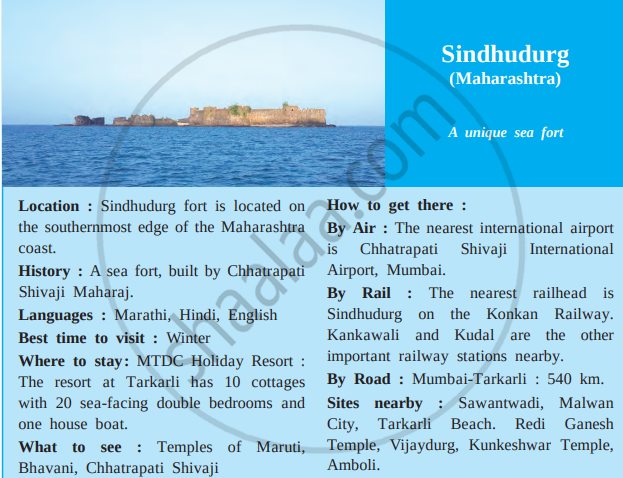

- Which places do these leaflets describe?
- What are the main points given in each leaflet?
- How can one reach Tadoba?
- Which is the best season to visit Tadoba? Why?
- List tourism-related words, e.g., tourist, booking etc.
Write a composition (in approximately 400 – 450 words) on the following subject.
You had to go on a train journey with your family. On reaching the railway station, you discovered that your train was delayed by two hours. Describe how you spent those two hours, detailing what you saw, the sounds you heard, and the interactions you had with the people around you. Express your feelings when you saw the train finally approaching the station.
