Advertisements
Advertisements
प्रश्न
Write conversation on the following situation.
Between a father and a son on choice of a career
Advertisements
उत्तर
| Father | Why don’t you take up B.E Information Technology? |
| Son | Dad, I am interested in music. |
| Father | It is good for entertainment. Will it give you a steady income? |
| Son | Dad, let me master music. I passionately love people. I may become a good musician. |
| Father | All can’t become like A.R. Rehman or Ilayara Raja. |
| Son | Dad, let me be myself. |
| Father | You are my only son. Will I suggest something bad for you? |
| Son | Dad, please suggest the dress in which I will look better. Suggest the food item which would suit me better. But, career option, please leave it to me. |
| Father | Do you really believe you can shine in the field of music? |
| Son | Dad, faith is life. Music is just not entertainment. |
| Father | OK. It is your life. Go to music college. |
| Son | Thanks, Dad. |
APPEARS IN
संबंधित प्रश्न
Have you are wondered why soldiers are always clad in green? This is to enable them to camouflage themselves during wartime. Hiding in the jungles, their green attire blends into the surrounding trees and shrubs, making it difficult for the enemies to spot them.
Long before man-made use of camouflaging, insects have already adopted the tactic of disguise to escape from the clutches of their predators. By having body colour close to those of the rocks and dried leaves, they can escape from being pursued by the predators.
Butterflies and moths have developed a variety of camouflage strategies since they are quite defenceless and their predators are abundant. Possessing wings which resemble dried leaves help certain butterflies and moths to hide among heaps of dried leaves when predators are around.
Fortunately, not all insects choose the art of disguise to escape from their predators; otherwise, the world would be so dull and colourless. There are insects which assimilate the bright body colours of bees and wasps to escape from being pursued by their predator. Long ago, birds have already learnt to avoid brilliantly coloured wasps and bees in fear of their painful stings. Hence, over millions of years, many harmless insects have assimilated the bees and wasps by imitating. their bright body colours and shapes. In this way, they appear dangerous and hence ward them off.
The beefy, not only appears like the bumblebee in terms of body colour, even its hums sound similar too. The only difference is that the beefy does not have a stirring and is hence harmless. The hoverfly is another insect which imitates. the body colours of the wasps. Their bodies are striped yellow and black. The only deviations are that hoverflies do not have stings, and they have only one pair of wings each while wasps have two pairs each. These variations are hardly noticed by the predators and hence help them to escape.
A1. Complete the table with the information from the passage : (2)
| Insects | Similarity | Difference |
| Bumblebee - Beefy | ||
| Wasp - Hoverfly |
A2. Complete the tree diagram : (2)

A3. Find out : (2)
‘Nature has given a self-protection mechanism to insects’.
Find out at least two examples from the passage to prove this statement.
A4. Vocabulary - (2)
Find the words from the passage for :
(i) animal or bird that hunts other for food
(ii) to get free from danger
(iii) to prevent something from harming
(iv) to make a copy
A5. Personal response - (2)
‘Soldiers disguise themselves to prevent enemies to spot them’.
Give two more examples when the disguising technique is used by humans.
A6. Grammar - (2)
Rewrite the following sentences in the ways instructed :
(i) They have only one pair of wings.
(Make it negative without changing the meaning)
(ii) Insects have already adopted the tactic of disguise to escape from the clutches of their predators.
(Replace infinitive with gerund and rewrite)
(B) Summary : (3)
Summarise the above extract with the help of the points given and suggest a suitable title.
Camouflage of soldiers and insects - reason and ways for disguising - assimilation of insects - need of imitation.
In what sense is the tree ‘the harvest of a coming age’?
Why does the bride have preference for yellow coloured bangles for her wedding morning?
What bells are being referred to here? Why are they rung?
Fill in the blank with an appropriate word:
The dog was hiding __________ the bed, barking at the stranger.
The delivery boy was requested to bring the parcel the next day. (Rewrite using direct speech)
With close reference to the story ‘The Bet’ by Anton Chekhov, mention the clauses of the bet as laid down between the young lawyer and the old banker. Give an account of the events that follow the bet .
Read the extract given below and answer the questions that follow:
“That only leaves October, November, and December,”’ said the Queen. "And after that, we shall have to begin all over again.”
“No, we shan’t,” said the King, “because I think twelve daughters are enough for any man and after the birth of dear little December I shall be reluctantly compelled to cut off your head.”
He cried bitterly when he said this, for he was extremely fond of the Queen.
(i) Why did the king change the names of his daughters so many times?
(ii) In what way was Princess September different from her sisters? What reason does the author give for this difference in their temperaments?
(iii) Which unusual birthday tradition did the King of Siam observe? Mention some of the gifts that he gave.
(iv) Why did Princess September put the Nightingale in a cage? What reasons did she give to the bird for putting it in a cage and then keeping it there?
(v) How did the bird behave upon being locked in a cage? What is the message of the story?
In what ways do you think we could help prevent the extinction of languages and dialects?
How has the author used the episode of the bank theft to comment on Satyajit's success in his career?
Locate instances of irony in the story.
The poet says, “Beauty is heard in …”
Can you hear beauty? Add a sound that you think is beautiful to the sounds the poet thinks are beautiful.
The poet, Keats, said:
Heard melodies are Sweet,
But those unheard are sweeter.
What do you think this means? Have you ever heard a song in your head, long after the song was sung or played?
Complete the flow chart showing the events on the day of the assault.

Compose four lines expressing the grief of having lost nature due to modernisation.
Given below is a list of words used to develop a CV or a Resume. Prepare a CV/Resume of your own.
Personal Information
- Name
- Address
- Date of birth
- Telephone / E-mail
- Nationality
- Marital status
Work Experience
- Experience/ Occupation / Position
- Employer / Employment History
- Internships
- Activities and responsibilities
Education
- Education and Training
- Primary school
- Secondary school
- Other qualification
Personal Skills and Competencies
- Competencies / Personal Competencies / Personal Skills/ Computer skills Mother tongue/ Other languages / Foreign languages
Write a newspaper article in about 100 words, comparing the achievements of the two sportswomen based on the information you have already collected.
Fill in the form given below.
POST OFFICE SAVING BANK
ACCOUNT OPENING/PURCHASE OF CERTIFICATE APPLICATION FORM FOR INDIVIDUALS

Write a formal email to Mr. Sundar Pitchai CEO of Google, requesting him for an appointment to interview him.
Trees can help you recognise seasons. How do the trees look different in each season? Write a short paragraph with the clues given below.
- Summer - Trees stretch their leafy branches towards the sun.
- Spring - Branches are full of new green leaves.
- Rain - Trees absorb water and look green.
- Autumn - Trees shed their leaves.
Here is a word, clock. Write down words relating to clock.

Now make sentences using some of the above words.
See the picture Travel Time below. Answer the questions that follow.
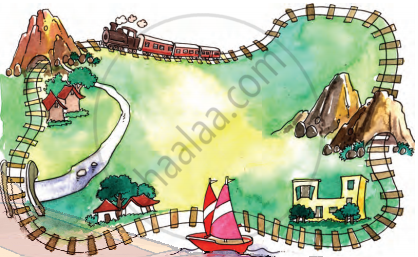
- Where did you go for an excursion/holiday?
- With whom did you go?
- What did you take with you?
- What was the first thing you saw when you reached your destination?
- What did you like best about the place?
- How long did you stay there?
- What did you miss about home?
Do you know that there are seven wonders in the world? Can you tell the name of the one which is in India? Find out and write the names of all the seven wonders and the countries they are located in.
| Wonders of the world | Countries | |
| (i) | The Taj Mahal | |
| (ii) | The Great Wall of China | |
| (iii) | ||
| (iv) | ||
| v) | ||
| (vi) | ||
| vii) |
You have recently attended a seminar on ‘Science and Literature’ in which writers presented papers on Science Fiction and Literature and focused on the creativity of young writers. Write a short report about it for a leading newspaper in about 100-120 words.
Write conversation on the following situation.
Between two friends about the importance of reading newspapers
What kind of relationship existed between Miss Meadows and the Science Mistress?
Write letter to your father asking permission to go on a educational tour.
What was the very first thing that the children noticed when it stopped raining on Venus in Ray Bradbury's story. 'All Summer in a Day'?
Prepare an attractive tourist leaflet for your native place, in English as well as in your mother tongue.
Using the given informal letter as a model, write a letter about the topic given below.
Write letter to your father asking permission to go on a educational tour.
