Advertisements
Advertisements
प्रश्न
The character of King Richard I is presented in Ivanhoe not only with all his admirable qualities but also with his shortcomings. Elaborate with close reference to the text.
Advertisements
उत्तर
King Richard I is a real, historical guy. He ruled England from 1189 to 1199 and led the Third Crusade of Christian knights to the Middle East to fight against the Muslims holding Palestine. He spent most of his life at war with various people – the French, the peoples of the Middle East, his own dad. With all this fighting, King Richard built up a reputation for chivalry – for living according to the honor codes of medieval knighthood – that has lasted for over eight centuries. (You can read more about the real Richard.) As a character in Ivanhoe, it's almost as if King Richard is two different people. There is that historical King Richard, the one we just described, who draws Ivanhoe out of England to fight by his side in the Crusades. That King Richard doesn't appear much in the book, because he's being held captive in Germany and then making his way back to England. (This really happened; he was held for ransom by Leopold V of Austria.) It's the absence of that King Richard that makes Ivanhoe possible, since it frees up his brother, Prince John, to bully the Saxons and generally make things more difficult for Ivanhoe and his family. King Richard's other face in the novel is that of the Black Knight. That guy loves jests and drinking songs and hanging around with jokers like Wamba and Friar Tuck. He doesn't always take a lot of initiative against the Normans, which is how he gets his other nickname, the Black Sluggard ("sluggard" means "lazy person"). For example, at the tournament at Ashby-de-la-Zouche, he doesn't really participate until he sees Ivanhoe about to get killed in a three-on-one fight with Athelstane, Reginald Front-de-Boeuf, and Brian de Bois-Guilbert.
Still, when the Black Knight does jump into a fight, his mighty arm seems invincible. Later, when he joins the outlaws of Sherwood to storm Torquilstone. As Rebecca comments, "it is fearful, yet magnificent, to behold how the arm and heart of one man can triumph over hundreds". This is a guy who knows how to kick back and have a good time, but he's also ready to battle evil one-on-one when he sees it. Scott points outright to this conflict between our ideal of the heroic King Richard and the reality of his poor performance on the home front. When Richard tells the outlaws of Sherwood his true identity, he settles in for a long party with the guys. He doesn't want to take back his throne and responsibilities as king. It takes the encouragement of Locksley (Robin Hood) and Ivanhoe for King Richard I to get a move on and put down his brother John's rebellion. King Richard I always comes off better in ballads and legends than he does in history books.
APPEARS IN
संबंधित प्रश्न
FOR SALE
In the following items, sentence A is complete, while sentence B is not. Complete sentence B, making it as similar as possible to sentence A. Write sentence B.
(A) As soon as the bell rings, the children run out to play.
(B) No sooner __________________________________.
How does the poem relate to our study of the Diary of Anne Frank and the events of the Holocaust?
Is there any significance of the logs of wood in the hands of the six people?
Do you agree with his justification of the war? Why/ why not?
What does Wordsworth compare himself to? Why?
Who won the race and how? Explain in about 50 words.
Make a critical appreciation of the short story, “A Horse and Two Goats,” by R.K. Narayan.
Discuss the theme of supernatural and paranormal as presented in the story?
List the pair of opposites found in the poem.
Below is a topic for essay writing. Follow the steps listed above to write on this topic.
Human Population Grows Up
Discuss in groups of four.
“Are we to leave our successors a scorched planet of advancing deserts, impoverished landscapes and an ailing environment?”
Explain the following phrase
Sure as eggs
Use it in a sentence of your own.
Go to your college library or surf the internet for names of various mountaineers who have successfully climbed Mt. Everest. Write in your notebook about their struggles, the interesting anecdotes they have shared, their failures, and the message that we get from their lives. Submit them to your teacher.
What is the meaning of ‘intellectual rubbish’?
Form groups of 5. Find at least two fairy tales/folk tales each and share them with other members of your group. Make a collection of 10 different stories in each group.
Write a complete review on any book that you have read recently. Use the following points for your Book Review.
- Introduction
- Selectivity of contents
- Subject/Title Apporpriacy
- Sequence of Contents
- Language Appropriacy/Type
- Good Points/Novelty in the book
- Advantages/Scope of the book. (if any)
- Demerits/Shortcomings (if any)
- Message/Opinion/Views (Personal)
- Conclusion (in short)
You are the receptionist of your school. Your Head master instructs you to send a message to all the parents of class ten to attend a PTA (Parent-Teacher Association) meet which is to be held on 22.12.2019
|
______________________________ ______________________________ ______________________________ ______________________________ |
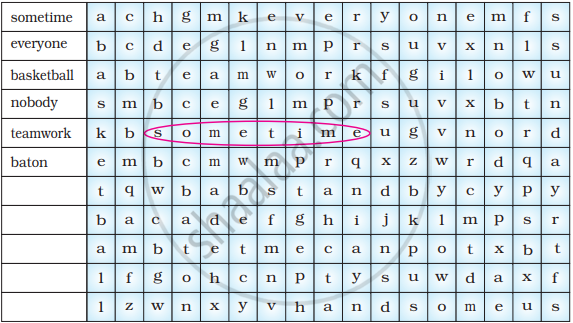
In the puzzle find the words given in the column. Notice that these words are formed by joining two words. One is done for you.
Find some more such words.
Fill in the blank by choosing the preposition from the option.
The children walked ______ the bridge.
Rewrite the passage below using capital letters where necessary
oh dear said the fir tree I like my old needle-like leaves best for goats don't eat them and no man can steal them
Which of the following would you expect a carpenter to use at work?
bench, poker, plane, chisel, fork, spade, blotting paper, lawn-mower, telescope, pincers, jaw, scissors, hammer, map, nails, lathe, pencil, anvil.
Describe the man awaiting the arrival of his friend.
Bring out the people’s reaction to the noises from the surgery.
What was the knife that Miss Meadows carried with her?
You have been given a small sum of money to buy a gift with for a friend. What gift would you choose (specify) and why would you choose this? Write a letter to your friend telling him/her about the gift and how it will benefit him/her.
Write letter to your father asking permission to go on a educational tour.
School examinations do not test intelligence. Express your views either for or against this statement
Imagine someone has invited your family to a programme and you were the only person at home when the invitation was given orally.
Write a note (4-5 lines) to pass on the message to the other people in your family. Or, Write an imaginary conversation in which you pass on the message to your parents.
Using the given informal letter as a model, write a letter about the topic given below.
Write a letter to your father asking permission to go on an educational tour.
