Advertisements
Advertisements
प्रश्न
The author’s grandmother was a religious person. What are the different ways in which we come to know this?
Advertisements
उत्तर
The author’s grandmother was a religious lady with a kind heart. She moved about in the house “telling the beads of her rosary”. Her lips constantly moved in “inaudible prayer”. She said her morning prayers in monotonous sing-song hoping that the author would learn it by heart. Every day, she went along with the author to his school and sat in the temple that was attached to it, reading the holy books for hours. She believed in the teachings about God and scriptures and did not like that her grandson was not taught about them in the city school. Gradually, she turned to recite prayers throughout the day. Before dying, she stopped talking to her family members and turned to prayers, and counting the beads.
APPEARS IN
संबंधित प्रश्न
Answer the following question in 200-250 words:
What is the main theme of 'The Diary of a Young Girl'?
Mention three ways in which the author’s grandmother spent her days after he grew up.
Discuss the following statement in groups of two pairs, each pair in a group taking opposite points of view.
Why do you think Professor Gaitonde decided never to preside over meetings again?
How do the words in bold, in the lines below, illustrate the poet’s ability to convey criticism cryptically?
Our meddling intellect
Misshapes the beauteous forms of things:
We murder to dissect.
Discuss the following in pairs or in groups of four:
“Tribal arts are not specifically meant for sale.” Does this help or hamper their growth and preservation?
Love is presented as the subject or the doer of actions in the poem. Why do you think the poet has used this form rather than involving human agents?
Why is the poem entitled 'Hawk Roosting'?
Fill in the blank.
Baban’s father and some elders mentioned the name of __________.
What decision taken by Dick changed his fortune?
Go through the text again and find the reasons that forced Peter to shoot down a person.
- The keepers spotted him.
- _________________________
- _________________________
Write down any two Slogans on 'Gender Equality'.
State whether the following statement is True or False. Correct the false statement by finding evidence from the poem to support your remark.
The cherry tree did not take long to grow.
Discuss in groups, reasons/ consequences/ effects:
The life of the cherry tree was threatened.
Discuss in groups, reasons/ consequences/ effects:
The cherry blossomed.
Sue and Johnsy were very close friends.
Think and answer in your own words.
What could have inspired the poet to compose this poem? Do you think it relates to our present-day life? Defend your choice.
Read the poem and complete the web about the activities the planners do.

Answer the following question in short.
Why did Pundit Shahane visit Vijaynagar?
Answer the following question in short.
What punishment did the emperor threaten the Pundits with?
Discuss the question after you have seen a presentation of the ‘ad’.
What does the ad tell you?
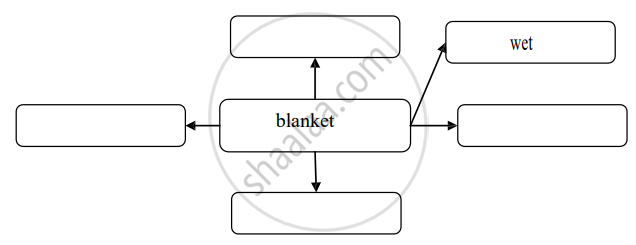
Draw word webs for the following. Begin with the given word and go on writing as many other words associated with it, as you can. Use these words to write other related words to form a word web.

Choose the appropriate phrase to insert in the gap, to make the sentence meaningful. Use the appropriate form of the verb.
Before we do the experiment in the Laboratory, let me ______ you all about it.
Write in your own words.
How does the poet glorify his home in the first stanza?
Who said the following, to whom, and when?
“O Holy Master, bless us with thy song !”
Find the meaning of the following word.
abused
Does Marouckla get any of the things she brings?
Make a list of the rhyming words in the poem.
Add one more rhyming word of your own to each pair.
Guess the meaning of on the wing.
Answer the question in a paragraph of about 100 – 150 word.
Narrate how Prospero made his enemies repent to restore his dukedom.
Use this passage to play the game. You can collect information on other famous personalities and play too.
Charlie Chaplin was born on April 16, 1889, in London England. His birth name was Charles Spencer Chaplin, though he had many nicknames growing up such as Charlie, Charlot, and The Little Tramp. His father, Charles Chaplin, and his mother, Hannah Chaplin, were inducted into the music hall of fame, leading the way to his exposure even as a young boy. His first onstage moment was when he was 5 years old; he sang a song that was intended to be sung by his own mother; she had become ill at the time of the performance, so little Charlie Chaplin stood instead and performed for his mother.

Charlie Chaplin came to the United States in 1910, at the age of 21. He was brought to New York, which was known to be a great place to start out for anyone trying to become a professional actor. Two years later, in 1913, Chaplin signed his very first contract at Keystone and it was no time before he headed to Hollywood. His first movie premiered in 1914, “Making a Living,” and went on to make over 35 movies total in that year alone. Charlie Chaplin grew to become one of the most popular and successful actors of all time. The moment that really kicked off his long career was in 1921 when he starred in, and produced, his first full-length film called “The Kid.” From then on, most people all over the world knew Charlie Chaplin and loved his movies. He had a great career and life, dying on December 25, 1977, in Vevey, Switzerland. He had apparently died of natural causes in his sleep from old age.
Read the story again and write how these character reacted in these situation:
It’s Somu’s thoughtless ways that reduce me to tears. Mrs. Krishnan …………………....…..
Dr. Krishnan ……………..…......…….
Discuss with your partner and complete the table.
| S.No. | Question | Who asked this? | Who answered? | What was the answer? |
|
1. |
Shall we run back together? | |||
| 2. | Can you see something behind the wall? | |||
| 3. | Who said good bye? | |||
| 4 | Was it just the wind? |
Teachers help me to learn ______ things.
- new
- bad
- difficult
How does the ability to question help us?
Read the poem aloud in pairs
The terrorists asked Neerja to collect the passports of the passengers because ______.
Who is Muthu?
What did mother ask Raj to buy?
Identify the speaker/character.
"Don't let us down now, Gulliver; we need your help."
What did Nilavan see through the window?
Try your own.

How did the old man disguise himself?
Identify the character or the speaker.
“I hope he is safe.”
Why was the fish floating on top?
Answer using Yes or No and pick sentence from the story to support your answer.
Do cannibals eat people?
Who is the hero of this story?
Why did Robinson name the tribe Friday?
The old man was carrying _____.
Choose and write the adverbs to complete the sentence.

She coloured the picture ____.
Read the passage carefully and answer the following question.
What did the farmer find in the field?
Match the rhyming words.
| 1. | say | fall |
| 2. | go | day |
| 3. | all | grow |
A person who overcomes problems, will get ______ at the end.
Which creatures wake up in the morning before the child does?
What sort of a boy is described in the poem?
What happens when the day is over?
Who agreed to help Helen?
Choose the right word.
The tamarind tree grows over Tansen’s ______.
Write the related words as shown in the example.
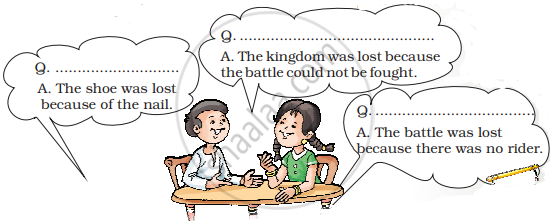
Read the poem.
For Want of a Nail
For want of a nail, the shoe was lost,
For want of a shoe the horse was lost,
For want of a horse, the rider was lost,
For want of a rider, the battle was lost,
For want of a battle, the kingdom was lost,
And all for the want of a horseshoe nail!
[traditional rhyme]
Now form questions for the answers given in the speech bubbles.
On the basis of your understanding of the given passage, make notes in any appropriate format.
The Sherpas were nomadic people who first migrated from Tibet approximately 600 years ago, through the Nangpa La pass and settled in the Solukhumbu District, Nepal. These nomadic people then gradually moved westward along salt trade routes. During 14th century, Sherpa ancestors migrated from Kham. The group of people from the Kham region, east of Tibet, was called “Shyar Khamba”. The inhabitants of Shyar Khamba, were called Sherpa. Sherpa migrants travelled through Ü and Tsang, before crossing the Himalayas. According to Sherpa oral history, four groups migrated out of Solukhumbu at different times, giving rise to the four fundamental Sherpa clans: Minyagpa, Thimmi, Sertawa and Chawa. These four groups have since split into the more than 20 different clans that exist today
Sherpas had little contact with the world beyond the mountains and they spoke their own language. AngDawa, a 76-year-old former mountaineer recalled “My first expedition was to Makalu [the world’s fifth highest mountain] with Sir Edmund Hillary’’. We were not allowed to go to the top. We wore leather boots that got really heavy when wet, and we only got a little salary, but we danced the Sherpa dance, and we were able to buy firewood and make campfires, and we spent a lot of the time dancing and singing and drinking. Today Sherpas get good pay and good equipment, but they don’t have good entertainment. My one regret is that I never got to the top of Everest. I got to the South Summit, but I never got a chance to go for the top.
The transformation began when the Sherpa Tenzing Norgay and the New Zealander Edmund Hillary scaled Everest in 1953. Edmund Hillary took efforts to build schools and health clinics to raise the living standards of the Sherpas. Thus life in Khumbu improved due to the efforts taken by Edmund Hillary and hence he was known as ‘Sherpa King’.
Sherpas working on the Everest generally tend to perish one by one, casualties of crevasse falls, avalanches, and altitude sickness. Some have simply disappeared on the mountain, never to be seen again. Apart from the bad seasons in 1922, 1970 and 2014 they do not die en masse. Sherpas carry the heaviest loads and pay the highest prices on the world’s tallest mountain. In some ways, Sherpas have benefited from the commercialization of the Everest more than any group, earning income from thousands of climbers and trekkers drawn to the mountain. While interest in climbing Everest grew gradually over the decades after the first ascent, it wasn’t until the 1990s that the economic motives of commercial guiding on Everest began. This leads to eclipse the amateur impetus of traditional mountaineering. Climbers looked after each other for the love of adventure and “the brotherhood of the rope” now are tending to mountain businesses. Sherpas have taken up jobs as guides to look after clients for a salary. Commercial guiding agencies promised any reasonably fit person a shot at Everest.
