Advertisements
Advertisements
प्रश्न
Give reasons for the following statement.
The author thought that his positive thinking strategy worked well after all.
Advertisements
उत्तर
The other afternoon when the author sat pondering his options over a glass of tea in the only café of Darchen. He was wondering if he could do the Kora alone, he had no idea whether the snow had cleared. Also, Tsetan had left and there was no one, who knew English well enough, to communicate. Despite all odds, the author forced himself to think positive and tried to be hopeful. Then he met Norbu, he had seen the book the author was reading. Then he came and asked the author if he was English. The author judged from Norbu's clothes that he did not belong to those parts. He had come to complete the Koraas well. He worked in Beijing at the Chinese Academy of Social Sciences, in the Institute of Ethnic Literature, he had been writing academic papers about the Kialish Kora and its importance in various works of Buddhist literature for many years. Norbu suggested that he and the author could be a team and this brought hope to the author; perhaps his positive-thinking strategy was working after all.
APPEARS IN
संबंधित प्रश्न
B1. Find reasons
(i) The effect of receding forest …………………………………. .
(ii) The number of animals is reduced because ………………………. .
(iii) Elephants entered the city because…………………… .
(iv) Elephants lived a wary life …………………….. .
On the left bank of the Ganga, where it emerges from the Himalayan foothills, there is a long stretch of heavy forest. There are villages on the fringe of the forest, inhabited by bamboo cutters and farmers, but there are few signs of commerce or pilgrimage. Hunters, however, have found the area an ideal hunting ground during the last seventy years, and as a result, the animals are not as numerous as they used to be. The trees, too, have been disappearing slowly; and, as the forest recedes, the animals lose their food and shelter and move further on into the foothills. Slowly, they are being denied the right to live
Only the elephants can cross the river. And two years ago, when a large area of the forest was cleared to make way for a refugee resettlement camp, a herd of elephants - finding their favourite food, the green shoots of the bamboo, in short supply - waded across the river. They crashed through the suburbs of Haridwar, knocked down a factory wall, pulled down several tin roofs, held up a train, and left a trail of devastation in their wake until they found a new home in a new forest which was still untouched. Here, they settled down to a new life but an unsettled, wary life. They did not know when men would appear again, with tractors,bulldozers and dynamite.
B2. Find out
Mention four things the elephants did when they found shortage of food:
(i)………………
(ii)………
(iii) …………
(iv) ………….
B3.Phrases
Make meaningful sentences by selecting any two of the following phrases:
(i) to make way for
(ii) in short
(iii) on the fringe of.
B4. Language study
Select the proper alternative to make the correct voice:
(i) Hunters have found an ideal hunting ground.
-An ideal hunting ground ........found by hunters. (had been, has been, was)
(ii) They are being denied the right to live.
- The people ........them the right to live. (are denying, were denying, denying)
B5.Personal response
What would be your contribution to protect the natural habitat of animals?
A1. (i) Two activities that mother was free to do:
(a)...........................................
(b)............................................
(ii)Two activities that children avoided doing because of television:
(a) .....................................
(b) ...................................
Oh yes, we know it keeps them still,
They don't climb out the window sill,
They never fight or kick or punch,
They leave you free to cook the lunch
And wash thedishes in the sink
But did you ever stop to think,
To wonder just exactly what
This does to your beloved tot?
It rots the sense in the head!
It kills imagination dead!
It clogs and clutters up the mind!
It makes a child so dull and blind
He can no longer understand
A fantasy, a fairyland!
His brain becomes as soft as cheese!
His power of thinking rust and freeze!
He cannot think - He only sees!
'All right!' you'll cry. 'All right!' you'll say,
'But if we take the set away,
What shall-we do to entertain
Our darling children? Please explain!'
We'll answer this by asking you,
'What used the darling ones to do?'
'How used they keep themselves contented
Before this monster was invented?'
Have you forgotten? Don't you know?
A2. According to the poem, why is excessive watching of TV harmful?
A3. His brain became as soft as cheese. The figure of speech is ..........because............
Answer any four of the following questions in 30 – 40 words each :
(a) After initial reluctance why did the lawyers tell Gandhiji that they were ready to follow him into jail?
(b) What is Mukesh's attitude towards the family business of making bangles?
(c) How does the poet show the futility of Aunt Jennifer's efforts?
(d) Stephen Spender in his poem, 'An Elementary School Classroom in a Slum' paints a dismal picture of poverty. Comment.
(e) Jackson went through the contents of Rev. McLeery's suitcase. Which object therein puzzled him sorely? What was his comment on that?
(f) How did the servants react when they realized that Dr. Sadao was going to save the life of an enemy?
Answer any four of the following questions in 30-40 words each:
(a) How could the peddler enter the forge without being noticed by the blacksmith?
(b) At Champaran what did the British landlords want from the sharecroppers?
(c) How does the poet show the futility of Aunt Jennifer's efforts?
(d) Stephen Spender in his poem, 'An elementary School Classroom in a Slum' paints a dismal picture of poverty. Comment.
(e) How did Evans have the last laugh at the Governor?
(f) How did the General plan to get rid of the American POW?
Answer any three of the following in 30-40 words each:
(a) Why has the poet’s mother been compared to the ‘late winter’s moon’?
(b) The poet says, ‘And yet, for these Children, these windows, not this map, their world.’ Which world do these children belong to? Which world is inaccessible to them?
(c) What was the plea of the folk who had put up the roadside stand?
(d) What will happen to Aunt Jennifer’s tigers when she is dead?
‘The Tale of Melon City’ has been narrated in a verse form. This is a unique style which lends extra charm to an ancient tale. Find similar examples in your language. Share them in the class.
Identify some of the improbable images the author has used to effect greater humour.
While tribal communities may not seem to possess the scientific temper,there are many ideas from tribal conventions that could enrich modern societies.
How do you respond to these lines?
Light, chill and yellow,
Bathes the serene
Foreheads of houses
How is colour highlighted in the poem and why? List all the words in the poem that suggest colour.
Many sentences and paragraphs in the excerpt begin with the word ‘And’. To what extent does this contribute to the rhetorical style of the lecture?
Read the following statement and mark those that apply to you.
I have a small group of close friends and have no wish to interact with anyone else.
Read the story and complete the following.
Revathi won the prize for the ‘Best plant’ because, ____________.
Answer in your own words.
Why did she decide to keep her new knowledge ‘a secret’?
Find evidence from the lesson and write in your own words.
In Israel, the media have a positive outlook and self-respect.
Answer the given question in your own words.
Why did the swallow decide to stay under the statue of the Happy Prince at night?
When we look at the sky, we find several objects. They stand for something or the other. Complete the following table by finding the significance of the given objects. One example is given to you.
| Celestial Bodies | Association |
| The Sun | Power, Heat, Energy, Commitment, etc. |
| The Moon | |
| The Rainbow | |
| The Stars |
In Gujarat, the kite - festival is celebrated to welcome the Spring.
The last leaf fell off during the rain.
Go through the poem and state whether the following statement is true or false.
Planners make tactful changes so that citizens do not recognize familiar landmarks.
Go through the text again to understand the important features of blogs. Discuss various blogs and their features with your friends.
A blog helps us to express our - ___________.
- Feelings
- _________
- _________
- _________
Form groups and discuss the following question:
Why are the clothes compared to living things?
Compare the features of a comedy and tragedy.
State whether the following statement is True or False:
Lysander and Demetrius fall in love with Helena as a result of the love potion.
Explain the use of the following property in the development of the play.
Stick
Discuss the following question after you have seen a presentation of the ‘ad’.
How many times is the name Krispy Krunchy repeated in the ad? Why?
Who do you think benefits most from commercial advertisements?
Find what Hirabai tells the traveller by reading her words from right to left.
Complete the following using your own idea:
His head was too big to ______.
Write a short note on the following:
Prince Siddharth’s protected life.
Read the following proverb that has a biblical reference.
‘Do unto others as you would have others do unto you.’ Now find at least 5 other proverbs/ axioms/quotations which convey the same message. Search the internet/dictionary of proverbs.
Prepare similar word chains using the following ideas.
size - big _______________.
Choose the appropriate phrase to insert in the gap, to make the sentence meaningful. Use the appropriate form of the verb.
Before we ______ let us stand in attention for the National Anthem.
Write in your own words.
How should that person sing?
Write out a few things that you would really miss about your home if you were to stay away from it for long.
Imagine you are one of the three brothers. Write in short what you did with the rice.
Read the word. Write the words that combine to make it.
snowwhite
List and say whether the following statement agrees with the passage or not.
You should try to talk most of the time whenever there is a discussion.
What did the Judge tell Ahmad?
Make a collection of Rangoli motifs and patterns.
Write about each motif or pattern in your own words -
it could just be a label or a description or some information or comment.
Identify the character or speaker.
I will soon move you.
Which theory of Ramanujan helps the ATMs to dispense cash?
What should we learn from our teachers?
The author did not want to plant saplings in the forest because______.
The boy was so inspired by Mithali that he was happy for his sister to play cricket.
The girl admitted to her brother that she was badly frightened.
Match the rhyming words.
| filth | farmer |
| cook | harm |
| charm | wealth |
| armour | look |
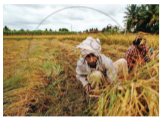
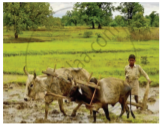
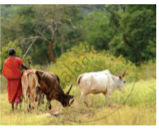
| Mr. Murugan is a farmer. He has a small piece of land and two bulls. He takes good care of his bulls as they help him in farming. Every morning, he takes the bulls for grazing. When it rains he ploughs the land with the bulls. As he has no one to help he starts sowing the seed before sunrise. He irrigates the crop till it grows. He reaps and binds the crop then takes it to thrash the paddy. Finally, with the help of the bulls, he takes the paddy to his house. |
Name the actions of Murugan.
 |
|
 |
|
 |
What does it sing?
Look at the picture and Choose the correct word.

The hen-pigeon got dry _______ for the bird catcher.
Look at the picture and tick choose the correct word.

______always stays to the last in our needs.
Who brought us to this world?
Moles dig ______ to catch earth worms.
Recite any 4 lines of the poem with intonation.
Senthil bought a ______ from his savings.
Draw me some hair, quickly, I look like a ______.
What do you think birds say to each other in the morning?
Who was burning with curiosity?
