Advertisements
Advertisements
प्रश्न
Find the co-ordinates of the foot of perpendicular drawn from the point A(1, 8, 4) to the line joining the points B(0, –1, 3) and C(2, –3, –1).
Advertisements
उत्तर
Let L be the foot of perpendicular drawn from the points A (1, 8, 4) to the line passing through B and C as shown in the Figure.
The equation of line BC by using formula `vecr = veca + lambda(vecb - veca)`, the equation of the line BC is
`vecr = (-hatj + 3hatk) + lambda(2hati - 2hatj - 4hatk)`
⇒ `xhati + yhati + xhatk = 2lambdahati - (2lambda + 1)hati + lambda(3 - 4lambda)hatk`
Comparing both sides, we get
`x = 2lambda, y = -(2lambda + 1), z = 3 - 4lambda` ......(1)
Thus, the co-ordinate of L are `(2lambda, -(2lambda + 1), (3 - 4lambda)`
So that the direction ratios of the line AL are `(1 - 2lambda), 8 + (2lambda + 1), 4 - (3 - 4lambda)`
i.e. `1 - 2lambda, 2lambda + 9, 1 + 4lambda`
Since AL is perpendicular to BC, we have
(1 – 2λ) (2 – 0) + (2λ + 9) (–3 + 1) + (4λ + 1) (–1 –3) = 0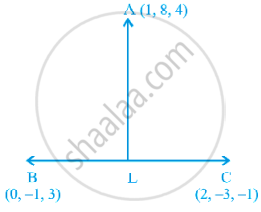
⇒ `lambda = (-5)/6`
The required point is obtained by substituting the value of λ, in (1), which is `((-5)/3, 2/3, 19/3)`.
APPEARS IN
संबंधित प्रश्न
Name the octants in which the following points lie: (5, 2, 3)
Name the octants in which the following points lie:
(4, –3, 5)
Name the octants in which the following points lie:
(–5, –4, 7)
Name the octants in which the following points lie:
(2, –5, –7)
Find the image of:
(–2, 3, 4) in the yz-plane.
Find the image of:
(–5, 4, –3) in the xz-plane.
Find the image of:
(5, 2, –7) in the xy-plane.
Find the image of:
(–5, 0, 3) in the xz-plane.
A cube of side 5 has one vertex at the point (1, 0, –1), and the three edges from this vertex are, respectively, parallel to the negative x and y axes and positive z-axis. Find the coordinates of the other vertices of the cube.
Determine the points in zx-plane are equidistant from the points A(1, –1, 0), B(2, 1, 2) and C(3, 2, –1).
Find the points on z-axis which are at a distance \[\sqrt{21}\]from the point (1, 2, 3).
Prove that the point A(1, 3, 0), B(–5, 5, 2), C(–9, –1, 2) and D(–3, –3, 0) taken in order are the vertices of a parallelogram. Also, show that ABCD is not a rectangle.
Find the locus of P if PA2 + PB2 = 2k2, where A and B are the points (3, 4, 5) and (–1, 3, –7).
Are the points A(3, 6, 9), B(10, 20, 30) and C(25, –41, 5), the vertices of a right-angled triangle?
Find the ratio in which the sphere x2 + y2 + z2 = 504 divides the line joining the points (12, –4, 8) and (27, –9, 18).
Write the distance of the point P (2, 3,5) from the xy-plane.
Write the distance of the point P(3, 4, 5) from z-axis.
The coordinates of the foot of the perpendicular drawn from the point P(3, 4, 5) on the yz- plane are
The x-coordinate of a point on the line joining the points Q(2, 2, 1) and R(5, 1, –2) is 4. Find its z-coordinate.
Find the coordinates of the point where the line through (3, – 4, – 5) and (2, –3, 1) crosses the plane passing through three points (2, 2, 1), (3, 0, 1) and (4, –1, 0)
A plane meets the co-ordinates axis in A, B, C such that the centroid of the ∆ABC is the point (α, β, γ). Show that the equation of the plane is `x/alpha + y/beta + z/γ` = 3
The coordinates of the foot of the perpendicular drawn from the point (2, 5, 7) on the x-axis are given by ______.
A line makes equal angles with co-ordinate axis. Direction cosines of this line are ______.
If a line makes angles α, β, γ with the positive directions of the coordinate axes, then the value of sin2α + sin2β + sin2γ is ______.
If a line makes an angle of `pi/4` with each of y and z axis, then the angle which it makes with x-axis is ______.
Prove that the lines x = py + q, z = ry + s and x = p′y + q′, z = r′y + s′ are perpendicular if pp′ + rr′ + 1 = 0.
Find the equation of a plane which bisects perpendicularly the line joining the points A(2, 3, 4) and B(4, 5, 8) at right angles.
If a variable line in two adjacent positions has direction cosines l, m, n and l + δl, m + δm, n + δn, show that the small angle δθ between the two positions is given by δθ2 = δl2 + δm2 + δn2
Find the equations of the line passing through the point (3,0,1) and parallel to the planes x + 2y = 0 and 3y – z = 0.
Show that the points `(hati - hatj + 3hatk)` and `3(hati + hatj + hatk)` are equidistant from the plane `vecr * (5hati + 2hatj - 7hatk) + 9` = 0 and lies on opposite side of it.
If the directions cosines of a line are k, k, k, then ______.
The area of the quadrilateral ABCD, where A(0, 4, 1), B(2, 3, –1), C(4, 5, 0) and D(2, 6, 2), is equal to ______.
The direction cosines of the vector `(2hati + 2hatj - hatk)` are ______.
The line `vecr = 2hati - 3hatj - hatk + lambda(hati - hatj + 2hatk)` lies in the plane `vecr.(3hati + hatj - hatk) + 2` = 0.
