Advertisements
Advertisements
प्रश्न
Find the co-ordinates of the foot of perpendicular drawn from the point A(1, 8, 4) to the line joining the points B(0, –1, 3) and C(2, –3, –1).
Advertisements
उत्तर
Let L be the foot of perpendicular drawn from the points A (1, 8, 4) to the line passing through B and C as shown in the Figure.
The equation of line BC by using formula `vecr = veca + lambda(vecb - veca)`, the equation of the line BC is
`vecr = (-hatj + 3hatk) + lambda(2hati - 2hatj - 4hatk)`
⇒ `xhati + yhati + xhatk = 2lambdahati - (2lambda + 1)hati + lambda(3 - 4lambda)hatk`
Comparing both sides, we get
`x = 2lambda, y = -(2lambda + 1), z = 3 - 4lambda` ......(1)
Thus, the co-ordinate of L are `(2lambda, -(2lambda + 1), (3 - 4lambda)`
So that the direction ratios of the line AL are `(1 - 2lambda), 8 + (2lambda + 1), 4 - (3 - 4lambda)`
i.e. `1 - 2lambda, 2lambda + 9, 1 + 4lambda`
Since AL is perpendicular to BC, we have
(1 – 2λ) (2 – 0) + (2λ + 9) (–3 + 1) + (4λ + 1) (–1 –3) = 0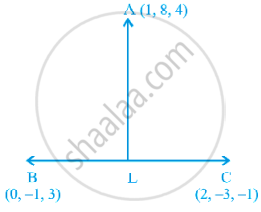
⇒ `lambda = (-5)/6`
The required point is obtained by substituting the value of λ, in (1), which is `((-5)/3, 2/3, 19/3)`.
APPEARS IN
संबंधित प्रश्न
The x-axis and y-axis taken together determine a plane known as_______.
Three vertices of a parallelogram ABCD are A (3, –1, 2), B (1, 2, –4) and C (–1, 1, 2). Find the coordinates of the fourth vertex.
Name the octants in which the following points lie: (5, 2, 3)
Name the octants in which the following points lie:
(–5, –4, 7)
Name the octants in which the following points lie:
(2, –5, –7)
Find the image of:
(–5, 4, –3) in the xz-plane.
Find the distances of the point P(–4, 3, 5) from the coordinate axes.
The coordinates of a point are (3, –2, 5). Write down the coordinates of seven points such that the absolute values of their coordinates are the same as those of the coordinates of the given point.
Determine the points in zx-plane are equidistant from the points A(1, –1, 0), B(2, 1, 2) and C(3, 2, –1).
Find the points on z-axis which are at a distance \[\sqrt{21}\]from the point (1, 2, 3).
Find the coordinates of the point which is equidistant from the four points O(0, 0, 0), A(2, 0, 0), B(0, 3, 0) and C(0, 0, 8).
Find the locus of P if PA2 + PB2 = 2k2, where A and B are the points (3, 4, 5) and (–1, 3, –7).
Are the points A(3, 6, 9), B(10, 20, 30) and C(25, –41, 5), the vertices of a right-angled triangle?
Verify the following:
(0, 7, –10), (1, 6, –6) and (4, 9, –6) are vertices of an isosceles triangle.
Find the equation of the set of the points P such that its distances from the points A(3, 4, –5) and B(–2, 1, 4) are equal.
Find the ratio in which the sphere x2 + y2 + z2 = 504 divides the line joining the points (12, –4, 8) and (27, –9, 18).
Show that the plane ax + by + cz + d = 0 divides the line joining the points (x1, y1, z1) and (x2, y2, z2) in the ratio \[- \frac{a x_1 + b y_1 + c z_1 + d}{a x_2 + b y_2 + c z_2 + d}\]
Write the coordinates of the foot of the perpendicular from the point (1, 2, 3) on y-axis.
What is the locus of a point for which y = 0, z = 0?
Let (3, 4, –1) and (–1, 2, 3) be the end points of a diameter of a sphere. Then, the radius of the sphere is equal to
XOZ-plane divides the join of (2, 3, 1) and (6, 7, 1) in the ratio
The coordinates of the foot of the perpendicular from a point P(6,7, 8) on x - axis are
The perpendicular distance of the point P (6, 7, 8) from xy - plane is
The perpendicular distance of the point P(3, 3,4) from the x-axis is
Find the direction cosines of the line passing through the points P(2, 3, 5) and Q(–1, 2, 4).
A plane meets the co-ordinates axis in A, B, C such that the centroid of the ∆ABC is the point (α, β, γ). Show that the equation of the plane is `x/alpha + y/beta + z/γ` = 3
If a line makes an angle of `pi/4` with each of y and z axis, then the angle which it makes with x-axis is ______.
Prove that the lines x = py + q, z = ry + s and x = p′y + q′, z = r′y + s′ are perpendicular if pp′ + rr′ + 1 = 0.
O is the origin and A is (a, b, c). Find the direction cosines of the line OA and the equation of plane through A at right angle to OA.
Find the foot of perpendicular from the point (2,3,–8) to the line `(4 - x)/2 = y/6 = (1 - z)/3`. Also, find the perpendicular distance from the given point to the line.
The plane ax + by = 0 is rotated about its line of intersection with the plane z = 0 through an angle α. Prove that the equation of the plane in its new position is ax + by `+- (sqrt(a^2 + b^2) tan alpha)z ` = 0
Show that the straight lines whose direction cosines are given by 2l + 2m – n = 0 and mn + nl + lm = 0 are at right angles.
The locus represented by xy + yz = 0 is ______.
The direction cosines of the vector `(2hati + 2hatj - hatk)` are ______.
The line `vecr = 2hati - 3hatj - hatk + lambda(hati - hatj + 2hatk)` lies in the plane `vecr.(3hati + hatj - hatk) + 2` = 0.
The vector equation of the line `(x - 5)/3 = (y + 4)/7 = (z - 6)/2` is `vecr = (5hati - 4hatj + 6hatk) + lambda(3hati + 7hatj - 2hatk)`.
