Advertisements
Advertisements
प्रश्न
If the origin is the centroid of the triangle PQR with vertices P (2a, 2, 6), Q (–4, 3b, –10) and R (8, 14, 2c), then find the values of a, b and c.
Advertisements
उत्तर
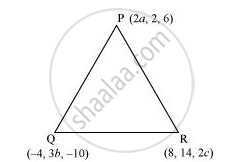
Given: The vertices of triangle PQR are P(2a, 2, 6), Q(−4, 3b, –10), R(8, 14, 2c).
∴ Centroid of ∆PQR `((x_1 + x_2 + x_3)/3, (y_1 + y_2 + y_3 - z_1 + z_2 +z_3)/3)`
or `((2a - 4 + 8)/3, (2 + 3b + 14)/3, (6 - 10 + 2c)/3)`
or `((2a + 4)/3, (3b + 16)/3, (2c - 4)/3)`
Since, the centroid is the origin (0, 0, 0), then
∴ `(2a + 4)/3 = 0,` or a = −2
`(3b + 16)/3 = 0, b = - 16/3`
`(2c - 4)/3 = 0, c = 2`
Hence, the values of a, b and c are −2, `-16/3` and 2 respectively.
APPEARS IN
संबंधित प्रश्न
Name the octants in which the following points lie:
(1, 2, 3), (4, –2, 3), (4, –2, –5), (4, 2, –5), (–4, 2, –5), (–4, 2, 5),
(–3, –1, 6), (2, –4, –7).
Name the octants in which the following points lie:
(–5, 4, 3)
Find the image of:
(–5, 4, –3) in the xz-plane.
Find the image of:
(–5, 0, 3) in the xz-plane.
Find the image of:
(–4, 0, 0) in the xy-plane.
Planes are drawn through the points (5, 0, 2) and (3, –2, 5) parallel to the coordinate planes. Find the lengths of the edges of the rectangular parallelepiped so formed.
Find the distances of the point P(–4, 3, 5) from the coordinate axes.
The coordinates of a point are (3, –2, 5). Write down the coordinates of seven points such that the absolute values of their coordinates are the same as those of the coordinates of the given point.
Determine the points in zx-plane are equidistant from the points A(1, –1, 0), B(2, 1, 2) and C(3, 2, –1).
Determine the point on z-axis which is equidistant from the points (1, 5, 7) and (5, 1, –4).
Find the points on z-axis which are at a distance \[\sqrt{21}\]from the point (1, 2, 3).
Are the points A(3, 6, 9), B(10, 20, 30) and C(25, –41, 5), the vertices of a right-angled triangle?
Verify the following:
(0, 7, 10), (–1, 6, 6) and (–4, 9, –6) are vertices of a right-angled triangle.
Find the locus of the points which are equidistant from the points (1, 2, 3) and (3, 2, –1).
Show that the points A(1, 2, 3), B(–1, –2, –1), C(2, 3, 2) and D(4, 7, 6) are the vertices of a parallelogram ABCD, but not a rectangle.
Show that the plane ax + by + cz + d = 0 divides the line joining the points (x1, y1, z1) and (x2, y2, z2) in the ratio \[- \frac{a x_1 + b y_1 + c z_1 + d}{a x_2 + b y_2 + c z_2 + d}\]
The perpendicular distance of the point P (6, 7, 8) from xy - plane is
The perpendicular distance of the point P(3, 3,4) from the x-axis is
Find the direction cosines of the line passing through the points P(2, 3, 5) and Q(–1, 2, 4).
If a line makes an angle of 30°, 60°, 90° with the positive direction of x, y, z-axes, respectively, then find its direction cosines.
A line makes equal angles with co-ordinate axis. Direction cosines of this line are ______.
If a line makes an angle of `pi/4` with each of y and z axis, then the angle which it makes with x-axis is ______.
Prove that the lines x = py + q, z = ry + s and x = p′y + q′, z = r′y + s′ are perpendicular if pp′ + rr′ + 1 = 0.
If the line drawn from the point (–2, – 1, – 3) meets a plane at right angle at the point (1, – 3, 3), find the equation of the plane
Find the equation of the plane through the points (2, 1, 0), (3, –2, –2) and (3, 1, 7).
Find the equations of the two lines through the origin which intersect the line `(x - 3)/2 = (y - 3)/1 = z/1` at angles of `pi/3` each.
Find the angle between the lines whose direction cosines are given by the equations l + m + n = 0, l2 + m2 – n2 = 0
O is the origin and A is (a, b, c). Find the direction cosines of the line OA and the equation of plane through A at right angle to OA.
Show that the points `(hati - hatj + 3hatk)` and `3(hati + hatj + hatk)` are equidistant from the plane `vecr * (5hati + 2hatj - 7hatk) + 9` = 0 and lies on opposite side of it.
Show that the straight lines whose direction cosines are given by 2l + 2m – n = 0 and mn + nl + lm = 0 are at right angles.
If l1, m1, n1 ; l2, m2, n2 ; l3, m3, n3 are the direction cosines of three mutually perpendicular lines, prove that the line whose direction cosines are proportional to l1 + l2 + l3, m1 + m2 + m3, n1 + n2 + n3 makes equal angles with them.
The area of the quadrilateral ABCD, where A(0, 4, 1), B(2, 3, –1), C(4, 5, 0) and D(2, 6, 2), is equal to ______.
The plane 2x – 3y + 6z – 11 = 0 makes an angle sin–1(α) with x-axis. The value of α is equal to ______.
The vector equation of the line `(x - 5)/3 = (y + 4)/7 = (z - 6)/2` is ______.
The vector equation of the line through the points (3, 4, –7) and (1, –1, 6) is ______.
The angle between the line `vecr = (5hati - hatj - 4hatk) + lambda(2hati - hatj + hatk)` and the plane `vec.(3hati - 4hatj - hatk)` + 5 = 0 is `sin^-1(5/(2sqrt(91)))`.
The vector equation of the line `(x - 5)/3 = (y + 4)/7 = (z - 6)/2` is `vecr = (5hati - 4hatj + 6hatk) + lambda(3hati + 7hatj - 2hatk)`.
