Advertisements
Advertisements
प्रश्न
Find the image of the point having position vector `hati + 3hatj + 4hatk` in the plane `hatr * (2hati - hatj + hatk)` + 3 = 0.
Advertisements
उत्तर
Let the given point be P`(hati + 3hatj + 4hatk)` and Q be the image of P in the plane `hatr * (2hati - hatj + hatk)` + 3 = 0 as shown in the figure.
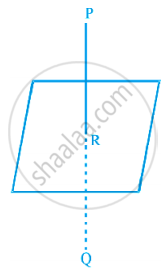
Then PQ is the normal to the plane.
Since PQ passes through P and is normal to the given plane
So the equation of PQ is given by `vecr = (hati + 3hatj + 4hatk) + lambda(2hati - hatj + hatk)`
Since Q lies on the line PQ, the position vector of Q can be expressed as `(hati + 3hatj + 4hatk) + lambda(2hati - hatj + hatk)`
i.e., `(1 + 2lambda)hati + (3 - lambda)hatj + (4 + lambda)hatk`
Since R is the mid point of PQ, the position vector of R is
`([(1 + 2lambda)hati + (3 - lambda)hatj + (4 + lambda)hatk] + [hati + 3hatj + 4hatk])/2`
i.e., `(lambda + 1)hati + (3 - lambda/2)hatj + (4 + lambda/2)hatk`
Again, since R lies on the plane `vecr * (2hati - hatj + hatk)` + 3 = 0
We have `{(lambda + 1)hati + (3 - lambda/2)hatj + (4 + lambda/2)hatk} * (2hati - hatj + hatk) + 3` = 0
⇒ λ = –2
Hence, the position vector of Q is `(hati + 3hatj + 4hatk) - 2(2hati - hatj + hatk)`
i.e. `-3hati + 5hatj + 2hatk`.
APPEARS IN
संबंधित प्रश्न
Three vertices of a parallelogram ABCD are A (3, –1, 2), B (1, 2, –4) and C (–1, 1, 2). Find the coordinates of the fourth vertex.
Name the octants in which the following points lie: (5, 2, 3)
Name the octants in which the following points lie:
(4, –3, 5)
Name the octants in which the following points lie:
(–5, –4, 7)
Name the octants in which the following points lie:
(2, –5, –7)
Name the octants in which the following points lie:
(–7, 2 – 5)
Find the image of:
(–5, 0, 3) in the xz-plane.
Find the image of:
(–4, 0, 0) in the xy-plane.
Find the distances of the point P(–4, 3, 5) from the coordinate axes.
Determine the point on z-axis which is equidistant from the points (1, 5, 7) and (5, 1, –4).
Find the point on y-axis which is equidistant from the points (3, 1, 2) and (5, 5, 2).
Prove that the triangle formed by joining the three points whose coordinates are (1, 2, 3), (2, 3, 1) and (3, 1, 2) is an equilateral triangle.
Show that the points (a, b, c), (b, c, a) and (c, a, b) are the vertices of an equilateral triangle.
Verify the following:
(0, 7, –10), (1, 6, –6) and (4, 9, –6) are vertices of an isosceles triangle.
Verify the following:
(–1, 2, 1), (1, –2, 5), (4, –7, 8) and (2, –3, 4) are vertices of a parallelogram.
Find the locus of the points which are equidistant from the points (1, 2, 3) and (3, 2, –1).
Show that the plane ax + by + cz + d = 0 divides the line joining the points (x1, y1, z1) and (x2, y2, z2) in the ratio \[- \frac{a x_1 + b y_1 + c z_1 + d}{a x_2 + b y_2 + c z_2 + d}\]
Find the point on y-axis which is at a distance of \[\sqrt{10}\] units from the point (1, 2, 3).
Let (3, 4, –1) and (–1, 2, 3) be the end points of a diameter of a sphere. Then, the radius of the sphere is equal to
The perpendicular distance of the point P(3, 3,4) from the x-axis is
The x-coordinate of a point on the line joining the points Q(2, 2, 1) and R(5, 1, –2) is 4. Find its z-coordinate.
Find the coordinates of the point where the line through (3, – 4, – 5) and (2, –3, 1) crosses the plane passing through three points (2, 2, 1), (3, 0, 1) and (4, –1, 0)
A plane meets the co-ordinates axis in A, B, C such that the centroid of the ∆ABC is the point (α, β, γ). Show that the equation of the plane is `x/alpha + y/beta + z/γ` = 3
Find the co-ordinates of the foot of perpendicular drawn from the point A(1, 8, 4) to the line joining the points B(0, –1, 3) and C(2, –3, –1).
A line makes equal angles with co-ordinate axis. Direction cosines of this line are ______.
Prove that the lines x = py + q, z = ry + s and x = p′y + q′, z = r′y + s′ are perpendicular if pp′ + rr′ + 1 = 0.
O is the origin and A is (a, b, c). Find the direction cosines of the line OA and the equation of plane through A at right angle to OA.
Find the equation of the plane which is perpendicular to the plane 5x + 3y + 6z + 8 = 0 and which contains the line of intersection of the planes x + 2y + 3z – 4 = 0 and 2x + y – z + 5 = 0.
The plane ax + by = 0 is rotated about its line of intersection with the plane z = 0 through an angle α. Prove that the equation of the plane in its new position is ax + by `+- (sqrt(a^2 + b^2) tan alpha)z ` = 0
Show that the points `(hati - hatj + 3hatk)` and `3(hati + hatj + hatk)` are equidistant from the plane `vecr * (5hati + 2hatj - 7hatk) + 9` = 0 and lies on opposite side of it.
Show that the straight lines whose direction cosines are given by 2l + 2m – n = 0 and mn + nl + lm = 0 are at right angles.
If l1, m1, n1 ; l2, m2, n2 ; l3, m3, n3 are the direction cosines of three mutually perpendicular lines, prove that the line whose direction cosines are proportional to l1 + l2 + l3, m1 + m2 + m3, n1 + n2 + n3 makes equal angles with them.
The locus represented by xy + yz = 0 is ______.
The unit vector normal to the plane x + 2y +3z – 6 = 0 is `1/sqrt(14)hati + 2/sqrt(14)hatj + 3/sqrt(14)hatk`.
The intercepts made by the plane 2x – 3y + 5z +4 = 0 on the co-ordinate axis are `-2, 4/3, - 4/5`.
The angle between the planes `vecr.(2hati - 3hatj + hatk)` = 1 and `vecr.(hati - hatj)` = 4 is `cos^-1((-5)/sqrt(58))`.
The vector equation of the line `(x - 5)/3 = (y + 4)/7 = (z - 6)/2` is `vecr = (5hati - 4hatj + 6hatk) + lambda(3hati + 7hatj - 2hatk)`.
