Advertisements
Advertisements
प्रश्न
Find the distances of the point P(–4, 3, 5) from the coordinate axes.
Advertisements
उत्तर
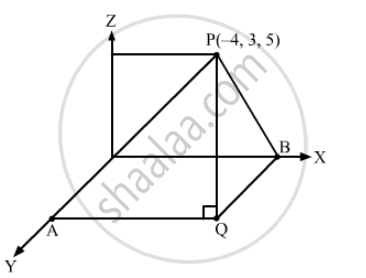
Let PQ be the perpendicular to the xy-plane and QA be perpendicular from Q to the y-axis.
PA will be perpendicular to the x-axis.
Also, QA = \[\left| 3 \right|\]and PQ =\[\left| 5 \right|\]
Now, distance of P from the x-axis:
PB =\[\sqrt{B Q^2 + Q P^2}\]
\[= \sqrt{3^2 + 5^2}\]
\[ = \sqrt{9 + 25} = \sqrt{34}\]
Similarly,
From the right-angled \[∆ PAQ\]distance of P from the y-axis:
PA =\[\sqrt{A Q^2 + Q P^2}\]
\[ = \sqrt{16 + 25} = \sqrt{41}\]
\[ = \sqrt{25} = 5\]
APPEARS IN
संबंधित प्रश्न
The x-axis and y-axis taken together determine a plane known as_______.
Three vertices of a parallelogram ABCD are A (3, –1, 2), B (1, 2, –4) and C (–1, 1, 2). Find the coordinates of the fourth vertex.
Name the octants in which the following points lie: (5, 2, 3)
Name the octants in which the following points lie:
(–5, 4, 3)
Name the octants in which the following points lie:
(–5, –4, 7)
Name the octants in which the following points lie:
(–5, –3, –2)
Find the image of:
(5, 2, –7) in the xy-plane.
Find the image of:
(–4, 0, 0) in the xy-plane.
A cube of side 5 has one vertex at the point (1, 0, –1), and the three edges from this vertex are, respectively, parallel to the negative x and y axes and positive z-axis. Find the coordinates of the other vertices of the cube.
The coordinates of a point are (3, –2, 5). Write down the coordinates of seven points such that the absolute values of their coordinates are the same as those of the coordinates of the given point.
Determine the point on z-axis which is equidistant from the points (1, 5, 7) and (5, 1, –4).
Find the point on y-axis which is equidistant from the points (3, 1, 2) and (5, 5, 2).
Find the points on z-axis which are at a distance \[\sqrt{21}\]from the point (1, 2, 3).
If A(–2, 2, 3) and B(13, –3, 13) are two points.
Find the locus of a point P which moves in such a way the 3PA = 2PB.
Show that the points (a, b, c), (b, c, a) and (c, a, b) are the vertices of an equilateral triangle.
Verify the following:
(0, 7, –10), (1, 6, –6) and (4, 9, –6) are vertices of an isosceles triangle.
Find the locus of the point, the sum of whose distances from the points A(4, 0, 0) and B(–4, 0, 0) is equal to 10.
Show that the points A(1, 2, 3), B(–1, –2, –1), C(2, 3, 2) and D(4, 7, 6) are the vertices of a parallelogram ABCD, but not a rectangle.
The ratio in which the line joining the points (a, b, c) and (–a, –c, –b) is divided by the xy-plane is
What is the locus of a point for which y = 0, z = 0?
If a line makes an angle of 30°, 60°, 90° with the positive direction of x, y, z-axes, respectively, then find its direction cosines.
A plane meets the co-ordinates axis in A, B, C such that the centroid of the ∆ABC is the point (α, β, γ). Show that the equation of the plane is `x/alpha + y/beta + z/γ` = 3
Find the co-ordinates of the foot of perpendicular drawn from the point A(1, 8, 4) to the line joining the points B(0, –1, 3) and C(2, –3, –1).
The coordinates of the foot of the perpendicular drawn from the point (2, 5, 7) on the x-axis are given by ______.
If α, β, γ are the angles that a line makes with the positive direction of x, y, z axis, respectively, then the direction cosines of the line are ______.
A line makes equal angles with co-ordinate axis. Direction cosines of this line are ______.
If a line makes an angle of `pi/4` with each of y and z axis, then the angle which it makes with x-axis is ______.
Find the equation of a plane which bisects perpendicularly the line joining the points A(2, 3, 4) and B(4, 5, 8) at right angles.
If a variable line in two adjacent positions has direction cosines l, m, n and l + δl, m + δm, n + δn, show that the small angle δθ between the two positions is given by δθ2 = δl2 + δm2 + δn2
O is the origin and A is (a, b, c). Find the direction cosines of the line OA and the equation of plane through A at right angle to OA.
The plane ax + by = 0 is rotated about its line of intersection with the plane z = 0 through an angle α. Prove that the equation of the plane in its new position is ax + by `+- (sqrt(a^2 + b^2) tan alpha)z ` = 0
The vector equation of the line `(x - 5)/3 = (y + 4)/7 = (z - 6)/2` is ______.
The vector equation of the line through the points (3, 4, –7) and (1, –1, 6) is ______.
The cartesian equation of the plane `vecr * (hati + hatj - hatk)` is ______.
If the foot of perpendicular drawn from the origin to a plane is (5, – 3, – 2), then the equation of plane is `vecr.(5hati - 3hatj - 2hatk)` = 38.
