Advertisements
Advertisements
प्रश्न
If the origin is the centroid of the triangle PQR with vertices P (2a, 2, 6), Q (–4, 3b, –10) and R (8, 14, 2c), then find the values of a, b and c.
Advertisements
उत्तर
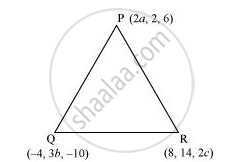
Given: The vertices of triangle PQR are P(2a, 2, 6), Q(−4, 3b, –10), R(8, 14, 2c).
∴ Centroid of ∆PQR `((x_1 + x_2 + x_3)/3, (y_1 + y_2 + y_3 - z_1 + z_2 +z_3)/3)`
or `((2a - 4 + 8)/3, (2 + 3b + 14)/3, (6 - 10 + 2c)/3)`
or `((2a + 4)/3, (3b + 16)/3, (2c - 4)/3)`
Since, the centroid is the origin (0, 0, 0), then
∴ `(2a + 4)/3 = 0,` or a = −2
`(3b + 16)/3 = 0, b = - 16/3`
`(2c - 4)/3 = 0, c = 2`
Hence, the values of a, b and c are −2, `-16/3` and 2 respectively.
APPEARS IN
संबंधित प्रश्न
Coordinate planes divide the space into ______ octants.
Name the octants in which the following points lie:
(–5, 4, 3)
Name the octants in which the following points lie:
(7, 4, –3)
Name the octants in which the following points lie:
(–5, –3, –2)
Name the octants in which the following points lie:
(2, –5, –7)
Find the image of:
(–4, 0, 0) in the xy-plane.
Find the point on y-axis which is equidistant from the points (3, 1, 2) and (5, 5, 2).
Find the points on z-axis which are at a distance \[\sqrt{21}\]from the point (1, 2, 3).
Show that the points A(3, 3, 3), B(0, 6, 3), C(1, 7, 7) and D(4, 4, 7) are the vertices of a square.
Verify the following:
(0, 7, 10), (–1, 6, 6) and (–4, 9, –6) are vertices of a right-angled triangle.
Find the locus of the point, the sum of whose distances from the points A(4, 0, 0) and B(–4, 0, 0) is equal to 10.
Write the distance of the point P(3, 4, 5) from z-axis.
What is the locus of a point for which y = 0, z = 0?
Find the ratio in which the line segment joining the points (2, 4,5) and (3, −5, 4) is divided by the yz-plane.
Find the point on y-axis which is at a distance of \[\sqrt{10}\] units from the point (1, 2, 3).
Find the point on x-axis which is equidistant from the points A (3, 2, 2) and B (5, 5, 4).
The ratio in which the line joining (2, 4, 5) and (3, 5, –9) is divided by the yz-plane is
XOZ-plane divides the join of (2, 3, 1) and (6, 7, 1) in the ratio
What is the locus of a point for which y = 0, z = 0?
The coordinates of the foot of the perpendicular drawn from the point P(3, 4, 5) on the yz- plane are
The length of the perpendicular drawn from the point P(a, b, c) from z-axis is
If the direction ratios of a line are 1, 1, 2, find the direction cosines of the line.
Find the coordinates of the point where the line through (3, – 4, – 5) and (2, –3, 1) crosses the plane passing through three points (2, 2, 1), (3, 0, 1) and (4, –1, 0)
A plane meets the co-ordinates axis in A, B, C such that the centroid of the ∆ABC is the point (α, β, γ). Show that the equation of the plane is `x/alpha + y/beta + z/γ` = 3
If a variable line in two adjacent positions has direction cosines l, m, n and l + δl, m + δm, n + δn, show that the small angle δθ between the two positions is given by δθ2 = δl2 + δm2 + δn2
Find the foot of perpendicular from the point (2,3,–8) to the line `(4 - x)/2 = y/6 = (1 - z)/3`. Also, find the perpendicular distance from the given point to the line.
Find the equation of the plane through the points (2, 1, –1) and (–1, 3, 4), and perpendicular to the plane x – 2y + 4z = 10.
Find the equation of the plane which is perpendicular to the plane 5x + 3y + 6z + 8 = 0 and which contains the line of intersection of the planes x + 2y + 3z – 4 = 0 and 2x + y – z + 5 = 0.
Show that the points `(hati - hatj + 3hatk)` and `3(hati + hatj + hatk)` are equidistant from the plane `vecr * (5hati + 2hatj - 7hatk) + 9` = 0 and lies on opposite side of it.
Show that the straight lines whose direction cosines are given by 2l + 2m – n = 0 and mn + nl + lm = 0 are at right angles.
The vector equation of the line through the points (3, 4, –7) and (1, –1, 6) is ______.
The unit vector normal to the plane x + 2y +3z – 6 = 0 is `1/sqrt(14)hati + 2/sqrt(14)hatj + 3/sqrt(14)hatk`.
The intercepts made by the plane 2x – 3y + 5z +4 = 0 on the co-ordinate axis are `-2, 4/3, - 4/5`.
The angle between the line `vecr = (5hati - hatj - 4hatk) + lambda(2hati - hatj + hatk)` and the plane `vec.(3hati - 4hatj - hatk)` + 5 = 0 is `sin^-1(5/(2sqrt(91)))`.
The line `vecr = 2hati - 3hatj - hatk + lambda(hati - hatj + 2hatk)` lies in the plane `vecr.(3hati + hatj - hatk) + 2` = 0.
