Advertisements
Advertisements
प्रश्न
Explain with two examples of the following:
Ligand
Advertisements
उत्तर
A ligand is an ion or molecule that has at least one lone pair of electrons and can donate it to a central metal atom or ion to form a coordinate bond. Ligands act as electron donors in the formation of coordination complexes. These may be simple ions such as Cl−, small molecules such as H2O or NH3, larger molecules such as H2NCH2CH2NH2 or N(CH2CH2NH2)3 or even macromolecules, such as proteins.
APPEARS IN
संबंधित प्रश्न
IUPAC name of the following compound is
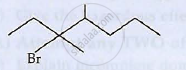
(a) 3 - Bromo- 3, 4- dimethylheptane
(b) 3, 4- dimethyl - 3- bromoheptane
(c) 5- Bromo- 4, 5- dimethylheptane
(d) 4, 5- dimethyl- 5- bromoheptane
Write applications of co-ordination compounds in medicine and electroplating.
Write structures of compounds A, B and C in of the following reactions

Write IUPAC name of the following Complex [Cr(NH3)3Cl3]
The oxidation number of Fe in K4[Fe(CN)6] is ____________.
The coordination number of the central ion may be obtained from:
In which of the following compounds the oxidation state of the nickel atom is 0?
What is the coordination number of chromium in \[\ce{[Cr(NH3)2(H2O2)2]Cl3}\]?
Which of the following is non-ionizable?
The correct \[\ce{IUPAC}\] name of \[\ce{[Pt(NH3)2Cl2]}\] is ______.
Which of the following complexes are homoleptic?
(i) \[\ce{[Co(NH3)6]^{3+}}\]
(ii) \[\ce{[Co(NH3)4 Cl2]^{+}}\]
(iii) \[\ce{[Ni(CN)4]^{2-}}\]
(iv) \[\ce{[Ni(NH3)4Cl2]}\]
A complex of the type \[\ce{[M(AA)2X2]^{n+}}\] is known to be optically active. What does this indicate about the structure of the complex? Give one example of such complex.
Which one of the following does not achieve an octet of electrons in the central atom?
Why chelate complexes are more stable than complexes with unidentate ligands?
The one that will show optical activity is: (en = ethane 1, 2-diamine)
Is the central metal atom in coordination complexes a Lewis acid or a Lewis base? Explain.
What is meant by the chelate effect? Give an example.
In the complex ion \[\ce{[CoCl(en)2ONO]+}\], the coordination number and the oxidation number of the central metal ion are ______ and ______.
Give two examples of unidentate ligands.
