Advertisements
Advertisements
प्रश्न
Draw the structure of the following atoms showing the nucleus containing – protons, neutrons and the orbits with the respective electron:
Sodium [At. no. = 11, Mass no. = 23]
Advertisements
उत्तर
Structure of atoms:
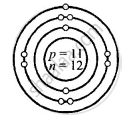
Z is Atomic Number and A is the mass number
Sodium \[\ce{^23_11Na}\]
Z = 11 = p = e
K L M
e = 11 = 2, 8, 1
A = p + n
23 = 11 + n
∴ n = 23 − 11 = 12
APPEARS IN
संबंधित प्रश्न
In Milikan’s experiment, static electric charge on the oil drops has been obtained by shining X-rays. If the static electric charge on the oil drop is - 1.282 × 10⁻¹⁸C, calculate the number of electrons present on it.
Fill in the blank of the following statement :
All the mass of an atom is concentrated in a small region of space called the ___________.
The mass number of an element is 18. It contains 7 electrons. What is the number of protons and neutrons in it? What is the atomic number of the element?
The properties of the elements are a periodic function of their __________.
If an atom ‘A’ has mass number 35 and atomic number 17, state the number of protons, electrons and neutrons it contains.
Draw the atomic diagram of the following element showing the distribution of – protons, neutrons and the electrons in the various shell of the atom.
Carbon – \[\ce{^12_6C}\]
[The upper number represent the – mass number and the lower number represent the – atomic number e.g. calcium – mass number = 40, atomic number = 20]
Match the statements in List I with the correct answer from List II.
| List I | List II |
| 1. Mass number of an atom is the number of protons and | A: Electron |
| 2. The sub-atomic particle with a negligible mass. | B: Argon |
| 3. An atom having stable electronic configuration. | C: Nitrogen |
| 4. A molecule formed by sharing of electrons [covalency] | D: Sodium |
| 5. A metallic atom having unstable electronic configuration. | E: Neutrons |
Show diagrammatically the electron distributions in a sodium atom and a sodium ion and also give their atomic number.
Explain the following terms.
- Proton
- Electron
- Neutron.
Mass No. 27 is for the element ______.
