Advertisements
Advertisements
प्रश्न
Draw the structure of the following atoms showing the nucleus containing – protons, neutrons and the orbits with the respective electron:
Silicon [At. no. = 14, Mass no. = 28]
Advertisements
उत्तर
Structure of atoms:

Z is Atomic Number and A is the mass number
Silicon \[\ce{^28_14Si}\]
Z = 14 = p = e
K L M
e = 14 = 2, 8, 4
A = p + n
28 = 14 + n
∴ n = 28 − 14 = 14
APPEARS IN
संबंधित प्रश्न
Which of the following are isoelectronic species i.e., those having the same number of electrons?
Na+, K+, Mg2+, Ca2+, S2–, Ar
Multiple Choice Questions
The sub atomic particle with negative charge is
An element has an atomic number 12. How many electrons will be present in the K, L and M energy shells of its atom?
The number of electrons in the atom of an element X is 15 and the number of neutrons is 16. Which of the following is the correct representation of an atom of this element ?
From the symbol `""_15^31"P"`, state :
(i) mass number of phosphorus,
(ii) atomic number of phosphorus, and
(iii) electron configuration of phosphorus.
Draw the atomic diagram of the following element showing the distribution of – protons, neutrons and the electrons in the various shell of the atom.
Oxygen – \[\ce{^16_8O}\]
[The upper number represent the – mass number and the lower number represent the – atomic number e.g. calcium – mass number = 40, atomic number = 20]
Draw the atomic diagram of the following element showing the distribution of – protons, neutrons and the electrons in the various shell of the atom.
Calcium – \[\ce{^40_20Ca}\]
[The upper number represent the – mass number and the lower number represent the – atomic number e.g. calcium – mass number = 40, atomic number = 20]
The diagram represents an isotope of hydrogen [H]. Answer the following:
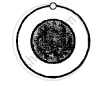
Atomic no. = 1
Mass no. = 1
If an isotope of ‘H’ has mass no. = 3, how many neutrons does it have.
Explain the following terms.
- Proton
- Electron
- Neutron.
The elementary particles such as protons and neutrons are collectively called ______.
