Advertisements
Advertisements
प्रश्न
Draw the structure of the following atoms showing the nucleus containing – protons, neutrons and the orbits with the respective electron:
Silicon [At. no. = 14, Mass no. = 28]
Advertisements
उत्तर
Structure of atoms:

Z is Atomic Number and A is the mass number
Silicon \[\ce{^28_14Si}\]
Z = 14 = p = e
K L M
e = 14 = 2, 8, 4
A = p + n
28 = 14 + n
∴ n = 28 − 14 = 14
APPEARS IN
संबंधित प्रश्न
In Milikan’s experiment, static electric charge on the oil drops has been obtained by shining X-rays. If the static electric charge on the oil drop is - 1.282 × 10⁻¹⁸C, calculate the number of electrons present on it.
From the symbol `""_15^31"P"`, state :
(i) mass number of phosphorus,
(ii) atomic number of phosphorus, and
(iii) electron configuration of phosphorus.
The atomic number of four elements A, B, C and D are 12, 13, 15 and 3 respectively. The element which cannot form a cation is :
Sulphur has an atomic number 16 and a mass of 32.
State the number of protons and neutrons in the nucleus of sulphur. Give a simple diagram to show the arrangement of electrons in an atom of sulphur.
Draw the atomic diagram of the following element showing the distribution of – protons, neutrons and the electrons in the various shell of the atom.
Oxygen – \[\ce{^16_8O}\]
[The upper number represent the – mass number and the lower number represent the – atomic number e.g. calcium – mass number = 40, atomic number = 20]
The diagram represents an isotope of hydrogen [H]. Answer the following:
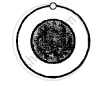
Atomic no. = 1
Mass no. = 1
Which sub-atomic particles in the 3 isotopes of ‘H’ are the same.
Differentiate between the following term:
Atomic number and mass number
Name the 3 sub-atomic particles of an atom.
Every atom has an equal number of protons and electrons. The nature of the atom is ______.
A ______ number describes a specific aspect of an electron.
