Advertisements
Advertisements
प्रश्न
Describe the general trends in the following properties of the elements in Groups 13 and 14.
Nature of halides
Advertisements
उत्तर
Except thallium, All the elements of the boron family combine with three atoms of halogens to form trihalides. All these halides exist as molecular species with hybridisation of sp2. All the trihalides are Lewis acid and their acidic strength of trihalides of boron is in order: Bf3 < BCl3 < BBr3 < Bl3. In group-14, except carbon, all group 14 elements on reaction with halogens form tetra halides where central metal atom shows the sp3 hybridisation state and corresponding tetrahedral shape.
There are few exceptions also, SnF4 and Pf4 are ionic in nature, while the rest are covalent compounds.
APPEARS IN
संबंधित प्रश्न
How can you explain higher stability of BCl3 as compared to TlCl3?
What happens when BF3 is reacted with ammonia?
What do you understand by inert pair effect?
Write a balanced equation for Al + NaOH → ?
Write a balanced equation for B2H6 + NH3 → ?
The geometry of a complex species can be understood from the knowledge of type of hybridisation of orbitals of central atom. The hybridisation of orbitals of central atom in [Be(OH)4]– and the geometry of the complex are respectively.
Which of the following oxides is acidic in nature?
In the structure of diborane ______.
A compound X, of boron reacts with NH3 on heating to give another compound Y which is called inorganic benzene. The compound X can be prepared by treating BF3 with Lithium aluminium hydride. The compounds X and Y are represented by the formulas.
The most commonly used reducing agent is ______.
Cement, the important building material is a mixture of oxides of several elements. Besides calcium, iron and sulphur, oxides of elements of which of the group (s) are present in the mixture?
Which of the following statements are correct. Answer on the basis of Figure.
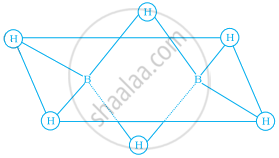
(i) The two birdged hydrogen atoms and the two boron atoms lie in one plane;
(ii) Out of six B – H bonds two bonds can be described in terms of 3 centre 2-electron bonds.
(iii) Out of six B – H bonds four B – H bonds can be described in terms of 3 centre 2 electron bonds;
(iv) The four-terminal B – H bonds are two centre-two electron regular bonds.
Complete the following chemical equations:
\[\ce{Z + 3 LiAlH4 -> X + 3LiF + 3AlF_3}\]
\[\ce{X + 6H2 -> Y + 6H2}\]
\[\ce{3X + 3O2 ->[Δ] B2O3 + 3H2O}\]
Match the species given in Column I with properties given in Column II.
| Column I | Column II |
| (i) Diborane | (a) Used as a flux for soldering metals |
| (ii) Galluim | (b) Crystalline form of silica |
| (iii) Borax | (c) Banana bonds |
| (iv) Aluminosilicate | (d) Low melting, high boiling, useful for measuring high temperatures |
| (v) Quartz | (e) Used as catalyst in petrochemical industries |
Describe the general trends in the following properties of the elements in Groups 13 and 14.
Metallic character
Account for the following observations:
Though fluorine is more electronegative than chlorine yet BF3 is a weaker Lewis acid than BCl3
BCl3 exists as monomer whereas AlCl3 is dimerised through halogen bridging. Give reason. Explain the structure of the dimer of AlCl3 also.
Boron compounds behave as Lewis acids because of their ______.
Which one of the following is the correct statement?
Taking stability as the factor, which one of the following represents the correct relationship?
