Advertisements
Advertisements
प्रश्न
Explain the following:
Boron does not exist as B3+ ion.
Advertisements
उत्तर
Boron has three electrons in the valence shell. Because of its small size and high sum of the first three ionisation enthalpies (i.e., ∆iH1 + ∆iH2 + ∆iH3), boron does not lose all its valence electrons to form B3+ ions.
APPEARS IN
संबंधित प्रश्न
Suggest reasons why the B–F bond lengths in BF3 (130 pm) and `"BF"_4^(-)` (143 pm) differ.
What happens when BF3 is reacted with ammonia?
Write a balanced equation for B2H6 + NH3 → ?
The exhibition of highest co-ordination number depends on the availability of vacant orbitals in the central atom. Which of the following elements is not likely to act as central atom in \[\ce{MF^{3-}6}\]?
A compound X, of boron reacts with NH3 on heating to give another compound Y which is called inorganic benzene. The compound X can be prepared by treating BF3 with Lithium aluminium hydride. The compounds X and Y are represented by the formulas.
Dry ice is ______.
Cement, the important building material is a mixture of oxides of several elements. Besides calcium, iron and sulphur, oxides of elements of which of the group (s) are present in the mixture?
Which of the following statements are correct. Answer on the basis of Figure.
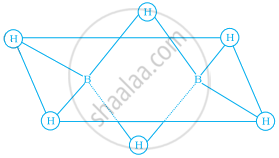
(i) The two birdged hydrogen atoms and the two boron atoms lie in one plane;
(ii) Out of six B – H bonds two bonds can be described in terms of 3 centre 2-electron bonds.
(iii) Out of six B – H bonds four B – H bonds can be described in terms of 3 centre 2 electron bonds;
(iv) The four-terminal B – H bonds are two centre-two electron regular bonds.
Explain why the following compounds behave as Lewis acids?
AlCl3
When BCl3 is treated with water, it hydrolyses and forms [B[OH]4]– only whereas AlCl3 in acidified aqueous solution forms [Al(H2O)6]3+ ion. Explain what is the hybridisation of boron and aluminium in these species?
Explain the following:
PbX2 is more stable than PbX4.
Match the species given in Column I with the hybridisation given in Column II.
| Column I | Column II |
| (i) Boron in [B(OH)4]– | (a) sp2 |
| (ii) Aluminium in [Al(H2O)6]3+ | (b) sp3 |
| (iii) Boron in B2H6 | (c) sp3d2 |
| (iv) Carbon in Buckminsterfullerene | |
| (v) Silicon in \[\ce{SiO^{4-}4}\] | |
| (vi) Germanium in [GeCl6]2– |
Describe the general trends in the following properties of the elements in Groups 13 and 14.
Atomic size
Describe the general trends in the following properties of the elements in Groups 13 and 14.
Oxidation states
Describe the general trends in the following properties of the elements in Groups 13 and 14.
Nature of halides
A group 13 element ‘X’ reacts with chlorine gas to produce a compound XCl3. XCl3 is electron deficient and easily reacts with NH3 to form \[\ce{Cl3X –> NH3}\] adduct; however, XCl3 does not dimerize X is ______.
Which one of the following is the correct statement?
