Advertisements
Advertisements
प्रश्न
Choose the correct option:
A magnetising field of 360 Am−1 produces a magnetic flux density (B) = 0.6T in a ferromagnetic material. What is its permeability in Tm A−1?
विकल्प
`1/300`
300
`1/600`
600
Advertisements
उत्तर
`1/600`
Explanation:
Calculate permeability `(mu)`
`mu = B/H` ......(1)
Substitute B = 0.6T and H = 360Am–1 in (1)
`mu = 0.6/360`
`mu = 1/600 TmA^-1`
APPEARS IN
संबंधित प्रश्न
Distinguish between ‘paramagnetic’ and ‘ferromagnetic’ substances.
Which of the following substances is ductile?
Show diagrammatically the behaviour of magnetic field lines in the presence of (i) paramagnetic and (ii) diamagnetic substances. How does one explain this distinguishing feature?
The magnetic susceptibility of annealed iron at saturation is 4224. Find the permeability of
annealed iron at saturation. (μ0 = 4Π × 10−7 SI unit)
The susceptibility of a magnetic material is 0·9853. Identify the type of magnetic material. Draw the modification of the field pattern on keeping a piece of this material in a uniform magnetic field.
Draw magnetic field line when a (i) diamagnetic, (ii) paramagnetic substance is placed in an external magnetic field. Which magnetic property distinguishes this behaviour of the field line due to the substances?
The magnetic susceptibility of platinum is 0.0001. It's relative permeability is:
Which of the following statements is correct for diamagnetic materials?
What happens to a ferromagnetic material when its temperature increases above curie temperature?
The susceptibility of a paramagnetic material is χ at 27° C. At what temperature its susceptibility be χ/3?
A rod of magnetic material of cross-section 0.25 cm2 is placed in a magnetizing field of intensity 4000 A/m-1. The magnetic flux passing through the rod is 25 × 10-6 Wb. Find out
(a) relative permeability
(b) magnetic susceptibility and
(c) magnetisation of the rod.
For a paramagnetic substance, the magnetic susceptibility is ______.
The susceptibility of a magnetic material is positive and small. The material is ______.
A small quantity of paramagnetic liquid is taken in a watch - glass and kept on two dissimilar magnetic poles. The liquid ____________.
The earth’s field departs from its dipole shape substantially at large distances (greater than about 30,000 km). What agencies may be responsible for this distortion?
A short bar magnet has a magnetic moment of 0.48 J T−1. Give the direction and magnitude of the magnetic field produced by the magnet at a distance of 10 cm from the centre of the magnet on
- the axis,
- the equatorial lines (normal bisector) of the magnet.
Why does a paramagnetic sample display greater magnetisation (for the same magnetising field) when cooled?
Would the maximum possible magnetisation of a paramagnetic sample be of the same order of magnitude as the magnetisation of a ferromagnet?
Explain qualitatively on the basis of domain picture the irreversibility in the magnetisation curve of a ferromagnet.
What kind of ferromagnetic material is used for coating magnetic tapes in a cassette player, or for building ‘memory stores’ in a modern computer?
A certain region of space is to be shielded from magnetic fields. Suggest a method.
Nickel shows ferromagnetic property at room temperature. If the temperature is increased beyond curie temperature, then it will show ______.
The given figure represents a material which is ______.

Which of the following property shows the property of ferromagnetic substances?
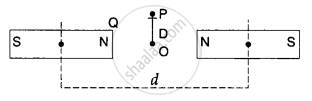
Two identical bar magnets are fixed with their centres at a distance d apart. A stationary charge Q is placed at P in between the gap of the two magnets at a distance D from the centre O as shown in the figure. The force on the charge Q is ______.
A hydrogen atom is paramagnetic. A hydrogen molecule is
For a diamagnetic material
Most of the substance show which of the magnetic property:-
Essential difference between electrostatic shielding by a conducting shell and magnetostatic shielding is due to ______.
- electrostatic field lines can end on charges and conductors have free charges.
- lines of B can also end but conductors cannot end them.
- lines of B cannot end on any material and perfect shielding is not possible.
- shells of high permeability materials can be used to divert lines of B from the interior region.
A permanent magnet in the shape of a thin cylinder of length 10 cm has M = 106 A/m. Calculate the magnetisation current IM.
Explain quantitatively the order of magnitude difference between the diamagnetic susceptibility of N2 (~5 × 10⁻⁹) (at STP) and Cu (~10–5).
From molecular view point, discuss the temperature dependence of susceptibility for diamagnetism, paramagnetism and ferromagnetism.
If the magnetizing field on a ferromagnetic material is increased, its permeability ______.
Magnetic susceptibility for a paramagnetic and diamagnetic materials is respectively ______.
Which of the following cannot modify an external magnetic field as shown in the figure?

The relative magnetic permeability of a substance X is slightly less than unity and that of substance Y is slightly more than unity, then ______.
What is magnetic hysterisis?
Explain the origin of paramagnetism on the basis of atomic structure.
State the dimensions of magnetization.
Which substances are feebly magnetised in a direction opposite to that of the magnetising field?
Which substances are feebly magnetised in the direction of the magnetising field?
How do diamagnetic substances respond to a magnetic field?
How do paramagnetic substances respond to a magnetic field?
Which mathematical relation expresses Curie's Law for paramagnetic substances?
What causes the magnetic behaviour of ferromagnetic substances?
