Advertisements
Advertisements
प्रश्न
\[\ce{CH2OH-CO-(CHOH)4-CH2OH}\] is an example of ______.
विकल्प
Aldohexose
Aldoheptose
Ketotetrose
Ketoheptose
Advertisements
उत्तर
\[\ce{CH2OH-CO-(CHOH)4-CH2OH}\] is an example of ketoheptose.
Explanation:
Ketoheptose → \[\begin{array}{cc}
\phantom{....}\ce{CH2 - OH}\\
|\phantom{.....}\\
\phantom{}\ce{C = O}\\
|\phantom{.....}\\
\phantom{..}\ce{(CHOH)4}\\
|\phantom{.....}\\
\phantom{...}\ce{CH2OH}
\end{array}\]
Aldohexose Glucose → \[\begin{array}{cc}
\phantom{}\ce{CHO}\\
|\phantom{....}\\
\phantom{...}\ce{(CHOH)4}\\
|\phantom{....}\\
\phantom{...}\ce{CH2OH}
\end{array}\]
Ketoheptose → Ketone group and 7 carbon present
Ketotetrose → Ketone group and 4 carbon present
संबंधित प्रश्न
Give scientific reasons:
The disaccharide sucrose gives negative Tollens test while the disaccharide maltose gives a positive Tollens test.
Write the name of the unit to which glucose unit is linked to from sucrose.
Classify the following carbohydrates into monosaccharide, disaccharide, oligosaccharide and polysaccharide:
glucose, cellulose, maltose, stachyose
Explain the classification of carbohydrates with examples.
What is the action of the following reagents on glucose?
acetic anhydride
Define carbohydrates.
Draw the Haworth projection structure of the following.
α-D-(–)-Fructofuranose
Identify the bond that links the carbon of two adjacent monosaccharides.
Which enzymes would work sequentially on potatoes consumed by an individual?
Which of the following is the basic unit of carbohydrates?
From the following which is a heteropolysaccharide?
______ is the prosthetic group of glycoproteins.
Which among the following compounds is obtained when glucose reacts with hydrogen cyanide?
Which is the product obtained, when Br2 water reacts with glucose?
Chitin is a/an ______.
____________ do not give smaller sugar units on hydrolysis.
Which among the following type of linkages is present in cellulose?
Prolonged heating of glucose with hot HI results in the formation of ____________.
All these carbohydrates contain \[\ce{1 -> 4β}\] glycosidic linkage, EXCEPT ____________.
Which element among the following is not present in saccharine?
The general formula for polysaccharide is ____________.
Stachyose is ____________.
Which following reagent is used to detect presence of five hydroxyl groups in a glucose molecule?
When 2 moles of stachyose is hydrolyzed, the number of moles of galactose obtained is ____________.
Which among the following sugars does not reduce Tollen's reagent?
Which among the following reagents is used for conversion of glucose to glucoxime?
What is the molecular formula of glyceraldehyde?
How many optical isomers are possible for a compound having four asymmetric carbon atoms?
Which one of the following rotates the plane polarized light towards left?
Which one given below is a non-reducing sugar?
Assertion: A solution of sucrose in water is dextrorotatory. But on hydrolysis in the presence of little hydrochloric acid, it becomes levorotatory.
Reason: Sucrose hydrolysis gives equal amounts of glucose and fructose. As a result of this change in sign of rotation is observed.
Which of the following are epimers?
Classify the following into monosaccharides, oligosaccharides and polysaccharides.
Lactose
Is the following sugar, D-sugar or L-sugar?

The molecule of glucose is also called ______.
Lactose is made of ______.
Glucose on oxidation with bromine water yields gluconic acid. This reaction confirms the presence of ______.
Which carbon atoms of fructose are bonded together through oxygen forming fructofuranose?
Identify the monosaccharide containing only one asymmetric carbon atom in its molecule.
Starch and cellulose are compounds made up of many units of ______.
The glycosidic linkage present in maltose is ______.
\[\ce{CH2OH - CO - (CHOH)4 - CH2OH}\] is an example of ______.
Assign D/L configuration to the following monosaccharides:
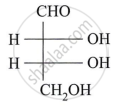
Describe the action of the following reagent on glucose:
Bromine water
Why carbohydrates are generally optically active.
Write the Zwitter ion structure of alanine.
\[\ce{CH2OH-CO-(CHOH)4-CH2OH}\] is an example of ______.
\[\ce{CH2OH - CO - (CHOH)4 - CH2OH}\] is an example of ______.
Why carbohydrates are generally optically active.
Two monosaccharides are held together by ______ bond.
Which of the following is used to separate glucose and fructose from hydrolysate of sucrose?
