Advertisements
Advertisements
प्रश्न
Write chemical reaction for following conversions
glucose into glucoxime
Advertisements
उत्तर
Glucose forms glucoxime by reaction with hydroxylamine:
\[\begin{array}{cc}
\phantom{}\ce{CHO}\phantom{.............}\ce{CH = N - OH}\phantom{.}\\
\phantom{.}|\phantom{..................}|\phantom{...............}\\
\ce{(CHOH)4 ->[NH2 - OH](CHOH)4 + H2O}\\
\phantom{}|\phantom{..................}|\phantom{..............}\\
\phantom{}\ce{\underset{\text{Glucose}}{CH2OH} \phantom{..........}\underset{\text{Oxime}}{CH2OH}}\phantom{........}
\end{array}\]
APPEARS IN
संबंधित प्रश्न
The glycosidic linkage in maltose is formed between _______________
Write the name of the polysaccharide used for the commercial preparation of glucose.
Write the name of the unit to which glucose unit is linked to from sucrose.
What is the action of the following reagents on glucose?
hydrogen iodide
Define carbohydrates.
Explain D and L configuration in sugars.
Write a commercial method for preparation of glucose.
What is monosaccharide?
Which of the following monosaccharides is a tetrose sugar?
Which of the following carbohydrate is sweet to taste?
Carbohydrates can contain which of the following chemical groups?
______ is the prosthetic group of glycoproteins.
Identify the WRONG statement.
Match the Column I and Column II select the correct option.
| Column I | Column II | ||
| i. | Monosaccharides | a. | Stored energy in animals |
| ii. | Glycogen | b. | Polymer made from ß-glucose molecules |
| iii. | Cellulose | c. | Exoskeleton of arthropods |
| iv. | Chitin | d. | Building blocks of carbohydrates |
| e. | Plant hormone |
Chitin is a/an ______.
Monosaccharides are ______ in nature.
From the following identify the two types of glucose polymers present in starch.
Match the columns and select the correct option.
| Column I | Column II | ||
| i. | Starch | a. | Animal storage molecule |
| ii. | Cellulose | b. | Plant storage molecule |
| iii. | Glycogen | c. | Heparin |
| iv. | Heteropolysaccharide | d. | Plant cell wall component |
Raffinose, sucrose and stachyose are respectively ____________.
All these carbohydrates contain \[\ce{1 -> 4β}\] glycosidic linkage, EXCEPT ____________.
Which one of the following is an oligosaccharide?
Which one of the following is a carbohydrate but does NOT follow the general formula of carbohydrate?
Which one of the following carbohydrates is insoluble in water?
Which one of the following is NOT soluble in water?
How many moles of fructose and galactose respectively are obtained on hydrolysis of 1 mole stachyose?
Which among the following reagents is used for conversion of glucose to glucoxime?
How many moles of acetic acid are obtained in the reaction when one mole glucose is treated with excess acetic anhydride?
How many optical isomers are possible for a compound having four asymmetric carbon atoms?
Which one of the following rotates the plane polarized light towards left?
The correct corresponding order of names of four aldoses with configuration given below Respectively is:
What are reducing and non-reducing sugars?
Why carbohydrates are generally optically active?
Classify the following into monosaccharides, oligosaccharides and polysaccharides.
Starch
Classify the following into monosaccharides, oligosaccharides and polysaccharides.
Sucrose
Classify the following into monosaccharides, oligosaccharides and polysaccharides.
Lactose
Classify the following into monosaccharides, oligosaccharides and polysaccharides.
Maltose
Is the following sugar, D-sugar or L-sugar?

Which of the following groups contain polysaccharides?
The two monosaccharides in a disaccharide are held together by ______ bonds.
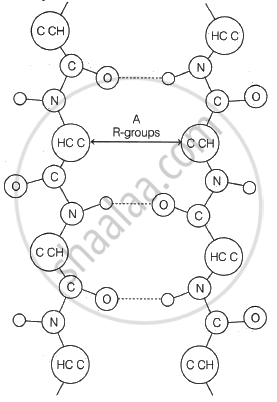
Starch and cellulose are compounds made up of many units of ______.
Which one is a non-reducing commercial sugar?
Consider the following reaction
\[\ce{A <-[Br2 - H2O] Glucose ->[HNO3] B}\]
Here, 'A' and 'B' are respectively.
Why carbohydrates are generally optically active.
Why carbohydrates are generally optically active.
Why carbohydrates are generally optically active.
Why are carbohydrates generally optically active?
Why carbohydrates are generally optically active.
Why carbohydrates are generally optically active?
\[\ce{CH2OH-CO-(CHOH)4-CH2OH}\] is an example of ______.
Why carbohydrates are generally optically active.
The sugar found in milk is ______.
