हिंदी
Maharashtra State BoardSSC (English Medium) 5th Standard

Rotation and Revolution

Advertisements

Topics

  • Activity 1
  • Activity 2
  • Rotation
  • Revolution
Maharashtra State Board: Class 5

Activity 1

To understand the concept of rotation and the axis of rotation by observing the movement of a spinning top.

  • Place the top on a flat surface.
  • Spin the top and observe its movement carefully.
  • Notice how the top turns around itself while spinning.
  • Imagine an invisible (imaginary) line going through the centre of the top from top to bottom. This is called the axis of rotation.
  • The top continues to spin around this axis and remains balanced for some time.

This shows how objects rotate around an imaginary line, just like the Earth rotates on its axis.

Maharashtra State Board: Class 5

Activity 2

To observe the Earth's tilted axis and understand the concept of poles, the equator, and hemispheres.

The Earth’s axis is an imaginary tilted line that passes through two fixed points on the globe: the North Pole (N) and the South Pole (S).

  • When a globe is placed on a flat surface and spun, it rotates around this axis, just like the Earth does in space.
  • The axis is not vertical; it is tilted at an angle of about 23.5°, which affects seasons and daylight patterns on Earth.
  • A plumb line (a hanging thread with a small weight) can be used to compare the earth's tilt. When held next to the spinning globe, the plumb line appears at an angle to the axis, showing this inclination.
  • The equator is an imaginary line that runs around the middle of the Earth, exactly halfway between the North and South Poles.
  • The equator divides the Earth into two equal halves:
    • The Northern Hemisphere (the upper half above the equator).
    • The Southern Hemisphere (the lower half below the equator).
  • These hemispheres help in understanding Earth’s geography, climate zones, and the distribution of land and water.
  • This activity helps visualise how the Earth rotates on a tilted axis, affecting time zones, seasons, and sunlight distribution.
 
A globe
Maharashtra State Board: Class 5

Rotation:

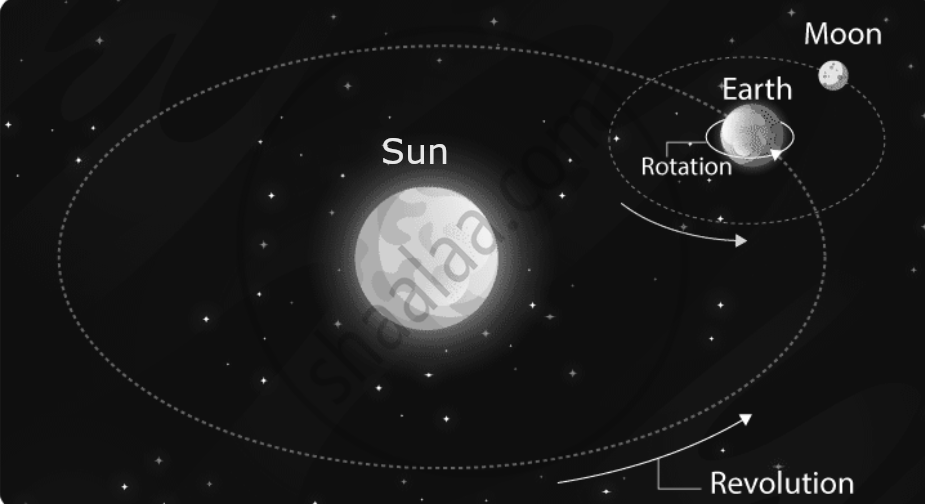
Rotation is the spinning of the Earth around its own axis. Imagine the Earth as a spinning top. The Earth takes about 24 hours to complete a full rotation. This spinning is what causes day and night. When your part of the earth faces the sun, it's day time, and when it turns away from the sun, it's night time.

Maharashtra State Board: Class 5

Revolution:

Revolution is the movement of the earth around the sun. The Earth takes about 365 days, or one year, to complete one full revolution around the Sun. This movement happens in a path called an orbit, which is like a giant loop. Because of the Earth's tilted axis as it revolves around the Sun, different parts of the earth get different amounts of sunlight at different times of the year. This is what results in the four seasons: spring, summer, autumn, and winter.

Advertisements
Share
Notifications

Englishहिंदीमराठी


      Forgot password?
Use app×