Topics
Term - 1
Numbers
- Fundamentals of Numbers
- Successor and Predecessor of Whole Number
- Introducing a 5 Digit Number - 10,000
- Introducing the Six Digit Number - 1,00,000
- Introducing seven-digit numbers
- Concept of Place Value
- Use of Commas
- Crores
- Comparing Numbers
- Ascending and Descending Order of Numbers
- Forming Numbers from Digits
- BODMAS Rule
- Rounding off a Number
- To Estimate Sum Or Difference
- Estimating Products of Numbers
- Whole Numbers
- Commutativity Property of Whole Number
- Associativity Property of Whole Numbers
- Distributivity Property of Whole Numbers
- Identity of Addition and Multiplication of Whole Numbers
Introduction to Algebra
Ratio and Proportion
Geometry
Statistics
Information Processing
- Systematic Listing
- Systematic Completion of Lists
Term - 2
Numbers
- Concept of Even and Odd Number
- Prime and Composite Numbers
- Eratosthenes’ Method of Finding Prime Numbers
- Tests for Divisibility of Numbers
- Divisibility by 2
- Divisibility by 3
- Divisibility by 5
- Divisibility by 4
- Divisibility by 6
- Divisibility by 8
- Divisibility by 9
- Divisibility by 10
- Divisibility by 11
- Prime Factorisation
- Factors and Common Factors
- Highest Common Factor (HCF)
- Multiples and Common Multiples
- Lowest Common Multiple
- Relationship between the Numbers and their HCF and LCM
Measurements
- Conversion of Units
- Fundamental Operations on Quantities with Different Units
- Measures of Time
- Conversion of Time
Bill, Profit and Loss
Geometry
- Basic Concepts of Triangles
- Classification of Triangles based on Sides
- Classification of Triangles based on Angles
- Basic Properties of a Triangle
- Triangle Inequality
- Drawing a Perpendicular to a Line
- Construction of Parallel Lines
Information Processing
- Tree Diagram
- Conversion of Tree Diagrams into Numerical Expressions
- Conversion of Algebraic Expressions into Tree Diagrams
Term - 3
Fractions
- Concept of Fraction
- Concept of Equivalent Fractions
- Comparing Fractions
- Addition of Fraction
- Subtraction of Fraction
- Concept of Mixed Fractions
- Multiplication of a Fraction by a Whole Number
- Using Operator 'Of' with Multiplication and Division
- Multiplication of Fraction
- Division of Fractions
- Concept of Proper and Improper Fractions
Integers
Perimeter and Area
- Concept of Perimeter
- Perimeter of a Rectangle
- Perimeter of Squares
- Perimeter of Triangle
- Concept of Area
- Area of Rectangle
- Area of Square
- Area of a Triangle
- Perimeter and Area of Combined Shapes
- Estimate the Area of Irregular Shape Using a Graph Paper
Symmetry
Information Processing
- Iterative Processes
- Iterative Process in Numbers
- Euclid’s Game
- Euclid’s Division Algorithm
- Arranging Things and Putting Them in Order
Notes
Commutative Property of Whole Numbers:
1. Commutativity of addition:
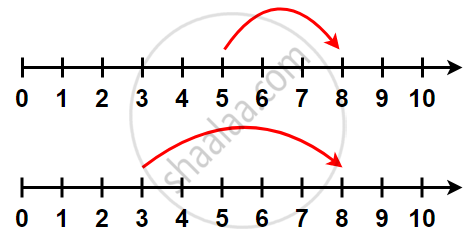
In both cases, we reach 8. 5 + 3 is the same as 3 + 5.
You can add two whole numbers in any order.
We say that addition is commutative for whole numbers. This property is known as the Commutativity of addition.
2. Commutativity of multiplication:
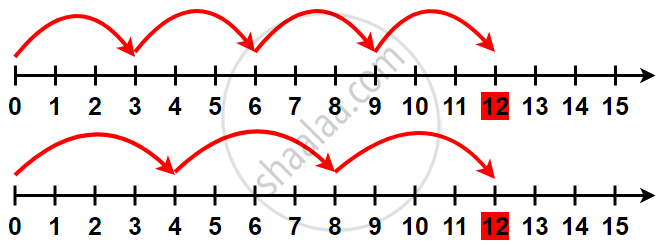
You will observe that 3 × 4 = 4 × 3.
You can multiply two whole numbers in any order.
We say multiplication is commutative for whole numbers.
3. Commutativity of Subtraction:
a - b ≠ b - a
a = 3, b = 5
a - b = b - a
3 - 5 = 5 - 3
- 2 ≠ 2
Thus, Subtraction is not commutative for whole numbers.
4. Commutativity of Division:
a ÷ b ≠ b ÷ a
a = 9 and b = 3
`9/3 = 3/9`
3 ≠ 0.333.
Thus, Division is not commutative for whole numbers.
Shaalaa.com | Commutative Property of Whole Numbers
to track your progress
Series: Commutative Property of Whole Numbers
0%
Related QuestionsVIEW ALL [6]
Match the following:
| (i) 425 × 136 = 425 × (6 + 30 +100) | (a) Commutativity under multiplication. |
| (ii) 2 × 49 × 50 = 2 × 50 × 49 | (b) Commutativity under addition. |
| (iii) 80 + 2005 + 20 = 80 + 20 + 2005 | (c) Distributivity of multiplication over addition. |
